Thursday, September 1, 2022
ROYAL EGYPTIAN CATS
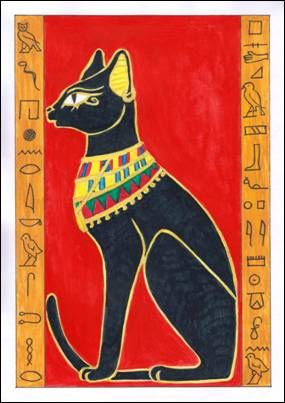
Royal Egyptian Cats
Learning Targets

I can...
- Create an original Royal Egyptian Cats using collage techniques learned in class
- Use primary colors (red, yellow, blue), shape variation (geometric, organic, free form), and texture (metallic, wood, sand) inspired by 4th Century (3000 BC- 100 AD) Prehistoric Egypt
- Use mixed media techniques (paper batik, papyrus drawing, cartouche) and design principles (composition, repetition, emphasis) based on Ancient Egypt
- Define Cartouche (a carved tablet or drawing representing a scroll with rolled up ends, using ornamentally, or bearing an inscription)
Lesson One
Day One, Art Start
1. An Egyptian Bronze Cat (332 BC- 30 BC) Royal Ontario Museum

2. The Winged Cat: A Tale of Ancient Egypt by Deborah Nourse Lattimore

3. Discussion Questions "What type of magic powers did Egyptians believe cats had? Why did ancient Egyptians use cats in art and sculptures? Why where cats mummified in ancient Egypt? How have artistic characteristics changed overtime? How do these images of cats different from images of cats today? How does ancient Egypt's commitment to the notion of perfection demonstrated by the preservation of past artistic styles? What type of Egyptian art and artifacts can be seen today? How important are these places in modern Egypt? Do people live in, work in, and visit these places?"
Lesson Activities
1. Choose 12" X 15" Drawing Paper
2. Use basic shapes (semi circle, oval, triangle) to draw recognizable parts of the cat paintings
3. Add feline parts (claws, teeth, whiskers, nose) to the recognizable parts of the Royal Egyptian Cats
Day Two, Art Start
1. Retrieve Royal Egyptian Cats for Assigned Table
2. Bastet Egyptian Protector Goddess (3000 BC- 100 AD) Prehistoric Egypt

3. Discussion Questions "What type of cat did the artist portray? What do artists use as motivation? What do you like about this sculpture? How does this artist use motivation? What do you think the cats are feeling in this sculpture? What do you think is the most difficult scene to draw? How do you describe this artwork to someone? What mood could be describe in this artwork? What does the images demonstrate her skill of? What do you like about this style? What was the punishment for hurting a cat in ancient Egypt? What is the name of the world's richest cat? Which part of a cat is as unique as a human fingerprint?"
Lesson Activities
1. Add patterns (dots stripes lines) to positive space (cat) of the Royal Egyptian Cats
2. Use bright colors (blue green purple) to fill in the positive space (cat) of the cat paintings
3. Use bright colors (red orange yellow) to fill in the negative space (background) of the cat paintings
Day Three, Art Start
1. Retrieve Royal Egyptian Cats for Assigned Table
2. Set Up Studio Area (oil pastels, erasers, pencils)
Lesson Activities
1. Add highlights (reflective light, light source) to the positive space (cat) of the cat paintings
2. Add shadows (cast shadow, reflective shadow) to the negative space (background) of the cat paintings
3. Add repeating patterns (dots, stripes, spots) to the negative space (background) of the Royal Egyptian Cats
Artist Examples
 Student Examples




Monday, August 31, 2020
CROSS HATCHING EGYPTIAN PHARAOHS
Crossing Hatching Egyptian Pharaohs

Learning Targets
I can...
- Create an original Crossing Hatching Egyptian Pharoah using drawing techniques learned in class
- Use solid colors (blue, green, black), form (two dimensional, three dimensional) and value (lightness, darkness) inspired by Egyptian Pharaoh (1321-1342) Tutankhamun
- Use drawing techniques (cross hatching, hatching, short dashes) and design principles (placement, proportion, composition) based on Ancient Egypt
- Define Nemes (pieces of striped head cloth worn by pharaohs in ancient Egypt)
Lesson One
Day One, Art Start
1. Mask of Tutankhamun (1323) Ancient Egypt

2. Read History Opens Windows: The Ancient Egyptians by Jane Shuter

3. Discuss Questions "What is the famous river that flows through Egypt? When was the Ancient Egyptian period? What would you find inside a mummy? What is the name of these hieroglyphics? Which animal l did the Egyptians love? Did the Egyptians make boats out of reeds? Who was the last ruler of Egypt? What is the importance behind the Great Sphinx of Giza? What does the word hieroglyphs mean? What was the first pyramid to be built called? What is the oldest known monumental sculpture in Egypt? How many pyramids consist of the Great Pyramid of Giza? Which ancient Egyptian dynasty was Ramses III the pharaoh of? Which pharaoh was the first historically confirmed female pharaoh? Which female pharaoh had the longest reign? Which pharaoh has the most surviving statues?"
Lesson Activities
1.Use pencil to draw shape variation (geometric, organic) of face parts (head, hair, shoulders, ears, of pharaoh portrait
2. Use line types (wavy, straight, narrow) to add facial features (eyes, eyelashes, eyebrows, hair) of pharaoh portrait
3. Use line types (wavy, straight, narrow) to add details (buttons, ribbons, stripes) to clothing of Crossing Hatching Egyptian Pharaoh
Day Two, Art Start
1. Retrieve Cross Hatching Egyptian Pharaoh for Assigned Table
2. Nefertiti Bust (1345) Thutmose

3. Discussion Questions "How many years did King Tut rule? How old was King Tut when he became pharaoh? What was the name of King Tut's wife? What does Tutankhuman mean? What year was King Tut's tomb discovered? How many times was King Tut's tomb robbed? How many items were found in King Tut's tomb? How many sacrcophagi was King Tut buried in? How high is the biggest pyramid? What was the most important livestock for Ancient Egyptians? Which one of these animals was not a sacred animal? What was a king in ancient Egypt called? Why were Egyptians buried with their possessions? What holidays did the Egyptians celebrate? What kind of foods did Egyptians eat? What were the major cities of Egypt? What are some fascinating facts about Ancient Egypt?"
Lesson Activities
1. Use solid colors (blue, brown, black) to fill in the positive space (portrait) of the pharaoh portrait
2. Use solid colors (blue, brown, black) to fill in the negative space (background) of the pharaoh portrait
3. Use line types (horizontal, vertical, diagonal) to fill in the positive space (portrait) with design for the Cross Hatching Egyptian Pharaohs
Day Three, Art Start
1. Retrieve Cross Hatching Egyptian Pharaohs for Assigned Table
2. Set Up Studio Area (metallic paint, brushes, water bucket)
Lesson Activities
1. Add highlights (light source, reflective light) to positive space (portrait) of pharaoh portraits
2. Add shadows (cast shadow, shadow) to negative space (background) of pharaoh portraits
3. Use stop motion program (iMotion, FlipaClip, Stop Motion) to add an animation to ones own Cross Hatching Egyptian Pharaohs
Artist Examples


Student Examples


 Posts
Posts

