Wednesday, October 2, 2024
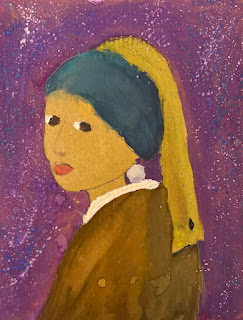
SHIFTING EYES PORTRAITS
Shifting Eyes Portraits

Learning Targets
I can...
- Create an original Shifting Eyes Portraits using drawing techniques learned in class
- Use line types (horizontal, vertical, diagonal), value (lightness, darkness, shadows, highlights), and texture (actual, visual, implied) inspired by Disney's The Haunted Mansion (2003) Rob Minkoff and David Berenbaum
- Use kinesthetic techniques (multi-sensory, ready made, hand operated) and design principles (movement, balance, composition) based on American Movies
- Define Portrait (a visual representation of a person which can be created in any artistic medium)
Lesson One
Day One, Art Start
1. Mona Lisa (1503) Leonardo Da Vinci

2. Read The Artist's Eyes: Vision And The History Of Art by Michael Marmor and James G. Ravine

3. Discussion Questions "What does eye tracking tell us about the rules of composition? How do painters make the eyes follow you in a painting? Why do the eyes in this painting seem to follow you? Do you think this effect happens because of a combination of elements leading the viewer through a composition? Does this mean that traditional compositional devices have no effect on our experience of the picture? How does the Mona Lisa have eyes that follow the viewer? Why do the eyes in paintings seem to follow you? Why do some paintings work in following the viewer but not other artworks? Did you know Filippo Brunellesco discovered how linear perspective creates a focal point for eye movement in paintings? How could you leverage this illusion within your own artwork? What did you learn when it comes to art history? Have you ever seen a portrait where the face or eyes appear to follow your every movement? Why would an artist want to draw a spooky portrait?"
Lesson Activities
1. Choose 12" X 15" Drawing Paper
2. Use graphite pencil to draw line types (contour, outline, continuous) of facial proportions (head, face, shoulder) of moving eye portraits
3. Use graphite pencil to add facial feathers (eyes, nose, mouth, eyebrows) to the positive space (portrait) of the Shifting Eyes Portraits
Day Two, Art Start
1. Retrieve Shifting Eyes Portraits for Assigned Tables
2. Self Portrait With Beret (1634) Rembrandt

3. Discussion Questions "What are your favorite Halloween themed monsters? Do you like mummies, Frankenstein, vampires, or zombies? How do different types of eyes reflect various emotions? How do people's eyes and body language capture emotion? How does the artist establish focal points in this painting? How does the artist change art elements to create an overall feeling or mood in this painting? How do artists create eye movement in art? How do artists use color to create eye movement in art? How can you use highlights and shadows to create eye movement in your artwork? What is the difference between shading and highlighting in an artwork?"
Lesson Activities
1. Add adornments (piercings, tattoos, hairstyles) to the positive space (portrait) of the moving eyes portraits
2. Add costumes (jewelry, clothing, make up) to the positive space (portrait) of the moving eyes portraits
3. Use black sharpie marker to outline the face features (eyes, nose, mouth) and facial proportions (head, face, shoulder) of the Shifting Eyes Portraits
Day Three, Art Start
1. Retrieve Shifting Eyes Portraits for Assigned Tables
2. Set Up Studio Area (cardboard, scissors, glue sticks, tape, tempera paint)
Lesson Activities
1. Use color combinations (analogous, neutral, secondary) to fill in the positive space (portrait, foreground) of the moving eyes portraits
2. Use color combinations (analogous, neutral, secondary) to fill in the negative space (background) of the moving eyes portraits
3. Use value (lightness, darkness) to add shadows (reflective shadow, cast shadow) and highlights (reflective light, light source) to the Shifting Eyes Portraits
Artist Examples
 Student Examples




Tuesday, September 24, 2024
CANDY APPLE COLLAGES
Candy Apple Collages

Learning Targets
I can...
- Create an original Candy Apple Collages using drawing techniques learned in class
- Use shape variation (geometric, organic, free form), line types (horizontal, vertical, diagonal) and texture (actual visual implied) inspired by American Painter (1920-2021) Wayne Thiebaud
- Use collage techniques (decoupage, assemblage, mixed media) and design principles (variation, balance, proportion) based on American Art
- Define Subject Matter (the focal point of an art piece, form used to create it, and intention behind the artists creation)
Lesson One
Day One, Art Start
1. Nine Jelly Apples (1964) Wayne Thiebaud

2. Read Apple Cider Making Days by Ann Purmell

3. Discussion Questions "Did you know that Wayne Thiebaud made prints of still life with apples many times? What colors did Wayne Thiebaud use to paint the darkest apples? What is the difference between the apples in this painting? Does this artwork make your stomach growl? Do you like caramel apples in the fall season? Why do artists choose food as subject matter when creating artwork? How does Wayne Thiebaud bend the rules in his paintings? What are some things you notice in this artwork? Do you think youth and simple art is something to celebrate? Why is it important for artists to paint their memories? Why is it important for artists to paint something that is important to them?"
Lesson Activities
1. Choose 12" X 15" Drawing Paper
2. Use graphite pencil to outline three dimensional shapes (apples, table, wallpaper) onto the positive space (apple) of the fruit collages
3. Use oil pastels to add patterns (swirls, dots, confetti) to the positive space (apple) of the fruit collages
Day Two, Art Start
1. Retrieve Candy Apple Collages for Assigned Tables
2. Three Candied Apples (1920) Wayne Thiebaud

3. Discussion Questions "Do you know what I mean when I say subject matter in art? What do you think about this subject matter? What makes you think this? What do you think is the focal point of this artwork? What is in the background? What is out of place? What kind of lines are used in this picture? Are the lines straight or curved? Do you see different textures? What are the textures in this artwork? Is the painting full or empty? What takes up most of the space? Do the objects in the painting seem to be moving or still? Is the image serious or lighthearted? What do you think the artist was thinking when he created this painting? How do you feel when looking at this artwork? What makes you say those things? Do you like this painting? Why or why not? Does everything in this picture make sense?"
Lesson Activities
1. Add texture (actual, implied visual) with a popsicle stick for the positive space (caramel apple) of the fruit collages
2. Add texture (actual, implied, visual) to add decorations (caramel, chocolate, confetti) to the positive space (caramel apple) of the fruit collages
3. Add texture (actual, implied, visual) to the negative space (background, wallpaper) of the Candy Apple Collages
Day Three, Art Start
1. Retrieve Candy Apple Collages for Assigned Tables
2. Set Up Studio Area (glue sticks, scissors, scrap paper, oil pastels)
Lesson Activities
1. Use neutral colors (black, grey, white) to add highlights (reflective light, light source) to the positive space (fruit) of the fruit collages
2. Use neutral colors (black, grey, white) to add shadows (cast shadow, reflective shadow) to the negative space (background) of the fruit collages
3. Fill in the positive space (fruit) and negative space (background) to remove any white space from the Candy Apple Collages
Artist Examples


 Student Examples


Tuesday, August 20, 2024
APPLE PIE DRAWINGS
Apple Pie Drawings
 Learning Targets

I can...
- Create an original Apple Pie Drawings using collage techniques learned in class
- Use shape variation (ellipse, square, rectangle), color combinations (primary, secondary, analogous), and texture (implied, actual, visual) inspired by American Patriotism
- Use drawing techniques (shading, blending, layering) and design principles (balance, composition, repetition) based on American Art
- Define Symbol (a solid recognizable thing that stands for something that would be hard to show in a picture)
Lesson One
Day One, Art Start
1. Jackson Pollock Apple Pie Recreation (2015) Robyn Lea

2. Read Apples To Oregon by Deborah Hopkinson

3. Discussion Questions "What do you know about American History involving Johnny Appleseed and the Oregon Trail? What are your favorite kinds of pies? What textures and colors do pies contain? Why do you think the artist choose this color for this image? What did Lois Ehlert's pie crust look like? Would you say this pie is a slice of American culture? What are some additional American traditions based on our country? Did you know Jackson Pollock made an award winning apple pie? How does apple pie address America's identity through imagery? How do symbols investigate the diverse experience of American life?"
Lesson Activities
1. Choose a 12 X 15 Drawing Paper
2. Use graphite pencil to drawing geometric shapes (ellipse, squares, rectangles) for the pie of the apple pie drawings
3. Use graphite pencil to draw perpendicular lines for the apple pie and parallel lines for the background (wallpaper, table) of the apple pie drawings
Day Two, Art Start
1. Retrieve Apple Pie Drawings for Assigned Tables
2. Apple pie (2014) Morgan Weistling

3. Discussion Questions "How does this artwork show a hopeful moment in American History? How has the boundless American frontier been an important factor in shaping the country's identity? How does an apple pie symbolize the complex reality of American life? What kinds of communities have existed and continue to exist in the American city? What promises have enticed individuals and families to move from countryside to the city? What perils and opportunities engage the urban individual?"
Lesson Activities
1. Use oil pastels to fill in the positive space (apple pie, table cloth) with primary colors (red blue yellow) of the apple pie drawings
2. Use oil pastels to fill in the negative space (background, table, wallpaper) with secondary colors (green purple orange) of the apple pie drawings
3. Add details (fork, napkins, flour) to the negative space (background, table, wallpaper) of the Apple Pie Drawings
Day Three, Art Start
1. Retrieve Apple Pie Drawings for Assigned Tables
2. Set Up Studio Area (oil pastels, erasers, pencils)
Lesson Activities
1. Add highlights (light source, reflective light) to the positive space (apple pie, table cloth) of the apple pie drawings
2. Add shadows (cast shadow, reflective shadow) to the negative space (table, wallpaper) of the apple pie drawings
3. Add embellishments (glitter, ribbon, beads) to the details (table cloth, wallpaper, decorations) of the Apple Pie Drawings
Artist Examples


 Student Examples


Thursday, October 26, 2023
DUMP TRUCK PAINTINGS
Dump Truck Paintings

Learning Targets
I can...
- Create an original Dump Truck Painting using drawing techniques learned in class
- Use shape variation (geometric, organic, free form), line types (horizontal, vertical, diagonal), and texture (visual, actual, implied) inspired by American Artist (2009-Present) Desiree Bender
- Use painting techniques (overlapping, layering, cropping) and design principles (composition, movement, repetition) based on American Art
- Define Texture (the feel or appearance of a surface)
Lesson One
Day One, Art Start
1. Mean Green (2009) Desiree Bender

2. Read Design In Motion: The Recycling Truck Project by Google Arts & Culture

3. Discussion Questions "What do you think of the saying "one person's trash another's treasure"? How would you describe your dream job? In what ways, could a vehicle be considered a work of art? What is the most artistic vehicle you have ever seen? Why should drivers begin decorating dump trucks? Why would someone spend so much money to decorate a truck? What impacts the way the while's are decorated? What purpose does this kind of public folk art serve? What feelings do the decorative design on these vehicles invoke? Why do you think so? Based on the images you see, what material do you are used to decorate the vehicle? Do you know anything about truck art? How man people are employed in workshops for truck art?"
Lesson Activities
1. Choose 12" X 15" Drawing Paper
2. Use geometric shapes (triangles, circles, rectangles) to draw exterior (outside) of the dump truck paintings
3. Use geometric shapes (triangles, circles, rectangles) to draw the main parts (wheels, cab, headlights) of the Dump Truck Paintings
Day Two, Art Start
1. Retrieve Dump Truck Paintings for Assigned Tables
2. Patterned Flight (2009) Desiree Bender

3. Discussion Questions "What type of transportation machines can you name? How are dump truck vehicles designed? What is the primary purpose of a dump truck? How do the different regions impact the way the vehicles are decorated? Based on the images you see, what kinds of materials do you think are used to decorate the vehicle? What value does this artwork have in society? What is the most important thing about dump trucks? What does the text teach us about the artist? What does the text teach us about the dump trucks? What are the important parts of a dump truck?"
Lesson Activities
1. Use line types (horizontal, vertical, diagonal) to outline the neutral colors (black, grey, white) of the dump truck paintings
2. Add decorative patterns (dots, swirls, stripes) to the positive space (dump truck) of the dump truck paintings
3. Add line types (horizontal, vertical, diagonal) to the negative space (background) of the dump truck paintings
Day Three, Art Start
1. Retrieve Dump Truck Paintings for Assigned Tables
2. Set Up Studio Area (tempera paint, paint brushes, water buckets)
Lesson Activities
1. Use warm colors (red orange yellow) to fill in the positive space (dump truck) of the dump truck paintings
2. Use cool colors (green blue purple) to fill in the negative space (background) of the dump truck paintings
3. Add highlights (reflective light, light source, lightness) to the positive space (foreground) of the Dump Truck Paintings
Artist Examples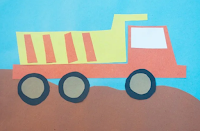


 Student Examples


 Posts

