Wednesday, April 2, 2025
CLAY TALAVERA ARMADILLOS
Clay Talavera Armadillos

Learning Targets
I can...
- Create an original Clay Talavera Armadillo using ceramic techniques learned in class
- Use shape variation (geometric, organic, free form), form (two dimensional, three dimensional), and texture (actual, visual, implied) inspired by Mexican Artisan (1950-Present) Jacobo Angles and Mexican Artisan (1950-Present) Maria Angeles Fernandez Cuesta
- Use sculpture techniques (carving, casting, modeling, assembling) and design principles (balance, emphasis, proportion) based on Mexican Ceramics
- Define Folk Art (artwork made by regional people who preserve one's own personal history, traditions, and culture through art)
Lesson One
Day One, Art Start
1. Totem (1973) Jacobo and Maria Angeles

2. Read Armadillo Ray by John Beifuss

3. Discussion Questions "Why did the Aztecs call the armadillo the turtle rabbit? How do armadillos find insect food below the ground even when being deaf and blind? What element of art and principle of design are found in folk art? What are some possible purposes for creating ceramics (decorative, utilitarian, celebrations)? What are some differences between Talavera ceramics, everyday plates, and kitchenware? What are the traditional and artistic aspects of Talavera ceramics? How do artist tell a story with ceramics? How does the artist use color and pattern to help tell a story? What is Armadillo Ray most curious about? How does Armadillo Ray interact with his friends? What are some of the lessons or themes explored in the story through Armadillo Ray's perspective?"
Lesson Activities
1. Turn clay slab into basic shapes (head, torso, arms, legs) for the positive space (foreground, animal) of the Clay Talavera Armadillos
2. Use modeling tools to draw features (clothing, jewelry, accessories) for the positive space (foreground, animal) of the Clay Talavera Armadillos
3. Add line for the facial features (nose, eyes, mouth) for the positive space (foreground, animal) of the Clay Talavera Armadillos
Day Two, Art Start
1. Retrieve Clay Talavera Armadillos for Assigned Tables
2. Little Armadillo (1973) Jacobo and Maria Angeles

3. Discussion Questions "What questions does Armadillo Ray have about the moon? Who are Armadillo Ray's desert animal friends? What are some of the fanciful ideas his friends have about the moon? Who does Armadillo Ray meet that helps him understand the moon? What does Armadillo Ray learn about the moon from the owl? What is the afterward in the book about? How does the story illustrate the phases of the moon? What is the role of the moon in legends around the world, according to the afterward? What kind of personality does Armadillo Ray have? What are some of Armadillo Ray's distinguishing features?What was his relationship with the owl in the story? What is the title of the book? Who wrote the book? What type of illustrations are used in the book? What is the overall tone or message of the book?"
Lesson Activities
1. Add lines for proportions (head, torso, arms, legs) within the silhouette (figure, foreground) of the Clay Talavera Armadillos
2. Mold clay into basic shapes (oval face, crescent ears, big eyes, round body) for the positive space (foreground, animal) of the Clay Talavera Armadillos
3. Use needle tools to draw features (eyes, nose, mouth, shell, nails) for the positive space (foreground, animal) of the Clay Talavera Armadillos
Day Three, Art Start
1. Retrieve Clay Talavera Armadillos for Assigned Tables
2. Set Up Studio Area (paint brushes, water buckets, tempera paint)
Lesson Activities
1. Add tempera paint with color combinations (complementary colors, analogous colors, earth tones) to the positive space (foreground) of the Clay Talavera Armadillos
2. Add tempera paint with color combinations (complementary colors, analogous colors, earth tones) to the negative space (background) of the Clay Talavera Armadillos
3. Apply Gloss Finish to the facial features, facial proportions, and accessories of the Clay Talavera Armadillos
Artist Examples


 Student Examples


Tuesday, October 1, 2024
VALUE SCALE GHOSTS
Value Scale Ghosts

Learning Targets
I can...
- Create an original Value Scale Ghost using drawing techniques learned in class
- Use line types (horizontal, vertical, diagonal), color combinations (analogous, neutral colors, rainbow order), and shape (positive, negative) inspired by Mexican Illustrator (2015-Present) Flavia Z. Drago
- Use value scale (gradation, grey scale, shades) and design principles (proportion, repetition, balance) based on Gustavo The Shy Ghost by Flavia Z. Drago
- Define Value (the lightness or darkness of a color)
Lesson One
Day One, Art Start
1. State Of The Art (2015) Flavia Z. Drago

2. Read Gustavo The Shy Ghost by Flavia Z. Drago

3. Discussion Questions "Who said ghosts must be scary? Did I mention the ghost loves to play the violin? Do you think monsters know each other? What do you notice about the window? What seems difficult for Gustavo? What do you notice about the other monsters? Do you see Gustavo in the pictures? What do you think he is hiding? Can you think of something in your own life that has felt terrifying? What does Gustavo do to make friends? Does this work? Where do you think they are in these pictures? Why could the monster not see him? What kinds of things did Gustavo enjoy doing? What did he love to do most in the world? What were some of the things that Gustavo was afraid of doing? What did his letter to the monster say?"
Lesson Activities
1. Choose 12" X 15" Drawing Paper
2. Use geometric shapes (oval, circle, rectangle) to draw the positive space (ghost) of the spooky themed artwork
3. Use line types (horizontal, vertical, diagonal) to draw the positive space (ghost) and negative space (background) of the Value Scale Ghosts
Day Two, Art Start
1. Retrieve Value Scale Ghosts for Assigned Tables
2. Party With Cakes (2022) Flavia Z. Drago

3. Discussion Questions "How do you think Gustavo feels when he cannot make friends? What kind of person (ghost) is Gustavo? Why do you think Gustavo invited everyone to a violin concert? What do you think Gustavo will do to try to make friends? How will the other monsters feel about Gustavo after hearing him play the violin? What do you think will happen to Gustavo after the concert? What are three things you think will happen to Gustavo, the shy ghost? How do you think Gustavo feels about this situation or event? What can you infer from the illustrations?"
Lesson Activities
1. Use line types (horizontal, vertical, diagonal) to add details (shadows, highlights, texture) to the positive space (ghost) of the spooky themed artwork
2. Use oil pastels to fill in the positive space (ghosts) with neutral colors (black white grey) for the spooky themed artwork
3. Use oil pastels to fill in the negative space (background) with neutral colors (black white grey) for the Value Scale Ghosts
Day Three, Art Start
1. Retrieve Value Scale Ghosts for Assigned Tables
2. Set Up Studio Area (construction paper, painting paper, tempera paint, black oil pastels)
Lesson Activities
1. Add customization parts (jewelry, candy bag, leaves, wind) with neutral colors (black, white, grey) to the spooky themed artwork
2. Use texture techniques (eraser, cloth, sponge) to add details (tongue, mouth, eyes) to the spooky themed artwork
3. Add highlights (reflective light, light source) and shadows (cast shadow, shadows) to the negative space (background) of the Value Scale Ghosts
Artist Examples


 Student Examples


Wednesday, October 25, 2023
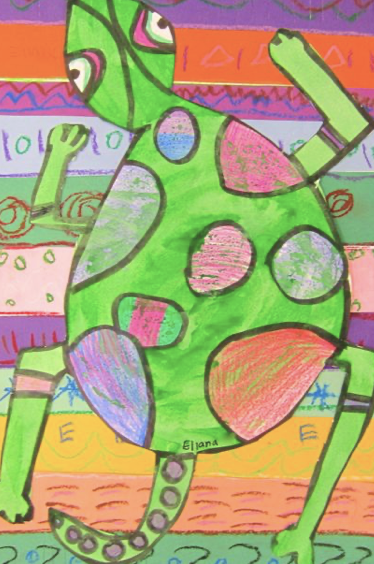
SERAPE BLANKETS WITH LIZARDS
Serape Blanket With Lizards Learning Targets

I can...
- Create an original Serape Blanket With Lizards using drawing techniques learned in class
- Use line types (horizontal, vertical, diagonal), shape variation (geometric, organic, free form), and space (positive, negative) inspired by the Aztecs
- Use collage techniques (assemblage, photomontage, mixed media) and design principles (composition, variation, balance) based on 19th Century Art History
- Define Serape (a shawl or blanket worn as a cloak in Latin America)
Lesson One
Day One, Art Start
1. Late Classic Serape (1865) The Nelson-Atkins Museum Of Art

2. Read The Serape by Wayne Lopes

3. Discussion Questions "What are three new things you found interesting when learning about these cultures? What is the difference between fine art and folk art? What are some of the folk art crafts of Mexico? Why do we call these crafts folk art? Is this fine art or craft art? Can a work of art be both at the same time? What symbols are shown throughout this artwork? What does the serape represent to the Mexican culture? Are Mexican blankets made from wool or cotton? What are Mexican blankets called? What does this artwork say about the culture in which it was produced? Was this intended to be a work of art or not? Why do you think that? How does this impact your understanding of the artwork? What was happening in history when this artwork was made? How can you create a design only using lines?"
Lesson Activities
1. Choose 12" X 15" Drawing Paper
2. Draw three thumbnail sketches of lizards using observational drawing skills (contour, outline, continuous0 for lizard collages
3. Add details (shadows, reflective light) to the negative space (background) of the Serape Blankets With Lizards
Day Two, Art Start
1. Retrieve Serape Blankets With Lizards for Assigned Tables
2. Dine Blanket (1850) The Nelson-Atkins Museum Of Art

3. Discussion Questions "How do you think this artwork was used by the people who made it? What was its function? What does this artwork teach us about the past? What are the values and beliefs of the culture in which this artwork was made? How might your interpretation of this artwork be different from someone in another culture? What are the types of lines you see in this artwork? What are the types of colors you see in this artwork? Who do you think this artwork was created for? Why do you sat that? How do you think this artwork was made? What do you think the artist is trying to say in this artwork/? What is the meaning or message in this artwork?"
Lesson Activities
1. Use drawing techniques (contour, outline, continuous) to add basic shapes (cone, triangle, rectangle) to the lizard drawings
2. Use design principles (composition, repetition, gradation) to fill in the positive space (lizards) of the lizard drawings
3. Use drawing techniques (composition, repetition, gradation) to add details (shadows, reflective light) to the Serape Blankets With Lizards
Day Three, Art Start
1. Retrieve Serape Blankets With Lizards for Assigned Tables
2. Set Up Studio Area (construction paper, scissors, glue sticks)
Lesson Activities
1. Use complementary colors (red green; blue orange; purple yellow) to fill in the positive space (lizard) of the lizard drawings
2. Use complementary colors (red green; blue orange; purple yellow) to fill in the negative space (background) of the lizard drawings
3. Add design details (shadows, reflective light) to the negative space (background) of the Serape Blankets With Lizards
Artist Examples


 Student Examples


Tuesday, September 5, 2023
FRIDA KAHLO STILL LIFE
Frida Kahlo Still Life

Learning Targets
I can...
- Create an original Frida Kahlo Still Life using drawing techniques learned in class
- Use color combinations (analogous, complementary, secondary), shape variation (geometric, organic, free form), and space (positive, negative) inspired by Mexican Painter (1907-1954) Frida Kahlo
- Use observational drawing techniques (perspective, proportion, grid measurement) and design principles (composition, alignment, movement) based on Symbolism
- Define Still Life (a work of art that shows inanimate objects from the natural or man-made world)
Lesson One
Day One, Art Start
1. Still Life With Parrot (1951) Frida Kahlo

2. Read Understanding Frida in Context Through Her Still Life: Pitahayas by MMOCA

3. Discussion Questions "How does still life represent the artist's unique identity? What elements in each piece show realism, surrealism, and symbolism? What is unique about Frida Kahlo? What does she tell us about herself in this artwork? What gives hints about her experiences and Mexican Identity in these paintings? What stories do the background of her image tell? What is unique about you that you would like to capture in a still life? Would you consider Still Life: Pitahayas a self portrait? Why or why not? What do objects depicted in this painting tell you about Kahlo's life? What fruits are native to Michigan or the Midwestern United States? What do the volcanic rock and cactus depicted in the painting tell you about the geology and climate of central Mexico? How do they compare to the landforms and vegetation of Michigan? Why do you think Kahlo included a skeleton in this painting? What would you include in your still life that reflects who you are, where you are, and something about your life?"
Lesson Activities
1. Choose 12" X 15" Drawing Paper
2. Add three dimensional shapes (cylinder, pyramid, cone) to the composition of arranged fruit (watermelon, strawberries, oranges) for the personal identity still life
3. Add horizon line in the background (table, fabric, wallpaper) to separate the subject matter from the wallpaper of the Frida Kahlo Still Life
Day Two, Art Start
1. Retrieve Frida Kahlo Still Life for Assigned Tables
2. Viva La Vida, Watermelons (1954) Frida Kahlo

3. Discussion Questions "What was Frida Kahlo's full birth name? Why did Frida Kahlo change hr date or birth on her birth certificate? Why was Kahlo pretending to be three years younger? Why was Frida Kahlo's nationality? Who or what is depicted in most of Frida's paintings? In what year did she joint Mexican Communist Party and fall in love with Diego Rivera? What was the first solo exhibition of Frida Kahlo's work held? When did Frida Kahlo begin her career as an artist? What was Frida and Diego's marriage often called? Who was Frida Kahlo? What are some of Frida Kahlo's most famous paintings? Do you have a favorite artist? What will you include in your artwork that represents what matters to you?"
Lesson Activities
1. Use color combinations (analogous, secondary, complementary) to fill in the positive space (fruit, inanimate objects, flag) of the personal identity still life
2. Use color combinations (analogous, secondary, complementary) to fill in the negative space (background) of the personal identity still life
3. Use painting tools (brayer, palette, paint brush) to add patterns (floral, swirls, dots) to the negative space (background) of the Frida Kahlo Still Life
Day Three, Art Start
1. Retrieve Frida Kahlo Still Life for Assigned Tables
2. Set Up Studio Area (tempera paint, water bucket, paint brushes)
Lesson Activities
1. Add highlights (reflective light, light source) to subject matter (watermelon, oranges, strawberries) of the personal identity still life
2. Add shadows (cast shadow, reflective shadow) to the negative space (background) of the personal identity still life
3. Outline details (pattern, floral, inanimate objects, fruits, vegetables) in the positive space (foreground, middle ground) of the Frida Kahlo Still Life
Artist Examples


 Student Examples


 Posts

