Wednesday, September 25, 2024
FRANKENCRAYON COLLAGES
Frankencrayon Collages Learning Targets

I can...
- Create an original Frankencrayon Collage using drawing techniques learned in class
- Use complimentary colors (red green; blue orange; yellow purple), shape variation (geometric, organic, free form), and space (positive negative) inspired by Michigan Author (2015-Present) Michael Hall
- Use collage techniques (overlapping, layering, assemblage) and design principles (composition, variation, balance) based on Frankencrayon by Michael Hall
- Define Scribble (a piece of writing or a drawing that is done quickly or carelessly)
Lesson One
Day One, Art Start
1. Garfield Orange Crayon (2024) Hoang Tran

2. Read Frankencrayon by Michael Hall

3. Discussion Questions "What color would you feed your scribble monster? What else could you feed a scribble monster? What color is Frankencrayon? What color is Frankencrayon's head? What color are Frankencrayon's arms? What color is Frankencrayon's body? Who is your favorite character in this story? What else could you make with broken crayons? How do we combine shapes, colors, and different materials to create art? What solutions to the scribble could you have come up with in that situation? Have you heard of Frankenstein? What do you know of this story? What are the different crayons in this story? How do they create a new taped-together character?"
Lesson Activities
1. Choose 12 X 15 Drawing Paper
2. Draw three thumbnail sketches of crayons using observational drawing skills (outline, contour, continuous) for the crayon collages
3. Add details (eyes, hair, mouth, shadows, highlights) to the positive space (crayon) of the Frankencrayon Collages
Day Two, Art Start
1. Retrieve Frankencrayon Collages for Assigned Tables
2. Mario Carvings (2023) Hoang Tran

3. Discussion Questions "Have you read Red: A Crayon's Story by Michael Hall? If so, what expectation do you have about this book? What do you recall about the author's style? What clues do readers get from this page to help make predictions? Were your predictions correct? What do you know about the Frankenstein story? Why has he told the story from so many perspectives? How has this added to your reading experience? Why are the crayons dressed in old-fashioned costumes? How important is the interjection from Frankencrayon, explaining details of the story that the narrator omitted? Why is it left to Frankenstein to show the reader a different side to the scribble? What is the author saying about acceptance and relationships?"
Lesson Activities
1. Use collage techniques (overlapping, cropping, layering) to add basic shapes (cylinder, cone, cube) of the crayons for the crayon collages
2. Use design principles (composition, repetition, gradation) to fill in the positive space (crayons) of the crayon collages
3. Use collage techniques (overlapping, cropping, layering) to add basic shapes (cylinder, cone, cube) to the negative space (background) of the Frankencrayon Collages
Day Three, Art Start
1. Retrieve Frankencrayon Collages for Assigned Tables
2. Set Up Studio Area (glue sticks, construction paper, scissors, oil pastels)
Lesson Activities
1. Use complementary colors (red, green; blue, orange; yellow, purple) to fill in the positive space (crayons) of the crayon collages
2. Use complementary colors (red, green; blue, orange; yellow, purple) to fill in the negative space (background) of the crayon collages
3. Add design details (overlapping, enlarging, cropping) to the negative space (background) of the Frankencrayon Collages
Artist Examples

 Student Examples


Friday, August 25, 2023
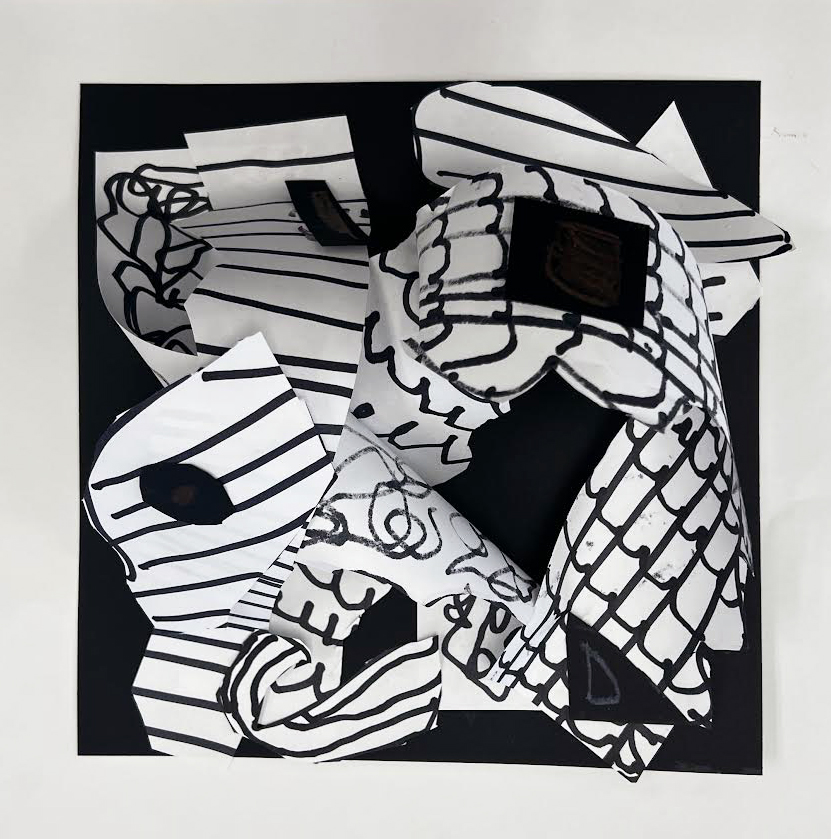
CHARLES MCGEE PAPER SCULPTURES
Charles McGee Paper Sculptures
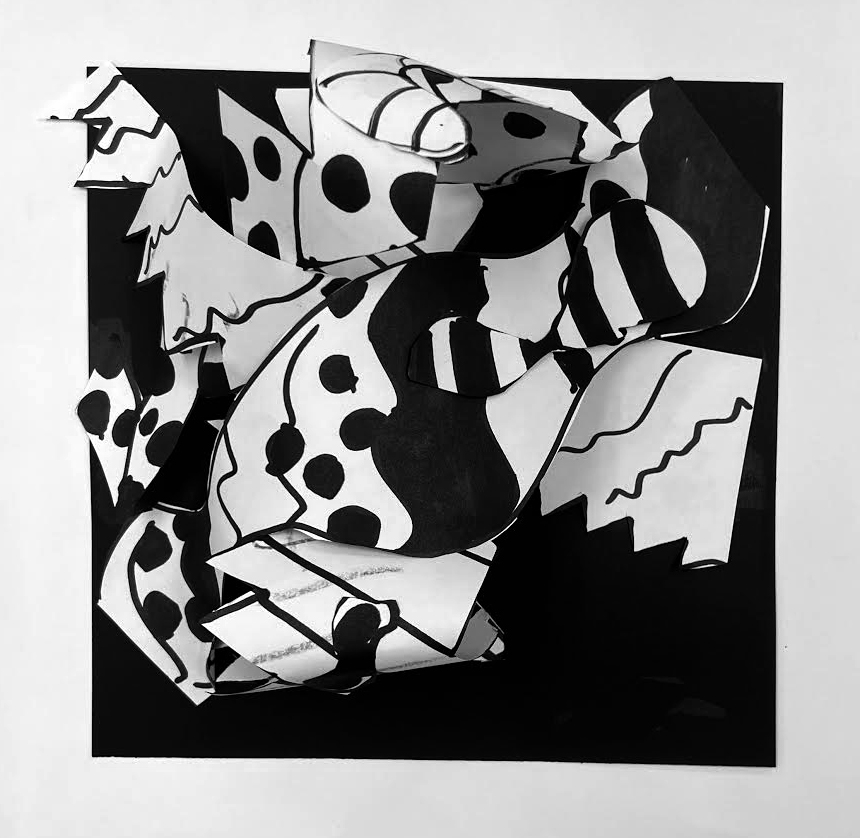
Learning Targets
I can...
- Create an original Charles McGee Paper Sculpture using drawing techniques learned in class
- Use neutral colors (black, white, grey), shape variation (geometric, organic, free form), and form (two dimensional, three dimensional) inspired by Michigan Artist (1924-2021) Charles McGee
- Use principle of design: pattern (zentangles, swirls, nature, stripes) and design principles (emphasis, repetition, contrast) based on Contemporary Art
- Define Relief (a wall mounted sculpture in which the three-dimensional elements are raised from a flat base)
Lesson One
Day One, Art Start
1. Rhapsody In Black And White (2008) Charles McGee

2. Read Charles McGee: 2008 Eminent Artist by Michelle Perron of Kresge Arts In Detroit

3. Discussion Questions "Does this remind you of a color or black and white movie overall? Is this low-key or high-key colors? What colors does he use to give a sense of sailing? What can you recognize in this artwork? What is a ritual? Does the artist make artwork for ritual purposes? Why do you think he used these images? What is line? Can you see line in this artwork? When you look at the artwork is the back and white areas balanced? Can you see a rectangular form in the composition? Does the rectangular box look like it is in front or behind the drawn objets? Have you ever looked at clouds and seen animas or different recognizable things? If you look at this artwork, do you see things that remind you of anything? What is value? What colors display different values? How does McGee create the lace-like imagery?"
Lesson Activities
1. Choose 12" by 12" Colored Construction Paper
2. Use three compositional elements (shape, color, texture) to represent a memory, place, or event for paper sculptures
3. Use line variation (stripes, swirls, dots, curls) as a design principles (balance, movement, repetition) with the Charles McGee Paper Sculptures
Day Two, Art Start
1. Retrieve Charles McGee Paper Sculptures for Assigned Tables
2. Regeneration (Drawing For Ford Hospital Installation) (2005) Charles McGee
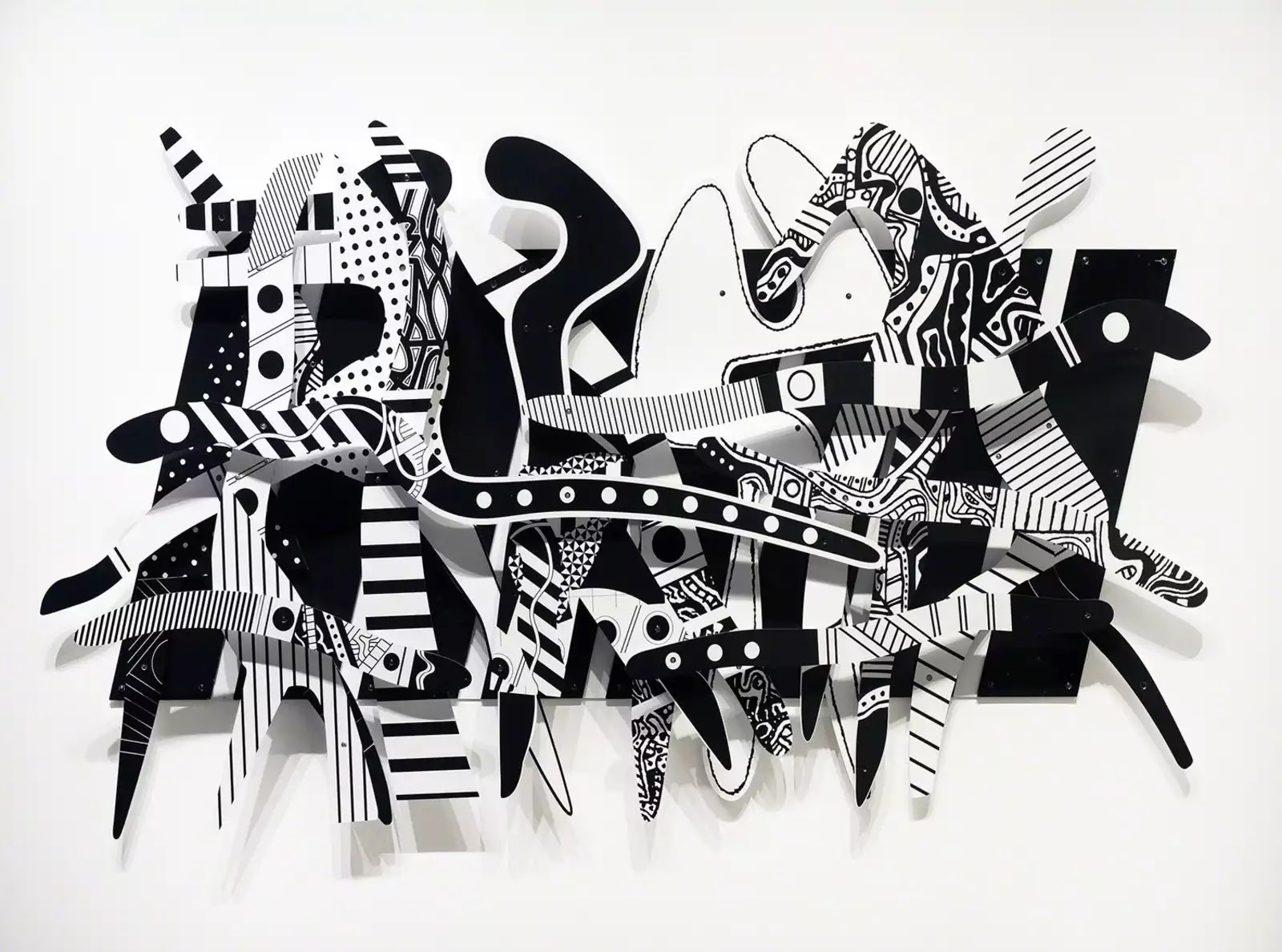
3. Discussion Questions "Can you see what figures are in the foreground and background within the central human forms? What is abstraction? How are the human forms abstract in this artwork? What is texture? How does McGee create texture on the forms? How can artists create textures on two-dimensional art? What do you think the title of the work means? What is the difference between these two paintings? What do you think the name of the paintings mean? Why did McGee paint snakes as if he was looking at them from above? What cultures can you compare McGee's artwork too? Why do you think the artist might use snakes in his artwork? What is significant about these colors?"
Lesson Activities
1. Use compasses, protractors, and texture plates to add symmetrical shapes and expressive lines to the paper sculptures
2. Use complementary colors (red, green; blue, orange; yellow, purple) to fill in the negative space (background) of the paper sculptures
3. Use complementary colors (red, green; blue, orange; yellow, purple) to fill in the positive space (foreground) of the Charles McGee Paper Sculptures
Day Three, Art Start
1. Retrieve Charles McGee Paper Sculptures for Assigned Tables
2. Set Up Studio Area (glue sticks, construction paper, markers)
Lesson Activities
1. Use scissors to cut out two dimensional symmetrical shapes (circle, triangle, rectangle, oval) to create a three dimensional paper sculpture
2. Glue down three dimensional symmetrical shapes (cone, prism, pyramid, cylinder, cube) to create a simplified paper sculpture
3. Use sharpie markers to add beautiful patterns (hearts, swirls, flowers, dots) to the positive space (foreground) of the Charles McGee Paper Sculptures
Artist Examples

 Student Examples


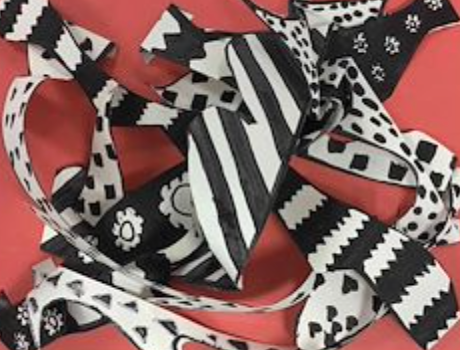




Monday, December 6, 2021
OLD FASHIONED INK BIRD CAGES
Old Fashioned Ink Bird Cages

Learning Targets
I can...
- Create an original Old Fashioned Ink Bird Cage using drawing techniques learned in class
- Use line types (horizontal, vertical, diagonal), neutral colors (black, brown, grey), and value (lightness, darkness) inspired by Michigan Impressionist Painter (1874-1939) Frederick Carl Frieske
- Use ink techniques (ink wash, scribbling, contour) and design principles (composition, movement, gradation) based on Impressionism
- Define Ink Wash (applying black ink to paper where a lighter ink was applied)
Lesson One
Day One, Art Start
1. The Bird Cage (1910) Frederick Carl Frieske

2. Read Frederick Carl Frieske: The Evolution of an American Impressionist by Nicholas Klimer

3. Discussion Questions "Which famous artist did he study under when in America? Where was the impressionist painter born? How was the work of the American Impressionists different than the Solen Style of the academic painting? How were the impressionists viewed by American and French society at the time? What were the subjects and themes the artist mainly painted? How were American impressionists different from French Impressionists of the time? What was different about the post- Impressionist from the impressionists? In your opinion, do you see Frederick Carl Friesek as talented at these earlier artists?"
Lesson Activities
1. Choose 12" X 15" Drawing Paper
2. Use pencil to draw line types (horizontal vertical diagonal) in the middle of paper for the bird drawings
3. Add scenery (ocean blue sky flowers) to the negative space (background) of the Old Fashioned Ink Bird Cages
Day Two, Art Start
1. Retrieve Old Fashioned Ink Bird Cages for Assigned Table
2. Bird In A Cage (1937) Frederick Carl Frieseke

3. Discussion Questions "Why might an artist paint the same thing more than once? Why do you think the artist was thinking about when he painted it? If you set out to work on a series of paintings, how do you know when you are done? Why do you think the artist decided to paint bird cages? What symbolism or meaning could bird cage have for the artist? What symbolism or meaning do bird cages have for you? If your opinion, do you like the artwork Frederick Carl Frieske painted?"
Lesson Activities
1. Add bird parts (beak, feather, talons) to the positive space (foreground) of the Old Fashioned Ink Bird Cages
2. Add texture (smooth rough) to the positive space (foreground) of the Old Fashioned Ink Bird Cages
3. Add texture (smooth rough) to the negative space (background) of the Old Fashioned Ink Bird Cages
Day Three, Art Start
1. Retrieve Old Fashioned Ink Bird Cages for Assigned Table
2. Set Up Studio Area (ink, paint brushes, water buckets)
Lesson Activities
1. Use neural colors (black, brown, grey) to fill in the positive space (foreground) of the Old Fashioned Ink Bird Cages
2. Use neutral colors (black, brown, grey) to fill in the negative space (background) of the Old Fashioned Ink Bird Cages
3. Add highlights (reflective light, light source) and shadows (cast shadow, shadows) to the Old Fashioned Ink Bird Cages
Artist Examples
 Student Examples


Tuesday, August 3, 2021
AARON ZENZ CLAY MONSTERS
Aaron Zenz Clay Monsters

Learning Targets
I can...
- Create an original Aaron Zenz Clay Monster using sculpture techniques learned in class
- Use form (two dimensional three dimensional), shape (geometric organic), and texture (rough smooth) inspired by Michigan Illustrator (2011-Present) Aaron Zenz
- Use language arts connections (storyboards illustration commercial design) and design principles (proportion balance movement) based on Illustration
- Define Illustration (a picture visually interpreting text, concepts, or process in published media)
Lesson One
Day One, Art Start
1. The Flower Keeper (2018) Aaron Zenz

2. Read Monsters Go Night-Night by Aaron Zenz

3. Discussion Questions "How do monster get ready for bed? What kind of pajamas do monsters wear? What do monster take baths with? Which snacks do monster eat? If you had a monster, what would your monster look like? How would your monster act and sound? When have you been in a situation where it was a long time for one person and short time for another? What do you do at night to help you get to sleep? What do you say and do to help meet a friend's needs? What should a friend say or do? Can a monster be good? When should you compromise, and when is it important to insist on what you want?"
Lesson Activities
1. Add lines for proportion (head, body, tail) within the silhouette of the monster sculptures
2. Mold clay into basic shapes (cylinder, cone, pyramid) for the positive space (body) of the monster sculptures
3. Use modeling tools to draw facial features (eyelashes, eyelids, freckles) within the silhouette of the Aaron Zenz Clay Monsters
Day Two, Art Start
1. Retrieve Aaron Zenz Clay Monsters for Assigned Tables
2. ChubbJaw (2017) Aaron Zenz

3. Discussion Questions "Will your monster be mean, nice, silly, scary, or happy? How do you make a scary mouth? What do silly eyes look like? What type of pattern will you add onto the monster? Are monster real? Where do monsters live? What role do monsters play in various cultures and how are they reflected in various art forms? How have monsters been viewed, what purpose do they serve, and why are they necessary? How does a monster look? What are some things you might do if you were in the same situation? Could this book be a story that someone made up?"
Lesson Activities
1. Add facial features (eyelashes, eyelids, freckles) within the silhouette of the Aaron Zenz Clay Monsters
2. Add details (pattern, gills, swirls) to the positive space (body) of the monster sculptures
2. Use modeling tools (brush grip paddle) to smooth out the facial features (eyelashes, eyelids, freckles) of the Aaron Zenz Clay Monsters
Day Three, Art Start
1. Retrieve Aaron Zenz Clay Monsters for Assigned Tables
2. Set Up Studio Area (rubber mat, paintbrushes, water bucket)
Lesson Activities
1. Add tempera paint (red yellow orange) to the positive space (body) of the monster sculptures
2. Add tempera paint (blue green purple) to the negative space (background) of the monster sculptures
3. Apply Gloss Finish to the facial proportions, facial features, and accessories of the Aaron Zenz Clay Monsters
Artist Examples


 Student Examples


 Posts
Posts

