Tuesday, October 3, 2023
WITCH HAT DRAWINGS
Witch Hat Drawings

Learning Targets
I can...
- Create an original Witch Hat Drawing using painting techniques learned in class
- Use shape variation (geometric, organic, free form), line types (horizontal, vertical, diagonal), and color combinations (muted, subdued, monochromatic) inspired by Spanish Painter (1746-1828) Francisco Goya
- Use observational drawing (perspective, proportion, grid measurement) and design principles (emphasis, movement, contrast) based on Romanticism
- Define Mood (the emotions that are elicit in the viewer of an artwork)
Lesson One
Day One, Art Start
1. The Witches Witchcraft Spell (1764) Francisco Goya

2. Read Room On The Broom by Julia Donaldson

3. Discussion Questions "How does his depictions of monsters reflect human nature? How can artwork make a government upset? Do you find this artwork intriguing? Do you want to know more about this artwork? What art movement does Francisco Goya's sense of imagination and emotion fit with? How does his artwork capture the behavior, actions, and everyday life of the people the artist observed? Did you know that a bad sickness left the painter Francisco Goya deaf? What did Francisco Goya's personal motto claim that he was doing throughout his life? What is original about the paintings that reflect social and political events of the time? How does the artist depict woman (queens, witches, lower class) as powerful? Why did Francisco Goya paint witches?"
Lesson Activities
1. Choose 12" X 15" Colored Construction Paper
2. Use hat template (witch hat, wizard hat) to fill in the positive space (foreground) of the hat designs
3. Use line types (horizontal, vertical, diagonal) to draw the patterns (stripes, plaid, floral, dots) onto the positive space (foreground) of the Witch Hat Drawings
Day Two, Art Start
1. Retrieve Witch Hat Drawings for Assigned Tables
2. The Witches Witchcraft Spell (1797) Francisco Goya

3. Discussion Questions "Are hats the same on both sides? What types of lines did you use to mark a pattern or design on the hats? How do you like your colorful hats? What eye-catching embellishments did you add to your hats? Is it merely decorative or did it pull your eye to something important? What are hats? How many of your have ever worn a hat? How many have you ever lost a hat? How did you feel when you lost the hat? Why are hats easy to lose? Will your hat be straight or have a bend at the top? Do you want a skinny hat or a wide hat? Will you make the brim big or little?"
Lesson Activities
1. Add highlights (reflective light, light source) to the positive space (foreground) of the hat designs
2. Add shadows (reflective shadow, cast shadow) to the negative space (background) of the hat designs
3. Add embellishments (jewels, sequins, floral, fabric) to the positive space (foreground) of the Witch Hat Drawings
Day Three, Art Start
1. Retrieve Witch Hat Drawings for Assigned Tables
2. Set Up Studio Area (pencils, colored pencils, erasers, sharpeners)
Lesson Activities
1. Use line types (horizontal, vertical, diagonal) to add patterns (dots, stripes, floral. plaid) to the positive space (foreground) of the hat designs
2. Use color combinations (analogous, complementary, secondary) to fill in the positive space (foreground) of the hat designs
3. Use color combinations (analogous, complementary, secondary) to fill in the negative space (background) of the Witch Hat Drawings
Artist Examples
 Student Examples


Thursday, September 28, 2023
PICASSO PAPER CUT OUTS
Picasso Paper Cut Outs

Learning Targets
I can...
- Create an original Picasso Paper Cut Outs using drawing techniques learned in class
- Use shape variation (geometric, organic, free form), form (two dimensional, three dimensional), and texture (actual, implied, visual) inspired by Spanish Artist (1881-1972) Pablo Picasso
- Use sculpture techniques (carving, assembling, modeling, casting) and design principles (composition, proportion, balance) based on Cubism
- Define Interconnect (having different parts or things connected or related to each other)
Lesson One
Day One, Art Start
1. Woman (1943) Pablo Picasso

2. Read Picasso Cut Papers by Cythnia Burlingham

3. Discussion Question "Did you know Pablo Picasso painted on vessels? Did you know Pablo Picasso made giant sculptures out of stone, steel, and cardboard? Do you notice how the artist used monochromatic colors to have the face looking in different directions? How many faces can be seen and how does each face feel? How did Cubist artists use collage to discuss the relationship between different people? What two animals did we see that are cut out of the paper? What is the mood in this paper sculpture? What would the impact of this work be if it were in color instead of black and white? How is this artwork similar and different to photographs?"
Lesson Activities
1. Add line types (horizontal, vertical, diagonal) for the proportion (head, neck, shoulder) within the silhouette of the face paper sculptures
2. Turn construction paper into basic shapes (oval face, crescent ears, rectangle neck) for the positive space (face) of the face paper sculptures
3. Use tools (scissors, glue sticks, pencils) to draw facial features (oval eyes, round nose, thin mouth) within the silhouette of the Picasso Paper Cut Outs
Day Two, Art Start
1. Retrieve Picasso Paper Cut Outs for Assigned Tables
2. Chair (1961) Pablo Picasso

3. Discussion Questions "What influenced Pablo Picasso's work? What is Cubism? where did Pablo Picasso grow up? Which political movements was Pablo Picasso associated with? Who invented Cubism with Pablo Picasso? Which political movements was Pablo Picasso associated with? Who invited Cubism with Pablo Picasso? When did Picasso start signing his artwork? How many works of art did Picasso create during his lifetime? How old was Pablo Picasso when he completed his first painting? Which is not a characteristic of Cubism? What is the name of this sculpture? What do you know about one of the greatest artists of the 20th century? What was the first of the most commonly accepted periods of Pablo Picasso's work?"
Lesson Activities
1. Add facial features (eyes, nose, mouth) to the positive space (face) of the silhouette of the face paper sculptures
2. Add details (eye sockets, brow bone, moles) to the facial features (eyes, nose, mouth) of the face paper sculptures
3. Use modeling tools (paddle, brush, grips) to smooth out facial features (eyes, nose, mouth) of the Picasso Paper Cut Outs
Day Three, Art Start
1. Retrieve Picasso Paper Cut Outs for Assigned Tables
2. Set Up Studio Area (scissors, glue sticks, pencils)
Lesson Activities
1. Add color combinations (analogous, complementary, secondary) to the positive space (neck, face, shoulder) of the face paper sculptures
2. Add color combinations (analogous, complementary, secondary) to the negative space (background) of the face paper sculptures
3. Apply Gloss Finish to the face proportions, facial features, and accessories of the Picasso Paper Cut Outs
Artist Examples


 Student Examples


Friday, January 13, 2023
PABLO PICASSO INSPIRED GUITARS
Pablo Picasso Inspired Guitars Learning Targets

I can...
- Create an original Pablo Picasso Inspired Guitar using collage techniques learned in class
- Use line types (horizontal, vertical, diagonal), monochromatic colors (light blue, dark blue), and value (tints, shades, hues) inspired by Spanish Painter (1881-1973) Pablo Picasso
- Use drawing skills (perspective, observational, contour) and design principles (balance, composition, repetition) based on Cubism
- Define Distort (elongate parts and shorten others to reposition an object)
Lesson One
Day One, Art Start
1. Guitar, Sheet Music, And Glass (1912) Pablo Picasso

2. Read The Three Musicians: A Children's Book Inspired By Pablo Picasso by Veronique Massenot

3. Discussion Questions "What is cubism? Who is Pablo Picasso? Why is Pablo Picasso important? Does this artwork show an understanding of cubism style by showing still life from multiple views or factoring planes? Did the artist create interest through value, contrast, various textures, and collage elements? Did the artist create variety using both white and black charcoal? How did cubism influence 20th century art culture? Which stages of art did Pablo Picasso create? Why was the Blue Period given its name? When was the Old Guitarist painted? What sort of shapes do you recognize in this work of art? Where do you see curved lines? Where do you see straight lines? what objects do you see? What does this artwork show?"
Lesson Activities
1. Use shape variation (geometric, organic, free form) to draw the musical instrument (guitar) on the positive space (foreground) of the guitar collages
2. Use a straight edge or ruler to add line types (horizontal, vertical, diagonal) to the positive space (foreground) of the guitar collages
3. Use black sharpie marker to outline the positive shape (foreground) and negative shape (background) of the Pablo Picasso Inspired Guitars
Day Two, Art Start
1. Retrieve Pablo Picasso Inspired Guitar for Assigned Tables
2. Guitar (1913) Pablo Picasso

3. Discussion Questions "How is Pablo Picasso's depiction of a guitar similar to a real guitar? How does Pablo Picasso's depiction of the guitar differ from a real guitar? What might be the idea of Cubism? What shapes can you identity in the guitar you have chosen? How do we come up with completely new and original things? Have you drawn something never seen before? Do you have a new perspective after looking at this artwork? What is a different way of seeing this same artwork? What differences do you notice between the Spanish and French compared to Russian Cubism? What choices would you have made if you were Pablo Picasso? How can you distinguish the parts of the Three Musicians? How would you use warm and cool colors? How would you use monochromatic colors?"
Lesson Activities
1. Use monochromatic colors (light blue, dark blue) to fill in the positive space (foreground) of the guitar collages
2. Use monochromatic colors (light blue, dark blue) to fill in the negative shape (background) of the guitar collages
3. Fill in the white space found within the positive space (foreground) and negative space (background) of the Pablo Picasso Inspired Guitars
Day Three, Art Start
1. Retrieve Pablo Picasso Inspired Guitars for Assigned Tables
2. Set Up Studio Area (glue sticks, construction paper, pencils)
Lesson Activities
1. Use line variation (horizontal, vertical, diagonal) to add patterns (swirls, florals, stripes) to the positive space (foreground) of the guitar collages
2. Add tint (white) to fill in the positive space (foreground) with highlights (reflective light, light source) of the guitar collages
3. Add shade (black) to fill in the negative space (background) with shadows (cast shadow, reflective shadow) of the Pablo Picasso Inspired Guitars
Artist Examples


 Student Examples


Thursday, September 10, 2020
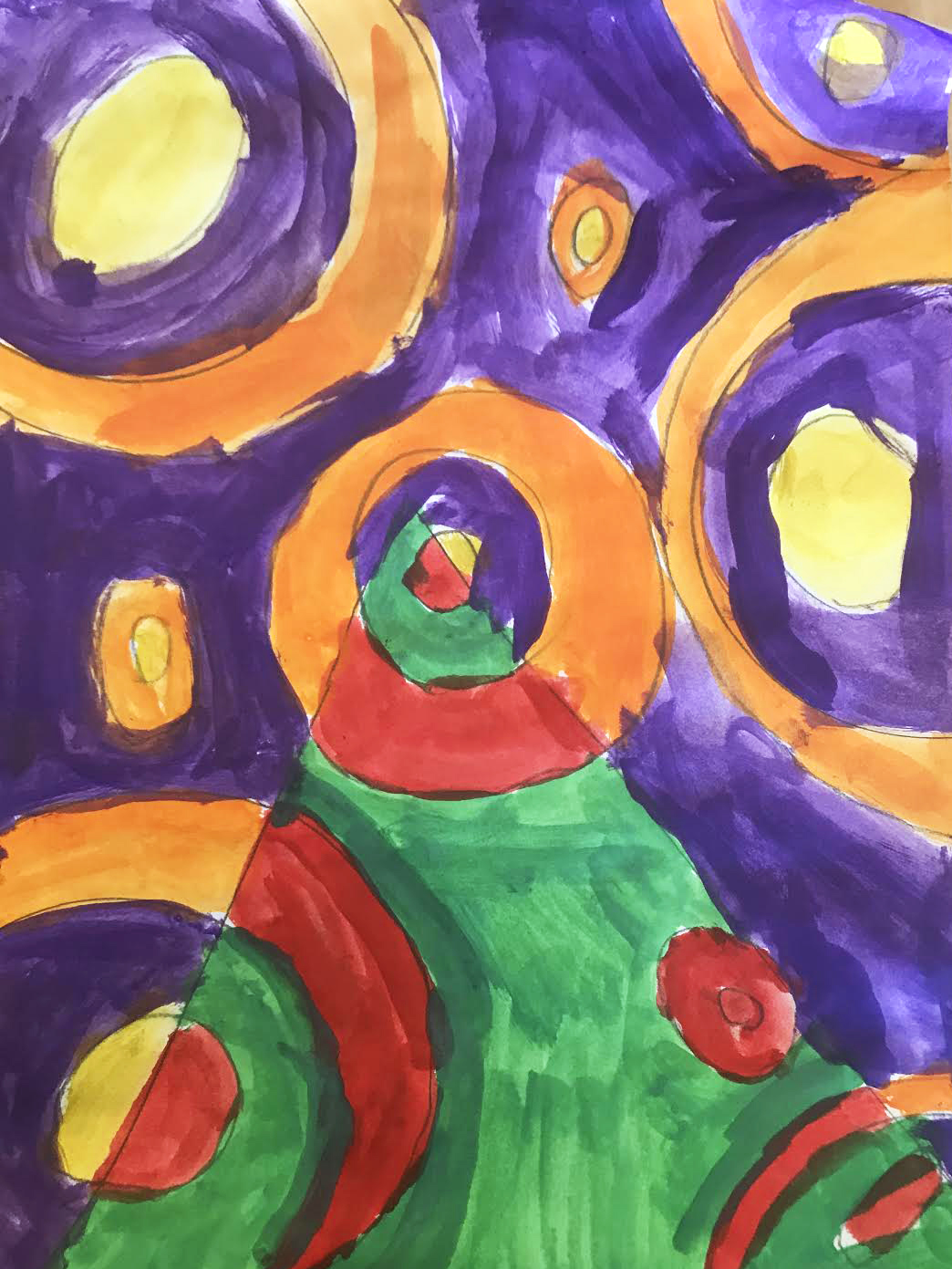
ABSTRACT TREES
Abstract Trees

Learning Targets
I can...
- Create an original Abstract Tree using drawing techniques learned in class
- Use line types (horizontal vertical diagonal), shape variation (geometric organic free form) and space (positive negative) inspired by French Painter (1882-1963) Georges Braque and Spanish Painter (1881-1973) Pablo Picasso
- Use art element: line (horizontal vertical diagonal) and design principles (composition proportion balance) based on Modern Art
- Define Cubism (using different viewpoints of subjects together in the same picture to create a fragmented artwork)
Lesson One
Day One, Art Start
1. Fruit Dish And Glass (1912) Georges Braque

2. Read Picasso And The Girl With A Ponytail: A Story About Pablo Picasso by Laurence Anholt

3. Discussion Questions "When did the Cubism art movement take place? What are the two main types of Cubism? What two artists were largely responsible for inventing Cubism? What Cubism artist wrote the first major essay on Cubism and painting "Woman with A Fan?" What artist painted Three Musicians and was a primary founder of the Cubism movement? What Spanish artist painted Portrait of Picasso and helped develop Synthetic Cubism? What co-founder of Cubism painted Violin and Candlestick? What artist used popular subjects in his art and helped to inspire the creation of Pop Art? What was the most common subject matter in the Cubism Art Movement? What style of Cubism focused on bright colors and the relationship between painting and music?"
Lesson Activities
1. Choose 12" by 15" Drawing Paper
2. Draw three thumbnail sketches of tree compositions using drawing techniques (blending smudging smooth) for tree drawings
3. Add details (leaves acorn hole) for the positive space (tree) of the Abstract Trees
Day Two, Art Start
1. Retrieve Abstract Trees for Assigned Table
2. Guitar and Fruit Dish (1909) Georges Braque

3. Discussion Questions "What kind of tree is this? How old is the tree? What season is it? Has anyone tried cutting it down? What else grows nearby? Who waters the tree? Does the tree get enough sunlight? Is the tree healthy? What is a tree a symbol of? Where is the tree located? If you were in the picture, where would you be? Did you enjoy creating a tree that represented you? What makes a good scientific sketch? What details were important to include in each tree? How tall do you think the tree is? Have you noticed how different the forest looks through the different seasons? If you climbed to the top of that tree and looked around, what do you think you would be able to see from there?"
Lesson Activities
1. Use drawing techniques (blending smudging smoothing) to add basic shapes (geometric organic free form) to tree drawings
2. Use design principles (composition balance proportion) to fill in the positive space (tree) of the tree drawings
3. Use drawing techniques (blending smudging smoothing) to add details (bark hole leaves) to Abstract Trees
Day Three, Art Start
1. Retrieve Abstract Trees for Assigned Table
2. Set Up Studio Area (construction paper, markers, pencils)
Lesson Activities
1. Use warm colors (red orange yellow) to fill in the negative space (background) of the tree drawings
2. Use cool colors (blue green purple) to fill in the positive space (tree) of the tree drawings
3. Add design details (Christmas lights, star, snow) to the positive space (tree) of the Abstract Trees
Artist Examples


 Student Examples




 Posts

