Saturday, September 26, 2020
PAUL KLEE FAMOUS LANDMARKS
Paul Klee Famous Landmarks

Learning Targets
I can...
- Create an original Paul Klee Famous Landmark using drawing techniques learned in class
- Use line types (horizontal vertical diagonal), shape variation (geometric organic free form) and space (positive negative) inspired by Swiss Artist (1879-1940) Paul Klee
- Use art element shape (geometric organic free form) and design principles (composition movement variation) based on Modern Art
- Define Cityscape (visual appearance of a city or urban area)
Lesson One
Day One, Art Start
1. Castle And Sun (1928) Paul Klee

2. Read The Cat And The Bird Inspired By A Painting By Paul Klee by Geraldine Elschner

3. Discussion Questions "What is happening in this artwork? What can you find in this artwork? What do you notice about the colors on the outside? How are the colors on the inside different? What do you think this artwork is about? What do you think it means? What do you like about this artwork? What can you see? What shapes are there? What colors do you see in this artwork? How does this artwork make you feel? What is Paul Klee known for? What does abstract mean? When and where was Paul Klee born? Which organization of artists did Paul Klee join? What important friendship exposed Paul Klee to both inspiration and success? What stylistic elements did he use to show his emotional state? What words would best describe the work of Paul Klee?"
Lesson Activities
1. Choose 12" X 15" Drawing Paper
2. Draw three thumbnail sketches of Famous Landmarks using perspective drawing skills (overlapping, cropping, enlarging) for cityscape drawing
3. Add details (fireworks, night sky, patterns) to negative space (background) of Paul Klee Famous Landmarks
Day Two, Art Start
1. Retrieve Paul Klee Famous Landmarks for Assigned Table
2. Temple Gardens (1920) Paul Klee

3. Discussion Questions "If this artwork were a person, what would they look like? If art could talk, what would it say? What was happening in history when this artwork was made? How does that change your understanding of the artwork? How does this artwork teach us about the future? How does this artwork teach us about the past? What does this painting say about the world in which we live in? What will you remember about this painting? What symbols do you notice in this artwork? What is the title? How does the title contribute to your understanding of the meaning? How do you think the artist was feeling when he created this artwork? What emotions do you notice in the artwork?"
Lesson Activities
1. Use commemorate ideas (freedom democracy opportunity) to add details (pattern emblems) to the composition of the landmark drawings
2. Use contrast (highlight, shadow) and balance (symmetrical asymmetrical) to fill in the positive space of the Paul Klee Famous Landmarks
3. Use drawing techniques (blending shading rubbing) to fill in the negative space (background) of the Paul Klee Famous Landmarks
Day Three, Art Start
1. Retrieve Paul Klee Famous Landmarks for Assigned Table
2. Set Up Studio Area (watercolor paint brush water cup)
Lesson Activities
1. Use complementary colors (red green; blue orange; purple yellow) to fill in the positive space (landmark) of the landmark drawings
2. Use complementary colors (red green; blue orange; purple yellow) to fill in the negative space (background) of the landmark drawings
3. Add design details (cropping enlarging overlapping) to the background of the Paul Klee Famous Landmarks
Artist Examples


 Student Examples


Friday, September 4, 2020
PAUL KLEE CAT AND BIRD
Paul Klee Cat And Bird

Learning Targets
I can...
- Create can original Paul Klee Cat And Bird using drawing techniques learned in class
- Use line types (horizontal, vertical, diagonal), shape variation (geometric, organic, free form), and space (positive, negative) inspired by Swiss Artist (1879-1940) Paul Klee
- Use design principle: balance (symmetrical, asymmetrical) and design principles (composition, variation, proportion) based on Expressionism
- Define Interpretations (giving an explanation of the meaning behind a creative work)
Lesson One
Day One, Art Start
1. Cat And Bird (1928) Paul Klee

2. Read The Cat And Bird: A Children's Story Book Inspired by Paul Klee by Geraldine Elschner

3. Discussion Questions "What are primary colors? What are secondary colors? How does Paul Klee use color in his artwork? What do they notice about the way the cat's head is depicted? What shapes can they identify within the head? What do they notice about the colors Klee has used? What colors are they and how are they arranged? What does the bird represent in this picture? What is the cat thinking about? What other things might a cat think about? What do you think this painting called Cat and Bird?"
Lesson Activities
1. Choose 12" by 15" Drawing Paper
2. Add shape variation (geometric, organic, free form) to positive space (cat) of cat drawings
3. Add shape variation (geometric, organic, free form) to negative space (background) of Paul Klee Cat And Bird
Day Two, Art Start
1. Retrieve Paul Klee Cat And Bird from Assigned Table
2. Castle And Sun (1928) Paul Klee

3. Discussion Questions "Why do you think the artist named this artwork Cat and Bird? Does it make you laugh? Why? What is the cat's head made of? Which shapes do you see? What colors did Klee use? Is there anything special about the relationship between these colors? What does it mean when colors are complementary? Which colors in the color wheel are complementary? Why do you think there is a bird in the middle of the cat's head? What else do you think a cat can think about? Did students design their cat out of basic shapes? Did students use complementary colors in their designs?"
Lesson Activities
1. Use analogous colors (orange yellow green) to fill in the positive space (cat) of the cat drawings
2. Use analogous colors (red orange yellow) to fill in the negative space (background) of the cat drawings
3. Add details (whiskers, bird, nose mouth) to positive space (cat) of the Paul Klee Cat And Bird
Day Three, Art Start
1. Retrieve Paul Klee Cat And Bird for Assigned Tables
2. Set Up Studio Area (construction paper, chalk, oil pastels)
Lesson Activities
1. Add highlights (reflective light, light source) to fill in positive space (cat) of cat drawings
2. Add shadows (cast shadow, reflective shadow) to fill in the negative space (background) of cat drawings
3. Add details (animal, facial expressions, spots) to positive space (cat) of Paul Klee Cat And Bird
Artist Examples
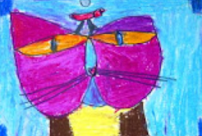


 Student Examples


 Posts
Posts

