Thursday, September 9, 2021
ARCTIC ANIMALS
Arctic Animals

Learning Targets
I can...
- Create an original Arctic Animal using drawing techniques learned in class
- Use warm/cool colors (red orange yellow, green blue purple), sharp variation (geometric organic), and line types (horizontal vertical diagonal) inspired by Canadian Artist (1926-2015) Ted Harrison
- Use art element: texture (rough smooth) and design principles (composition repetition balance) based on Canadian Art
- Define Texture (the feel or appearance of a surface)
Lesson One
Day One, Art Start
1. Floating Gulls (1994) Ted Harrison

2. Read Arctic Animals by Tad Carpenter

3. Discussion Questions "What could be cuter than a cozy textured polar bear, arctic fox, narwhal, or arctic hare? What can you identify in the artwork using directional words? Which line is above this line? How many lines did you draw below this line? How did the artist create a landscape using curved liens and organic shapes? Did the artist use short, straight lines to add fur texture to their polar bear? What do all arctic animals have in common? What is the most interesting animal in the Arctic? How do animals adapt to arctic conditions? What animals are found in the arctic? Why are arctic animals white? How many animals live in the Arctic?"
Lesson Activities
1. Use three geometric shapes (rectangle, oval, circle) to create a three dimensional silhouette of an arctic animal (fox, bear, wolf) for the animal composition
2. Add details (eyes, nose, claws) to the three dimensional silhouette of an arctic animal (fox, bear, wolf) for the animal composition
3. Outline positive space (arctic animal) with neutral colors (black, brown, grey) for the Arctic Animals
Day Two, Art Start
1. Retrieve Arctic Animal for Assigned Table
2. Flying South (1993) Ted Harrison

3. Discussion Questions "What do you see in this picture? Does your picture have space or distance? Does your picture have an horizon line, one point perspective, or background? How can we create the illusion of depth within our own Arctic Animals? What do you think was the most important tool the artist used when creating this work? Why are you drawn to this subject? What connections did the artist have to her work? Does this artwork represent something about the artist? Is there an element of the artwork you enjoy working with most? What do you think the artist meant when creating this artwork?"
Lesson Activities
1. Add finished details (eyes, nose, claws) to the positive space (fox, wolf, bear) of the arctic animal composition
2. Finish outlining positive space (fox, wolf, bear) with neutral colors (brown, black, grey) for the arctic animal composition
3. Add embellishments (salt, glitter, metallic) for the negative space (background) of the Arctic Animals
Day Three, Art Start
1. Retrieve Arctic Animal for Assigned Table
2. Set Up Studio Area (water bucket, paint brush, watercolor)
Lesson Activities
1. Finish adding embellishments (salt, glitter, metallic) for the negative space (background) of the Arctic Animals
2. Add neutral colors (black, grey, brown) to the three dimensional silhouette (fox, bear, wolf) of the arctic animal composition
3. Add value (highlight, shadows) to the positive space (fox, bear, wolf) of the Arctic Animals
Artist Examples
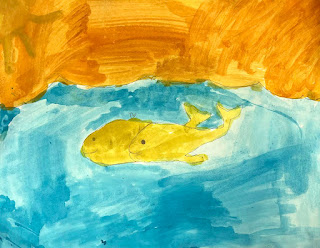
 Student Examples


Thursday, August 12, 2021
TED HARRISON WINTER LANDSCAPES
Ted Harrison Winter Landscapes

Learning Targets
I can...
- Create an original Ted Harrison Winter Landscape using drawing techniques learned in class
- Use complementary colors (red, green; blue, orange; yellow, purple), shape variation (geometric, organic), and space (positive, negative) inspired Canadian Artist (1926-2015) Ted Harrison
- Use painting techniques (wet on wet, dry brush, blending) and design principles (movement gradation proportion) based on Canadian Art
- Define Mood (atmosphere, state of mind, or feelings generated from an image)
Lesson One
Day One, Art Start
1. Mount Baker (1993) Ted Harrison

2. Read O Canada by Ted Harrison

3. Discussion Questions "What do you know about the Inuit culture, past and present? How are arts inspired by different cultures as well as their own? What types of art does Ted Harrison create? What do you see in this artwork? What types of colors does the artist use? What moods do the paintings evoke? How do you feel when you see the art? What does the artwork remind you of?"
Lesson Activities
1. Use graphite pencil to draw the background (sky clouds hillside) of the winter landscapes
2. Use graphite pencil to draw the middle ground (fields house trees) of the winter landscapes
3. Use graphite pencil to draw the foreground (bushes animals rocks) of the Ted Harrison Winter Landscapes
Day Two, Art Start
1. Retrieve Ted Harrison Winter Landscapes for Assigned Table
2. Visitor From Space (1988) Ted Harrison

3. Discussion Questions "What does the scene tell us about he area of the country in which the artist lived in? How has art been influenced by elements of the artist's life? How does this artwork reflect the community? What kind of scenes were the subjects of Inuit artists? How does this work differ from the artwork of other artists during the same era? How many lines are in this artwork?"
Lesson Activities
1. Add lines (horizontal vertical diagonal) to the background (sky clouds hillside) of the winter landscapes
2. Add lines (horizontal vertical diagonal) to the middle ground (fields houses trees) of the winter landscapes
3. Add lines (horizontal vertical diagonal) to the foreground (bushes, animals, rocks) of the winter landscapes
Day Three, Art Start
1. Retrieve Ted Harrison Winter Landscapes for Assigned Table
2. Set Up Studio Area (paint brushes, tempera paint, water bucket)
Lesson Activities
1. Use complementary colors (red green, blue orange, purple yellow) to paint in the background (sky clouds hillside) of the winter landscapes
2. Use complementary colors (red green, blue orange, purple yellow) to paint in the middle ground (fields houses trees) of the winter landscapes
3. Use complementary colors (red green, blue orange, purple yellow) to paint in the foreground (bushes animals rocks) of the Ted Harrison Winter Landscapes
Artist Examples

 Student Examples




 Posts
Posts

