Tuesday, August 2, 2022
MARK ROTHKO COLOR FIELDS
Mark Rothko Color Fields

Learning Targets
I can...
- Create an original Mark Rothko Color Fields using drawing techniques learned in class
- Use color combinations (analogous, complementary, monochromatic), shape variation (geometric, organic), and line types (horizontal, vertical, diagonal) inspired by American Painter (1903-1970) Mark Rothko
- Use value (lightness, darkness) and design principles (gradation, movement, composition) based on Abstract Expressionism
- Define Monochromatic (using only one color)
Lesson One
Day One, Art Start


Lesson Activities
Day Two, Art Start

Lesson Activities
Day Three, Art Start
Lesson Activities
Artist Examples

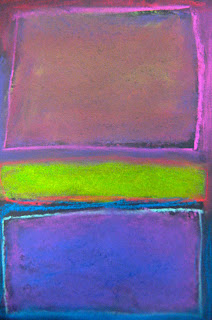


Student Examples 


Wednesday, January 5, 2022
GILLIAN AYRES INSPIRED COLLAGES
Gillian Ayres Inspired Collages

Learning Targets
I can...
- Create an original Gillian Ayres Inspired Collages using drawing techniques learned in class
- Use line types (horizontal, vertical, diagonal), shape variation (geometric, organic), and value (tints, shades) inspired by English Painter (1930-2018) Gillian Ayres
- Use painting techniques (pigment, pointillism, layering) and design principles (garadation, proportion, composition) based on Abstract Expression
- Define Collage (a piece of art made by sticking various materials (photographs, paper, fabric) together)
Lesson One
Day One, Art Start
1. Song Beneath the Stars (2009-2010) Gillian Ayres

2. Read Gillian Ayres by Mel Gooding

3. Discussion Questions "What do you think the artist is thinking about when working in this painting? Do you think the artist will know what the painting will look like when it his finished? How do artists know when an artwork is complete? Do you think this work is inspired by American Abstract Expressionism? What do you think the origin of the titles say about the artwork? How are these titles inspired from historical literature and classical mythology? How do you think the artist feels about painting? Do you think artists should keep changing their style?"
Lesson Activities
1. Choose 12" X 15" Drawing Paper
2. Draw three line types (horizontal, vertical, diagonal) as a line design for the abstract collages
3. Outline three line types (contour continuous outline) with black oil pastels for the Gillian Ayres Inspired Collages
Day Two, Art Start
1. Retrieve Gillian Ayres Inspired Collages for Assigned Table
2. The Seeds That Woke The Clay (2010) Gillian Ayres

3. Discussion Questions "What does art mean to you? What ideas, concerns, or objectives have motivated your work? How would you describe your artistic style? What is success or successful to you? Is there a distinct mood? Does it make you think about anything? Does anything jump out at you? What did the artist say about the piece? How did you start out as an artist? When do you feel your best? Do you struggle with comparison to other artists? If so, how are you able to move past this? What do your paintings reveal about your personality? Where or how do you rediscover inspiration? Who is the artist shown above?"
Lesson Activities
1. Use drawing techniques (contour outline continuous) to add basic shapes (geometric organic) to the positive space (foreground) of the abstract collages
2. Use drawing techniques (contour outline continuous) to add basic shapes (geometric organic) to the negative space (background) of the abstract collages
3. Use drawing techniques (contour outline continuous) to add details (patterns, texture, designs) to the Gillian Ayres Inspired Collages
Day Three, Art Start
1. Retrieve Gillian Ayres Inspired Collages for Assigned Tables
2. Set Up Studio Area (scissors, glue sticks, paper, oil pastels)
Lesson Activities
1. Use complementary colors (red green; blue orange; yellow purple) to fill in the positive space (foreground) of the abstract collages
2. Use complementary colors (red green; blue orange; yellow purple) to fill in the negative space (background) of the abstract collages
3. Add design details (pattern texture designs) to the positive space (foreground) of the Gillian Ayres Inspired Collages
Artist Examples
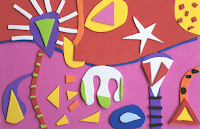

 Student Examples


Wednesday, August 11, 2021
ABSTRACT MOOSE
Abstract Moose

Learning Targets
I can...
- Create an original Abstract Moose using drawing techniques learned in class
- Use shape variation (geometric organic), line types (horizontal vertical diagonal) and space (positive negative) inspired by Australian Artist (1992-Present) Dawn Gerety
- Use repetitive patterns (dots, swirls, stripes) and design principles (contrast, gradation, movement) based on Contemporary Art
- Define Pattern (a repeated decorative design)
Lesson One
Day One, Art Start
1. River Moose (2021) Dawn Gerety

2. Read Morris the Moose by B. Wiseman

3. Discussion Questions "What do you know about moose? What do you think when you hear about moose? What is the reason that Morris gives for the cow being a moose? What reasoning did Morris use to conclude that the cow is a moose? What is wrong with Morris's reasoning? Do you agree with Morris, that he knows that the cow is a moose? Is there more knowledge than having reasons for a brief? When was there time you had a reason for knowing something? As a result of what you have now said, do you think that everything you know you know for a reason? How does the cow do this? How does Morris respond? Has anything like this ever happened to you?"
Lesson Activities
1. Use three geometric shape (rectangle, oval, circle) to create a three-dimensional silhouette of a abstract moose for the winter landscapes
2. Add details (eyes, horns, ears) to the three dimensional silhouette of the abstract moose for the winter landscapes
3. Outline positive space (moose) with neutral colors (black brown grey) for the Abstract Moose
Day Two, Art Start
1. Retrieve Abstract Moose for Assigned Table
2. Aurora Bou (2021) Dawn Gerety

3. Discussion Questions "Why do you think people keep saying they know something even though they do not? Does yelling make Morris right? Why does he yell? What do you think he should have done to convince the deer that he was wrong and that Morris was not a deer? Why does seeing their own reflections convince the animals that they were wrong? What does the saying "seeing is believing" mean? Do you agree with it? Why is Morris not convinced when the other animals tell him that he is wrong? Can you think of other situations in which people have persisted in their mistakes despite having evidence that they were wrong? Can you think of situations in which new evidence has made people change what they think?"
Lesson Activities
1. Add finished details (eyes nose ears) to the positive space (moose) of the winter landscapes
2. Finish outlining positive space (moose) with neutral colors (brown black grey) for the winter landscapes
3. Add embellishments (salt, glitter, metallic) for the negative space (background) of the Abstract Moose
Day Three, Art Start
1. Retrieve Abstract Moose for Assigned Table
2. Set Up Studio Area (water bucket, paintbrush, watercolor)
Lesson Activities
1. Finish adding embellishments (salt, glitter, metallic) for the negative space (background) of the Abstract Moose
2. Add neutral colors (brown black grey) to the three dimensional silhouette (moose) of the Abstract Moose
3. Add value (highlights, shadows) to the positive space (animal) of the Abstract Moose
Artist Examples


 Student Examples


Sunday, July 25, 2021
REGINALD LAURENT ABSTRACT ART
Reginald Laurent Abstract Art

Learning Targets
I can...
- Create an original Reginald Laurent Abstract Art using painting techniques learned in class
- Use line types (horizontal vertical diagonal), shape variation (geometric organic), and space (positive negative) inspired by Abstract Artist (196-Present) Reginald Laurent
- Use art element: shape (geometric organic) and design principles (composition variation balance) based on Abstraction
- Define Shape (a closed space made when a line connects to itself)
Lesson One
Day One, Art Start
1. When I Think of Love (2004) Reginald Laurent

2. Read We're All Works of Art by Mark Sperring

3. Discussion Questions "How long has Reginald Laurent been an artist? Does the artist prefer to work on a large or small canvas? How would your describe his process of making colorful abstract forms? What inspires artists to create such colorful abstract art? What tips does the artist have for aspiring artists who would like to create abstract art? What do you see? What was it like to draw your shapes using white oil pastels on white paper? Was it fun to draw abstract shapes without thinking about making a realistic scene? What was your favorite part of this lesson? Would anyone like to share their art if time allows?"
Lesson Activities
1. Choose 12" X 15" Drawing Paper
2. Draw three line types (horizontal vertical diagonal) as a line design for the abstract collages
3. Outline three line types (contour continuous outline) with black oil pastels for the Reginald Laurent Abstract Art
Day Two, Art Start
1. Retrieve Reginald Laurent Abstract Art for Assigned Table
2. Journey To Me (2003) Reginald Laurent

3. Discussion Questions "What does art mean to you? What ideas, concerns or objectives have motivated your work? How would you describe your artistic style? What is success or successful for you? Is there a distinct mood? Does it make you think about anything? Does anything jump out at you? What did the artist say about the piece? How did you start out as an artist? When do you feel your best? Do you struggle with comparison to other artists? If so, how are you able to move past this? What do your paintings reveal about your personality? Where or how do you rediscover inspiration? Who is the artist shown above?"
Lesson Activities
1. Use drawing techniques (contour outline continuous) to add basic shapes (geometric organic) to the positive space (foreground) of the abstract collages
2. Use drawing techniques (contour outline continuous) to add basic shapes (geometric organic) to the negative space (background) of the abstract collages
3. Use drawing techniques (contour outline continuous) to add details (pattern texture designs) to the Reginald Laurent Abstract Art
Day Three, Art Start
1. Retrieve Reginald Laurent Abstract Art for Assigned Table
2. Set Up Studio Area (scissors glue sticks oil pastels)
Lesson Activities
1. Use complementary colors (red green; blue orange; yellow purple) to fill in the positive space (foreground) of the abstract collages
2. Use complementary colors (red green; blue orange; yellow purple) to fill in the negative space (background) of the abstract collages
3. Add design details (pattern texture designs) to the positive space (foreground) of the Reginald Laurent Abstract Art
Artist Examples


 Student Examples


 Posts
Posts

