Thursday, November 5, 2026
CLAY PUFFER FISH
Clay Puffer Fish Learning Targets

I can...
- Create an original Clay Puffer Fish using ceramic techniques learned in class
- Use form (two dimensional, three dimensional), space (positive, negative), and texture (actual, visual, implied) inspired by Australian Visual Artist (1977-Present) Tom Moore
- Use sculpture techniques (carving, modeling, casting, assembling) and design principles (composition, repetition, balance) based on Glass Art
- Define Anthropomorphic (giving human form, traits, emotions, speech, or behaviors to nonhuman beings such as animals, objects, or natural forces)
Lesson One
Day One, Art Start
1. Pyrotechnic Puffer Fish (2016) Tom Moore

2. Read Barry The Fish With Fingers by Sue Hendra

3. Discussion Questions "What is the favorite snack choice of a puffer fish? How can we show that the puffer fish might like eating green leaves or crunchy crabs? Is your puffer fish sharp, prickly, bumpy, or soft? Where does your puffer fish like to live (stamp textures, seashells, comb, rough coral, aluminum foil)? What type of fins does the puffer fish have to make the fish a speedy swimmer or a slow drifter? Does your puffer fish have a best underwater friend such as a starfish, snail, or worm to put on top of the head? What makes your puffer fish different from every other fish in the ocean? Will the fish be round, oval, tall, short, or an unusual shape? Could the puffer fish have oversized eyes, tiny fins, or a funny mouth? What could you change about your spikes, eyes, or patterns to make your fish one of a kind? What makes your puffer fish different from all other puffer fish in the ocean?"
Lesson Activities
1. Add line types (horizontal, vertical, diagonal) for proportions (head, eyes, tail) within the positive space (foreground, middle ground, puffer fish) of the Clay Puffer Fish
2. Mold clay into basic shapes (circle eyes, triangle tail, oval body) for the positive space (foreground, middle ground, puffer fish) of the Clay Puffer Fish
3. Use modeling tools to draw facial features (whiskers, gills, scales, fins) for the positive space (foreground, middle ground, puffer fish) of the Clay Puffer Fish
Day Two, Art Start
1. Retrieve Clay Puffer Fish for Assigned Tables
2. Puffer Pair (2021) Tom Moore

3. Discussion Questions "What is a puffer fish? How big can puffer fish grow? How many varieties of puffer fish are there? How long can puffer fish live? Why did the artist use those colors and background for the puffer fish? What do you think is beautiful about this artwork? What can you learn from viewing this artwork? Why are fish important to the ecosystem? What special features do fish have? What are fish a sign of? What is the hidden meaning of seeing a fish? How far can a fish swim? What are the unique characteristics of a fish? What do you think fish eat? What do fish have on the scales? What type of fish are in our story? What type of noises do fish make? Which types of fish live in North America? Do either or both of these fish live where you do?"
Lesson Activities
1. Add facial features (whiskers, eye lids, eyelashes, fins) for the positive space (foreground, middle ground, fish) of the Clay Puffer Fish
2. Add details (patterns, scales, stripes) to the positive space (foreground, middle ground, fish) of the Clay Puffer Fish
3. Use modeling tools (brush, grips, paddle) to smooth out the facial features (whiskers, eye lids, eyelashes) for the Clay Puffer Fish
Day Three, Art Start
1. Retrieve Clay Puffer Fish for Assigned Tables
2. Set Up Studio Area (rubber mat, modeling tools, water bucket, air dry clay)
Lesson Activities
1. Add color combinations (warm/cool colors, analogous colors, complementary colors) for the positive space (foreground, middle ground, fish) of the Clay Puffer Fish
2. Add color combinations (warm/cool colors, analogous colors, complementary colors) for the negative space (background) of the Clay Puffer Fish
3. Apply Gloss Fish to the facial proportions, facial features, and accessories of the Clay Puffer Fish
Artist Examples


 Student Examples


Tuesday, February 24, 2026
OVER UNDER FROGS PAINTINGS
Over Under Frogs Paintings Learning Targets

I can...
- Create an original Over Under Frogs Paintings using drawing techniques learned in class
- Use line types (horizontal vertical diagonal), shape variation (geometric, organic, free form), and texture (actual visual implied) inspired by American Artist (2005-Present) Samuel Popovich
- Use painting techniques (impasto, alla prima, glazing, dry brush) and design principles (composition, movement, variation) based on American Art
- Define Anthropomorphic (a description of human form, personality, or attributes to non-human entities)
Lesson One
Day One, Art Start
1. Frog Ross (2024) Samuel Popovich

2. Read Tuesday by David Wiesner

3. Discussion Questions "Did you know some frogs can jump up to 20 times their body length? What else could be in the pond with the frog? How can we draw inspiration from the artist's life and art to explore the frog life cycles? How can we draw inspiration from the artist's life and art to understand the frog's role as an indicator species? How do these artworks make you feel? What do you think motivated the artist to create immersive art? What do you think the artist's artwork expresses about his own feelings? Do learners think this is an indicator that the frog did not feel healthy, safe, or creative in the previous environment? What kind of environment do learners require to feel heathy, safe, and creative? What elements of their environment can help them to thrive? What elements in their environment hinder their wellness? How do we affect our environment with art? How is our art an indicator of our environmental health?"
Lesson Activities
1. Use ruler, compass, or straightedge to draw the scenery (background, foreground, middle ground) of the Over Under Frog Paintings
2. Add details (leaves, flowers, trees, plants) with the scenery (foreground, middle ground, background) of the Over Under Frog Paintings
3. Use colored sharpies to outline the scenery (foreground, middle ground, background) of the Over Under Frog Paintings
Day Two, Art Start
1. Retrieve Over Under Frog Paintings for Assigned Tables
2. Honest Work (2025) Samuel Popovich

3. Discussion Questions "What do you think will happen to the frogs next Tuesday night? What would you do if you were one of the frogs flying on a lily pad? How can you tell what time of day it is in this picture? Why are the police officers so confused when they find the lily pads? What do you notice on the front cover? Why do you think the dog is looking up? Why do you think the author choose a day of the week for the title? What would you do if you saw frogs flying outside your window? Why are the townspeople puzzled about finding lily pads everywhere? What clues did the frogs leave behind? Why do you think David Wiesner decided not to use words? How would the story change if there were words on every page?"
Lesson Activities
1. Add patterns (swirls, clouds, stars) into the scenery (foreground, middle ground, background) of the Over Under Frogs Paintings
2. Use color combinations (analogous, complementary, intermediate) to fill in the scenery (foreground, middle ground, background) of the Over Under Frogs Paintings
3. Use color combinations (analogous, complementary, intermediate) to fill in the scenery (foreground, middle ground, background) of the Over Under Frog Paintings
Day Three, Art Start
1. Retrieve Over Under Frogs Paintings for Assigned Tables
2. Set Up Studio Area (paint brushes, water bucket, glue sticks, scissors)
Lesson Activities
1. Add highlights (reflective light, light source, reflection) within the scenery (foreground, middle ground, background) of the Over Under Frogs Paintings
2. Add shadows (cast shadow, reflective shadow) within the scenery (foreground, middle ground, background) of the Over Under Frog Paintings
3. Add details (animals, plants, accessories) within the scenery (foreground, middle ground, background) of the Over Under Sheep Paintings
Artist Examples


 Student Examples


Saturday, March 22, 2025
CLAY ALIEN SCULPTURES
Clay Alien Sculptures Learning Targets

I can...
- Create an original Clay Alien Sculpture using ceramic techniques learned in class
- Use shape variation (geometric, organic, free form), form (two dimensional, three dimensional), and texture (actual, visual, implied) inspired by UFO newspaper clippings
- Use sculpture techniques (carving, casting, modeling, assembling) and design principles (balance, proportion, emphasis) based on Extraterrestrial Art
- Define Anthropomorphic (a depiction of non-human entities (animals, objects, deities) with human characteristics, traits, behaviors, or appearances)
Lesson One
Day One, Art Start
1. The Annunciation With Saint Emidius (1486) Carlo Crivelli

2. Read Aliens Love Underpants by Claire Freedman

3. Discussion Questions "What signs of life do scientists use to look for life in other worlds? What traits will your alien have to survive various environmental conditions? Do you believe we are the only living beings in the universe? If we are not, what does life look like on other planets? Do you think similar characteristics would be needed for plant or animal life on another planet? What can you add to your space ship to make it a place you and your friend would feel safe? What could you add to your spaceship to make it a place you and your friends would feel conformable traveling in? What do you think it would be like to leave Earth and travel to far away planets? Which activities would you explore with your friends and how might you go about them in space? What would you bring with you when meeting your new space friend? How would the friends you are travelling with get along with your new space friend? How would the friends you are traveling with get along if there were any struggles? What makes your space friend a good travel buddy to have in your friendship group?"
Lesson Activities
1. Turn clay slab into basic shapes (head, shoulder, neck) for the positive space (foreground, alien) of the Clay Alien Sculptures
2. Use modeling tools to draw features (clothing, jewelry, make up) for the positive space (foreground, alien) of the Clay Alien Sculptures
3. Add lines for the facial features (nose, eyes, mouth) for the positive space (foreground, alien) of the Clay Alien Sculptures
Day Two, Art Start
1. Retrieve Clay Alien Sculptures for Assigned Tables
2. Baptism Of Christ (1710) Aert de Gelder

3. Discussion Questions "Do you think aliens could live on other planets, moon, or even in space? What do scientists think about aliens? Do you think aliens could be similar or different from us? Would aliens be friendly or scary? What would happen if you met an alien? What does the term UFO stand for? What tools do scientists use to find aliens? What is important to you in a friendship? What will you remember most from your imagined journey in space with your friends? Did you learn anything new from your friend? Did they learn anything from you? What can be helpful when we have difficulties with friends? What are some ways you can share and understand different opinions? How can friendships can as we get older?"
Lesson Activities
1. Add lines for proportions (head, neck, shoulders) within the silhouette of the Clay Alien Sculptures
2. Mold clay into basic shapes (oval face, crescent ears, rectangle neck) for the positive space (foreground, alien) of the Clay Alien Sculptures
3. Use needle to draw facial features (eyes, nose, mouth) within the silhouette of the Clay Alien Sculptures
Day Three, Art Start
1. Retrieve Clay Alien Sculptures for Assigned table
2. Set Up Studio Area (water bucket, needle tools, rubber mat)
Lesson Activities
1. Add tempera paint with color combinations (analogous colors, complementary colors, primary colors) to positive space (foreground, alien) of the Clay Alien Sculptures
2. Add tempera paint with color combinations (complementary colors, analogous colors, primary colors) to the negative space (foreground, alien) of the Clay Alien Sculptures
3. Apply Gloss Finish to the facial features, facial proportions, and accessories of the Clay Alien Sculptures
Artist Examples

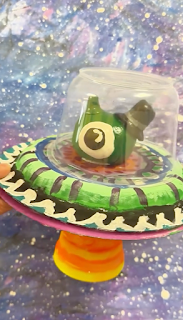
 Student Examples


Thursday, October 22, 2020
LAURENCE VALLIERES CARDBOARD ANIMALS
Laurence Vallieres Cardboard Animals

Learning Targets
I can...
- Create an original Cardboard Animal using sculpture techniques learned in class
- Use form (two dimensional, three dimensional), shape variation (geometric organic free form) and space (positive negative) inspired by Montreal Artist (1986-Present) Laurence Vallieres
- Use cardboard techniques (scoring, slots, stacking) and design principles (composition balance repetition) based on Contemporary Art
- Define Anthropomorphism (attribution of human characteristics to an animal or object)
Lesson One
Day One, Art Start
1. Taureau (Bull) (2017) Laurence Vallieres

2. Read Not A Box by Antoinette Portis

3. Discussion Questions "Can you believe this is made out of cardboard? What sketch, figurine, or nature inspires the artists work? What is anthropomorphism? What does the animal imagery symbolize or represent? What metaphors are shown throughout the artists work? When looking at this work, what captures the eye of the viewer? What do you think is happening in this composition? What action do you see? How does this action contribute to the feeling of the piece? What else do you see in this sculpture? How would you describe the expressions on the faces? Does this work look natural, representational, or is it stylized? How does this work make you feel? What techniques were used to create this piece? How is the artist telling us a story? How has the artist set the scene or developed these characters?"
Lesson Activities
1. Choose Three 12 X 12 Cardboard Sheets
2. Use three compositional elements (shape color texture) to represent a memory, place, or event from ones own history
3. Use line variation (wavy straight curved) as a design principle (balance composition repetition) within ones own Laurence Vallieres Cardboard Animals
Day Two, Art Start
1. Retrieve Laurence Vallieres Cardboard Animals for Assigned Table
2. Raccoon (2014) Laurence Vallieres

3. Discussion Questions "What was going on historically, economically, socially during this period? How does this work of art reflect the time period? What materials were on hand for this creation of this work? What does this tell us about the environment in which it was made? What do you think this work of art is all about? What is the artist interested in saying with this work? What purpose would this object serve for the society in which it was created? What odes this object reveal about the person who created it? What does this object tell us about the culture in which it was created? Why did the artist do it that way? what is the artist trying to convey?"
Lesson Activities
1. Use compass, protractor, and texture plates to add symmetrical shapes and expressive lines to cardboard houses
2. Use form (two dimensional three dimensional) to fill in the positive space (animal) of the cardboard animals
3. Use form (two dimensional three dimensional) to fill in the negative space (base) of the Laurence Vallieres Cardboard Animals
Day Three, Art Start
1. Retrieve Laurence Vallieres Cardboard Animals for Assigned Table
2. Set Up Studio Area (glue bottles, cardboard, push pins)
Lesson Activities
1. Use scissors to cut out two dimensional symmetrical shapes to create a three dimensional cardboard animals
2. Glue Down three dimensional symmetrical shapes to create a three dimensional cardboard animals
3. Add decorations (old art, newspaper, fabric scraps, colored paper, buttons, collage bits) to positive space of Laurence Vallieres Cardboard Animals
Artist Examples


Student Examples


 Posts

