Monday, December 7, 2020
GLENNRAY TUTOR INSPIRED MARBLES
Glennray Tutor Inspired Marbles

Learning Targets
I can..
- Create an original Glennray Tutor Inspired Marbles using collage techniques learned in class
- Use line types (horizontal vertical diagonal), shape variation (geometric organic free form) and value (lightness darkness) inspired by American Painter (1950-Present) Glennray Tutor
- Use drawing techniques (horizon line vanishing point parallel lines) and design principles (composition balance proportion) based on Photorealism
- Define Reflection (representations of mirroring surfaces in a painting)
Lesson One
Day One, Art Start
1. Phoenix (2020) Glennray Tutor

2. Read A Bag Of Marbles by Joseph Joffo

3. Discussion Questions "In the game of marbles, which type of marbles is made of stone? What is the difference between bombing and lagging in marbles? How many people can play marbles? When was the last time you played with marbles? How would you become a good marble player? What do you find interesting about marbles? Have you ever lost your marbles? What is an idiom? Where did the phrase "lose your marbles" originate? What does it mean? What are marbles made out of? Did your parents have marbles as children? Have you played marbles? Can you think of other phrases you might lose if you feel like you are losing your mind? How do you feel? Have you ever lost your marbles? What other phrases could you use, though, to express different feelings? Do any friends or family members use similar phrases?"
Lesson Activities
1. Use three geometric shapes (circle, oval, ellipse) to create a three-dimensional sphere for sphere drawings
2. Use line variation (thick, thin) to show type of object (ravens wood, Milky Way, peacock) for marble drawings
3. Use complimentary colors (red green, blue orange, yellow purple) to fill in the positive space (marble) of the Glennray Tutor Inspired Marbles
Day Two, Art Start
1. Retrieve Glennray Tutor Inspired Marbles for Assigned Tables
2. Solo (I Dreamed It All) (2006) Glennray Tutor

3. Discussion Questions "What type of liens are being used in this artwork? How did this artist use space? How does your eye move through this artwork? What elements of this artwork seem real? What adjectives would you use to describe this artwork? What verbs would you use to describe this artwork? What do we know about the artist after viewing this artwork? If you could ask the artist a question, what would you ask him? What do you think this artwork was created for? How do you think this artwork was made? Why do you think the artist created this work? What do you think the artist is trying to say in this work? What is the meaning or message?"
Lesson Activities
1. Use complementary colors (red green, blue orange, yellow purple) to fill in the negative space (background) of the marble drawings
2. Add patterns (stripes, waves, swirls) to fill in the negative space (background) of the marble drawings
3. Use neutral colors (white) to fill in the highlights (reflective light, light source) of the Glennray Tutor Inspired Marbles
Day Three, Art Start
1. Retrieve Glennray Tutor Inspired Marbles for Assigned Table
2. Set Up Studio Area (glue sticks, scissors, chalk)
Lesson Activities
1. Use neutral colors (black, grey) to fill in the shadows (cast shadow, shadow) of the marble drawings
2. Add highlights (reflective light, light source) to subject matter (marbles) of marble drawings
3. Use drawing tools (pencils, oil pastels, chalk) to add details to marbles of Glennray Tutor Inspired Marbles
Artist Examples


 Student Examples


Sunday, December 8, 2019
PATTERN LANDSCAPES
Pattern Landscapes

Learning Targets
- Create an original Pattern Landscape using drawing techniques learned in class
- Use line variation (swirls, squiggles, curves), visual texture (rock, grass, wood), and shape (geometric, organic, free form) inspired by American Painter (1891-1942) Grant Wood
- Understand Art Element: Line (curved, whirling, straight) and design principles (balance, composition, emphasis) based on Folk Art
- Define Zentangle (style of drawing or doodling with repeating pattern to create a dynamic piece)
Lesson One
Day One Art Start
1. Young Corn (1931) Grant Wood
2. Read Grant and Tillie Go Walking by Monica Kulling

Lesson Activities
1. Use graphite pencil to draw the background (sky, clouds, hillside) of the pattern landscapes2. Use graphite pencil to draw the middle ground (fields, houses, trees) of the pattern landscapes
3. Use graphite pencil to draw the foreground (bushes, animals, rocks) of the pattern landscapes
Day Two, Art Start
1. Retrieve Pattern Landscapes for Assigned Table2. Read Foster Creative Books: The Art of Zentangle by Notions Walker

Lesson Activities
1. Add pattern (stripes, zig zags, polka dots) to background (sky, clouds, hillside) of pattern landscapes2. Add pattern (stripes, zig zags, polka dots) to middle ground (fields, houses, trees) of pattern landscapes
3. Add pattern (stripes, zig zags, polka dots) to foreground (bushes, animals, rocks) of pattern landscapes
Day Three, Art Start
1. Retrieve Pattern Landscapes for Assigned Table2. Set Up Studio Area (paint brushes, tempera paint, water bucket)
Lesson Activities
1. Use warm/cool colors (red, orange, yellow) to paint in the background (sky, clouds, hillside) of pattern landscapes2. Use warm/cool colors (red, orange, yellow; green, blue, purple) to paint in the middle ground (fields, houses, trees) of pattern landscape
3. Use warm/cool colors (red, orange, yellow; green, blue, purple) to paint in the foreground (bushes, animals, rocks) of pattern landscape
Artist Examples


 Student Examples


Saturday, November 2, 2019
SHAPE AND FORM PAINTINGS
Shape and Form Paintings

Learning Targets
I can...- Create a Shape and Form Painting using painting techniques learned in class
- Use neutral colors (white, grey, black), value types (lightness, darkness), and basic form (cone, cylinder, sphere, cube, torus) inspired by the Five Basic Forms
- Use basic techniques (proportion, perspective, gradation) and design principles (movement, balance, emphasis) based on Art Fundamentals
- Define Form (an object having length, width, and depth that is in an enclosed space)
Lesson One
Day One, Art Start
1. The Blue Fan (1922) Francis Campell Boileau Cadell
3. Discussion Questions "How does contrast work to establish three-dimensional form? How do we use perspective to create a cube? What are some other examples of pictures such as a television or a canvas? What words would you use to describe this painting? What other words might you use? How would you describe the lines in this picture? The shapes? The colors? What does this painting show? What observations can you make about this painting? How would you describe this painting to a person would could not see it?"
Lesson Activities
1. Choose 12" X 15" Painting Paper2. Draw five basic forms (cone, cylinder, sphere, cube, torus) before adding light, middle, and dark values within Shape and Form Paintings
3. Add an horizon line in the background to separate the five basic shapes from the background (wallpaper, table) of the form paintings
Reminder:
- Initials & Home Teacher on Back of Paper
Day Two, Art Start
1. Retrieve Shape and Form Paintings for Assigned Table2. Still Life with a Peach and Two Green Pears (1883-1887) Paul Cezanne

Lesson Activities
1. Use neutral colors (black, white, grey) to fill in the positive space (cone, cylinder, sphere, cube, torus) of the Shape and Form Paintings2. Use neutral colors (black, white, grey) to fill in the negative space (wallpaper, table) of the Shape and Form Paintings
3. Use felt tip pens to add a contour line to the positive/negative space of the form paintings
Day Three, Art Start
1. Retrieve Shape and Form Paintings for Assigned Table2. Set Up Studio Area (water bucket, paint brushes, paint)
Lesson Activities
1. Add tints (add white, reflective light, light source) to subject matter (cone, cylinder, sphere, cube, torus) of the form paintings2. Add shades (add black, cast shadows, shadow) to background (wallpaper, table) of the form paintings
3. Use drawing tools (pencils, oil pastel, chalk) to add details to the Shape and Form Paintings
Artist Examples


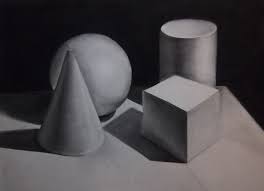


Student Examples


 Posts
Posts

