Wednesday, December 18, 2024
CARDBOARD STEAMPUNK MACHINES
Cardboard Steampunk Machines
 Learning Targets

I can...
- Create an original Cardboard Steampunk Machines using drawing techniques learned in class
- Use color combinations (metallic, earth tones, neutral colors), form (two dimensional, three dimensional) and texture (actual visual implied) inspired by Russian Sculptor (1987-Present) Igor Verny
- Use sculpture techniques (slots, tabs, folds, brackets) and design principles (balance, proportion, movement) based on Steampunk
- Define Kitbashing (art of making a sculpture by taking bits out of broken plastic toys, found objects, or recycled materials)
Lesson One
Day One, Art Start
1. Little Bird (2020) Igor Verny

2. Read How The Steam Locomotive And Steam Technology Work by Robert Lamb

3. Discussion Questions "How has the Victorian Era affected art, literature, culture, fashion, and technology? What is the difference between form and function? How has the Gilded Age brought forth change? Which one: form or function does Steampunk identify with the most? What is the most significant imagery in Steampunk? How is Steampunk portrayed? How does the Victorian Era set the stage for fashion and how is fashion design a form of art? How does the Steampunk art movement relate to us now and how will it relate to generations from now? How do authors, illustrators, filmmakers, and artists integrate technology and science fiction with art to create Steampunk? Who and what has influenced the art movement? How has Steampunk influenced other pursuits and studies?"
Lesson Activities
1. Choose Three 12 X 12 Cardboard Sheets
2. Use three compositional elements (shape color texture) to represent a memory, place, or event from ones own history
3. Use line variation (wavy, straight, curved) as a design principle (balance, proportion, composition) within ones own Cardboard Steampunk Machines
Day Two, Art Start
1. Retrieve Cardboard Steampunk Machines for Assigned Tables
2. Wasp (2018) Igor Verny

3. Discussion Questions "How has the use of steam made life easier for people throughout history? Can your sculptural piece embody the spirit of Steampunk? Did you know writings about imaginary spaceships can be traced to over 300 years ago? What structures today are similar to being in the air? What role does imagination play in science and vice versa? What fashion trends have influenced and contributed to steampunk fashion? How do thinkers and makers take inspiration from science fiction stories? How do artists have an impact on modern culture and future inventions?"
Lesson Activities
1. Use compass, protractor, and texture plates to add symmetrical shapes (circle, square, triangle) and expressive lines (thick, thin, straight, curved) to the cardboard machines
2. Use form (two dimensional, three dimensional) to fill in the positive space (animal, object, creature) of the cardboard machines
3. Add decorations (old newspaper, goggles, gears, bolts, screws) to the positive space (foreground) of the Cardboard Steampunk Machines
Day Three, Art Start
1. Retrieve Cardboard Steampunk Machines for Assigned Tables
2. Set Up Studio Area (glue bottles, cardboard, push pins, metallic paint)
Lesson Activities
1. Use scissors to cut out two dimensional shapes (circle, square, triangle) to create three dimensional shapes (cylinder, cone, pyramid) for the steampunk machines
2. Glue down three dimensional symmetrical shapes (cylinder, cone, pyramid) to create a three dimensional structure (cylinder, cone, pyramid) for the steampunk machines
3. Add decorations (old art, newspaper, colored paper) to the positive space (foreground) of the Cardboard Steampunk Machines
Artist Examples


 Student Examples


Friday, January 6, 2023
CLARE YOUNGS JUNK BIRDS
Clare Youngs Junk Birds Learning Targets

I can...
- Create an original Clare Youngs Junk Birds using drawing techniques learned in class
- Use form (two dimensional, three dimensional), shape variation (geometric, organic, free form), and space (positive, negative) inspired by Contemporary Artist (2009-Present) Clare Youngs
- Use sculpture techniques (carving, assemblage, casting) and design principles (balance, harmony, unity) based on Contemporary Art
- Define Sculpture (two and three dimensional form made by carving, casting, or shaping)
Lesson One
Day One, Art Start
1. Love Birds (2022) Clare Youngs

2. Read National Wildlife Federation's World Of Birds by Kim Kurki

3. Discussion Questions "Do any of you hunt or help your parents outside in the garden? Did you ever think that hunting, gardening, and art could be combined? Where are these birds from? How do artists make money with this artwork? What was the purpose in making this kind of artwork? What materials or mediums did this artist use? What is the style of this artwork? What shapes, colors, and sizes of birds do you notice? What geometric shapes could be put together to form a simple bird shape? What sizes and shapes do birds come in?"
Lesson Activities
1. Choose Three 12 X 12 Cardboard Sheets
2. Use three compositional elements (shape, color, texture) to represent a memory, place, or event from history for bird sculptures
3. Use line variation (wavy, curved, straight) as a design principle (balance, composition, repetition) within ones own Clare Youngs Junk Birds
Day Two, Art Start
1. Retrieve Clare Youngs Junk Birds for Assigned Tables
2. Golden Owl (2022) Clare Youngs

3. Discussion Questions "Can you believe this is made out of cardboard? what sketch, figure, or nature inspired the artists work? what is anthropomorphism? What does the animal imagery symbolize or represent? What metaphors are shown throughout the artists work? When looking at tis work, what captures the eye of the viewer? What do you think is happening in this composition? What action do you see? How does this action contribute to the feeling of the piece? What else do you see antis sculpture? How would you describe the expressions on the faces? Does this work look natural, representation, or is it stylized? How does this work make you feel? What techniques were used to create this piece? How is the artist telling us a story? How has the artist set the scene or developed these characters?"
Lesson Activities
1. Use compass, protractor, and texture plates to add symmetrical shapes and expressive lines to bird sculptures
2. Use form (two dimensional, three dimensional) to fill in the positive space (animal) of the bird sculptures
3. Use form (two dimensional, three dimensional) to fill in the negative space (base) of the Clare Youngs Junk Birds
Day Three, Art Start
1. Retrieve Clare Youngs Junk Birds For Assigned Tables
2. Set Up Studio Area (glue bottles, cardboard, push pins)
Lesson Activities
1. Use scissors to cut out two dimensional symmetrical shapes to create a three dimensional cardboard bird sculpture
2. Glue down three dimensional symmetrical shapes to create a three dimensional cardboard bird sculpture
3. Add decorations (old art, newspaper, fabric scraps, colored paper, buttons, collage bits) to the positive space (animal) of the Clare Youngs Junk Birds
Artist Examples
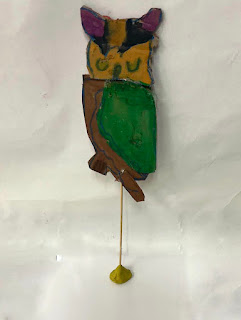
 Student Examples




Thursday, October 22, 2020
LAURENCE VALLIERES CARDBOARD ANIMALS
Laurence Vallieres Cardboard Animals

Learning Targets
I can...
- Create an original Cardboard Animal using sculpture techniques learned in class
- Use form (two dimensional, three dimensional), shape variation (geometric organic free form) and space (positive negative) inspired by Montreal Artist (1986-Present) Laurence Vallieres
- Use cardboard techniques (scoring, slots, stacking) and design principles (composition balance repetition) based on Contemporary Art
- Define Anthropomorphism (attribution of human characteristics to an animal or object)
Lesson One
Day One, Art Start
1. Taureau (Bull) (2017) Laurence Vallieres

2. Read Not A Box by Antoinette Portis

3. Discussion Questions "Can you believe this is made out of cardboard? What sketch, figurine, or nature inspires the artists work? What is anthropomorphism? What does the animal imagery symbolize or represent? What metaphors are shown throughout the artists work? When looking at this work, what captures the eye of the viewer? What do you think is happening in this composition? What action do you see? How does this action contribute to the feeling of the piece? What else do you see in this sculpture? How would you describe the expressions on the faces? Does this work look natural, representational, or is it stylized? How does this work make you feel? What techniques were used to create this piece? How is the artist telling us a story? How has the artist set the scene or developed these characters?"
Lesson Activities
1. Choose Three 12 X 12 Cardboard Sheets
2. Use three compositional elements (shape color texture) to represent a memory, place, or event from ones own history
3. Use line variation (wavy straight curved) as a design principle (balance composition repetition) within ones own Laurence Vallieres Cardboard Animals
Day Two, Art Start
1. Retrieve Laurence Vallieres Cardboard Animals for Assigned Table
2. Raccoon (2014) Laurence Vallieres

3. Discussion Questions "What was going on historically, economically, socially during this period? How does this work of art reflect the time period? What materials were on hand for this creation of this work? What does this tell us about the environment in which it was made? What do you think this work of art is all about? What is the artist interested in saying with this work? What purpose would this object serve for the society in which it was created? What odes this object reveal about the person who created it? What does this object tell us about the culture in which it was created? Why did the artist do it that way? what is the artist trying to convey?"
Lesson Activities
1. Use compass, protractor, and texture plates to add symmetrical shapes and expressive lines to cardboard houses
2. Use form (two dimensional three dimensional) to fill in the positive space (animal) of the cardboard animals
3. Use form (two dimensional three dimensional) to fill in the negative space (base) of the Laurence Vallieres Cardboard Animals
Day Three, Art Start
1. Retrieve Laurence Vallieres Cardboard Animals for Assigned Table
2. Set Up Studio Area (glue bottles, cardboard, push pins)
Lesson Activities
1. Use scissors to cut out two dimensional symmetrical shapes to create a three dimensional cardboard animals
2. Glue Down three dimensional symmetrical shapes to create a three dimensional cardboard animals
3. Add decorations (old art, newspaper, fabric scraps, colored paper, buttons, collage bits) to positive space of Laurence Vallieres Cardboard Animals
Artist Examples


Student Examples


Saturday, September 5, 2020
BEVERELY BUCHANAN CARDBOARD HOUSES
Beverly Buchanan Cardboard Houses

Learning Targets
I can...
- Create an original Beverely Buchanan Cardboard House using assemblage techniques learned in class
- Use form (two dimensional, three dimensional), shape variation (geometric, organic, free form), and space (positive negative) inspired by African American Artist (1940-2015) Beverly Buchanan
- Use sculpture techniques (assemblage, carving, casting) and design principles (balance, harmony, unity) based on American Art
- Define Architecture (the art or practice of designing and constructing buildings)
Lesson One
Day One, Art Start
1. Red Ladder (1995) Beverly Buchanan

2. Read "Beverly Buchanan: Shackworks A Sixteen Year Survey" by Eleanor Flomenhaft

3. Discussion Questions "How do artists work? How do artists and designers determine whether a particular direction in their work is effective? How do artists and designers learn from trial and error? What responsibilities come with the freedom to create? How do artists grow and become accomplished in art forms? What role does persistence play in revising, refining, and developing artwork? In what ways do artist take risks with their work? How do artist make and solve problems as they work on a piece of art? How do artists change their minds about their artwork as they continue working on it? How do artists talk and write about their artwork? How do artists talk and write about their experiences in making art?"
Lesson Activities
1. Choose Three 12 X 12 Cardboard Sheets
2. Use three compositional elements (shape, color, texture) to represent a memory, place, or event from ones own heritage
3. Use line variation (wavy, straight, curved) as a design principle (balance, movement, repetition) within ones Beverely Buchanan Cardboard House
Day Two, Art Start

Lesson Activities
1. Use compass, protractors and texture plates to add symmetrical shapes and expressive lines to cardboard houses
2. Use form (two dimensional three dimensional) to fill in the positive space (house) of the cardboard houses
3. Use form (two dimensional three dimensional) to fill in the negative space (base) of the Beverly Buchanan Cardboard Houses
Day Three, Art Start
1. Retrieve Beverely Buchanan Cardboard Houses for Assigned Tables
2. Set Up Studio Area (glue sticks, cardboard, push pins)
Lesson Activities
1. Use scissors to cut out two dimensional symmetrical shapes to create a three dimensional cardboard sculpture
2. Glue Down three dimensional symmetrical shapes to create a three dimensional cardboard house
3. Add decorations (old art, newspaper, fabric scraps, colored paper, buttons, collage bits) to positive space (house) of Beverely Buchanan Cardboard Sculptures
Artist Examples


 Student Examples


 Posts
Posts

