Wednesday, September 16, 2026
LOONEY TUNES GRID DRAWINGS
Looney Tunes Grid Drawings Learning Targets

I can...
- Create an original Looney Tunes Grid Drawings using drawing techniques learned in class
- Use color combinations (neutral, complementary, analogous), shape variation (geometric, organic, free form), and space (positive, negative) inspired by Looney Tunes (1930-Present) Warner Brothers
- Use grid method (proportion, scale, square, diagonal lines) and design principles (composition, proportion, balanced) based on American Animation
- Define Cartoon (a drawing, illustration, or animated film that uses nonrealistic, stylized, or exaggerated art to entertain, tell a joke, or offer political and social commentary)
Lesson One
Day One, Art Start
1. Daffy Duck (1937) Tex Avery and Bob Clampett

2. Read Learn To Draw Looney Tunes: Learn To Draw All Your Favorite Looney Tunes Characters by Walker Foster

3. Discussion Questions "Why do artists create artwork about cartoons and pop culture? How do artists master the basic principles when drawing favorite characters? Which specific character (Daffy Duck, Tweety, Sylvester) would you like to draw? Can you tell me the history of the characters and the men who created them? What do you know about the Warner Brothers Animation? How was the animation unit established and how did it go? Did you know Hugh Harman helped design animated characters like Bosko, Bugs Bunny, and Daffy Duck? Did you know Rudolf Ising was the lead animator for Looney Tunes? Did you know Rudolf Ising served in the army as part of the animation and film division? Did you know the first Looney Tunes series launched in the 1930s? Did you know Rudolf Ising became famous from his interviews with historian Mark Kausler? Did you know that Bosko was the first character to say "That's All Folks?"
Lesson Activities
1. Choose 12" X 15" Drawing Paper
2. Use pencil to add line types (horizontal, vertical, diagonal) to the subject matter (character, foreground, middle ground) of the Looney Tunes Grid Drawings
3. Use line types (horizontal, vertical, diagonal) to add details (hat, facial features, accessories) to the positive space (foreground, middle ground, character) of the Looney Tunes Grid Drawings
Day Two, Art Start
1. Retrieve Looney Tunes Grid Drawings for Assigned Tables
2. Tweetie Pie (1947) Bob Clampett

3. Discussion Questions "What colors do you see? What kinds of lines can you find? What kind of shapes can you find? What new title would you give this artwork? Why do you think the artist made the artwork this way? How would you tell someone about this artwork? What are some mathematical techniques you could incorporate into your own artwork? Does an artist need firsthand experience to represent it successfully? How might an artwork be interpreted differently at different moments in history? Do you think artists see the world differently than non artists? Is being an artist a stewardship? Do artists have a responsibility to share their artwork with the world? Can artists interact with cartoons as subject matter in different ways?"
Lesson Activities
1. Use drawing techniques (blending, smudging, smearing, shading) to add highlights (highlights, light source) to the Looney Tunes Grid Drawings
2. Use drawing techniques (blending, smudging, smearing, shading) to add shadows (reflective shadow, cast shadow, shadow) to the Looney Tunes Grid Drawings
3. Use neutral colors (black, grey, brown, white) to add contrast to the positive space (foreground, middle ground, characters) of the Looney Tunes Grid Drawings
Day Three, Art Start
1. Retrieve Looney Tunes Grid Drawings for Assigned Tables
2. Set Up Studio Area (oil pastels, pencils, erasers, grid paper)
Lesson Activities
1. Use drawing techniques (blending, smudging, smearing, shading) to add value (lightness, darkness, tints, shades) to the Looney Tunes Grid Drawings
2. Use drawing materials (kneaded erasers, conte crayons, pencil sharpeners) to blend in the positive space (foreground, middle ground, character) of the Looney Tunes Grid Drawings
3. Use drawing materials (kneaded erasers, conte crayons, pencil sharpeners) to blend in the negative space (background) of the Looney Tunes Grid Drawings
Artist Examples


 Student Examples


Tuesday, September 30, 2025
CARTOON SKELETONS
Cartoon Skeletons

Learning Targets
I can...
- Create an original Cartoon Skeleton using drawing techniques learned in class
- Use neutral colors (black white grey brown), value (lightness darkness highlights shadows) and space (positive negative) inspired by Contemporary Artist (1995-Present) Michael Paulus
- Use drawing techniques (proportional rules basic forms shading methods) and design principles (composition repetition proportion) based on Contemporary Art
- Define Cartoon (a motion picture using animation techniques to photograph a sequence of drawings rather than real people or objects)
Lesson One
Day One, Art Start
1. Salve Cattus Sine Oris (Hello Kitty) (2025) Michael Paulus

2. Read Bonaparte Falls Apart: A Funny Skeleton Book For Kids and Toddlers by Margery Cuyler

3. Discussion Questions "Have you ever thought of what kind of skeletons might be holding up that weird character? What is the difference between a real skeleton and the cartoon version? Why do artists alter anatomy for an artistic effect? What are the basic shapes and how do they connect to form a skeleton? How can we use measurement and proportion to make our skeleton look realistic? What kind of story can we tell through a skeleton's pose? What do we notice about the skull? Where are the eyes, nose, and mouth located? How do the ribs connect to the spine? What are the key bone landmarks to look for drawing this figure? What are some examples of artists who have explored the skeleton in their work? What did they express through this subject matter? What happens when we combine different drawing or painting media to create our skeletons? What affect can we achieve by contrasting different textures in our artwork? How does understanding the bone structures (skull, spine, rib cage) help us draw people and animals?"
Lesson Activities
1. Choose 12" X 15" Drawing Paper
2. Use pencil to add line types (horizontal vertical diagonal) of subject matter (skull, bones, outline) of the Cartoon Skeletons
3.Use line types (horizontal vertical diagonal) to add details (roses feathers fabric) to the negative space (background) of the Cartoon Skeletons
Day Two, Art Start
1. Retrieve Cartoon Skeleton for Assigned Tables
2. Callidus Canem (Snoopy) (2016) Michael Paulus

3. Discussion Questions "How is photography from inside your body different from a regular photograph? What colors do you see? What kinds of lines can you find? What kind of shapes can you find? What new title would you give this artwork? Why do you think the artist made the artist this way? How would you tell someone about this artwork? What are some photograph techniques you could incorporate into your own artwork? How was Michael Paulus inspired by other artists? Does an artist need firsthand experience to represent it successfully? How might an artwork be interpreted differently at different moments in history? Do you think artists see the world differently than nonwartists? Is being an artist a stewardship? Do artists have a responsibility to share their artwork with the world? Can artists interact with cartoons as subject matter in different ways?"
Lesson Activities
1. Use drawing techniques (blending, smudging, smearing, shading) to add value (highlights shadows contrast) to the Cartoon Skeletons
2. Look at images of photographs of different human bones (skull, teeth, femur, rubs) when adding details (highlights, shadows, contrast) to the Cartoon Skeletons
3. Use permanent markers to add contrast to the positive space (bones, foreground, middle ground) and negative space (background, shadow) of the Cartoon Skeletons
Day Three, Art Start
1. Retrieve Cartoon Skeletons for Assigned Tables
2. Set Up Studio Area (erasers, permanent markers, washable markers, felt tip pens)
Lesson Activities
1. Use drawing techniques (blending, smudging, smearing, shading) to add value (highlights, shadows, contrast) to the Cartoon Skeletons
2. Use drawing materials (kneaded erasers, conte crayons, pencil sharpeners) to blend in the negative space (background) of the Cartoon Skeletons
3. Use drawing materials (kneaded erasers conte crayons pencil sharpeners) to add finishing details (bones, foreground, middle ground) to the Cartoon Skeletons
Artist Examples


 Student Examples


Monday, August 26, 2024
GERGELY DUDAS SEARCH DRAWINGS
Gergely Dudas Search Drawings
Learning Targets

I can...
- Create an original Gergely Dudas Search Drawing using collage techniques learned in class
- Use shape variation (geometric, organic, free form), line types (horizontal, vertical, diagonal), and color combinations (analogous, secondary, primary) inspired by Hungarian Artist (2019-Present) Gergely Dudas
- Use drawing techniques (shading, blending, overlapping) and design principles (composition, repetition, movement) based on Seek And Find Cartoons
- Define Repetition (the use of two or more of the same or similar elements such as colors, shapes, or lines)
Lesson One
Day One, Art Start
1. Find BB-8 (2024) Gergely Dudas

2. Read Bear's Spooky Book Of Hidden Things (2018) Gregory Dudas

3. Discussion Questions "Did you ever play "I Spy with my Little Eye" game? What are your favorite games to play at home and in the classroom? What does "I Spy" mean? Where did "I Spy With My Eye" come from? Have you played I Spy games indoors or outdoors? Have you played the I Spy game with friends, family, or adults? How do you play "I Spy with my little eye?" What are the rules of this game? When you play I Spy, do you use yes or no questions to help find the answer? Does I Spy use number recognition or shape identification for young children? Why would visual perception be an important skill for learning to read? What are some of your interests? What do you notice in your surroundings?"
Lesson Activities
1. Use three geometric shapes (rectangle, oval, circle) to create a three dimensional silhouette of a fall animal (fox, moose, squirrel, deer) for the search compositions
2. Add details (eyes, nose, claws) to the three dimensional silhouettes of a fall animal (fox, moose, squirrel ,deer) for the search compositions
3. Outline the positive space (foreground, animals) with neutral colors (black, grey, white) for the Gergely Dudas Search Drawings
Day Two, Art Start
1. Retrieve Gergely Dudas Search Drawing for Assigned Tables
2. Sheep Among Goats (2024) Gregely Dudas

3. Discussion Questions "What do you notice is different with the shapes, colors, and arrangement within this artwork? What is the same and different about each picture? What colors are being used in this artwork? Which area of the artwork is emphasized by the artist? How would you describe this artwork to someone who has never seen it? How does the artist use rotation and translation to create a search composition? Do you think a circle or oval could fill the search composition? Do any spaces cover the space exactly? How can you explain the movement of one tile to another tile? Did everyone use the same number of shapes in their search compositions? Why might the number of shapes vary between students? How many different arrangements did you discover?"
Lesson Activities
1. Add finishing details (eyes, nose, claws) to the positive space (animal, foreground) of the search compositions
2. Use neutral colors (black, grey, white) to outline the positive space (animal, foreground) of the search compositions
3. Add embellishments (salt, glitter, metallic) for the negative space (background, negative space) of the Gergely Dudas Search Drawings
Day Three, Art Start
1. Retrieve Gergely Dudas Search Drawings for Assigned Tables
2. Set Up Studio Area (colored pencils, erasers, markers, sharpeners)
Lesson Activities
1. Add embellishments (salt, glitter, metallic) for the negative space (background, negative space) of search compositions
2. Add neutral colors (black, white, brown, grey) to the three dimensional silhouettes (animal, foreground) of the Gergely Dudas Search Drawings
3. Add value (lightness, darkness, highlights, shadows) to the positive space (animal, foreground) of the Gergely Dudas Search Drawings
Artist Examples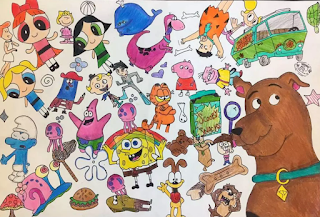


 Student Examples


Wednesday, September 2, 2020
LOUD MOUTH MONSTERS
Loud Mouth Monsters

Learning Targets
I can..
- Create an original Loud Mouth Monster using drawing techniques learned in class
- Use shape variation (geometric, organic, free form), form (two dimensional, three dimensional) and space inspired by American Artist (1982-Present) Greg Mike
- Use collage techniques (cutting out, combining, stamping) and design principles (composition, variation, proportion) based on Street Art
- Define Speech Bubbles (a graphic symbol used in comics to represent words or thoughts of a given character)
Lesson One
Day One, Art Start
1. Lands Music Festival (2015) Greg Mikes

2. Read Smile A While by Kyle Brooks

3. Discussion Questions "Where do you think the artists finds his inspiration? Do you recognize any of these cartoon characters? Do you notice how he combines realistic and cartoon styles together? What does your loud mouth have to say? What do they want to share with the world? How does this artwork make you feel? Do you remember being interested in art and drawing as a child? When and how did Greg Mike's career in art begin? What artists influenced him when he was growing up? Are there any cartoon characters that have influenced you growing up?"
Lesson Activities
1. Choose 12" by 12" Construction Paper
2. Add shape variation (geometric, organic, free form) to positive space (facial features) of monster collages
3. Add shape variation (geometric, organic, free form) to negative space (background) of Loud Mouth Monsters
Day Two, Art Start
1. Retrieve Loud Mouth Monsters for Assigned Table
2. Top Of Mountain (2020) Greg Mike

3. Discussion Questions "What is your first memory of art? What can you learn about his background from looking at his artwork? How would you describe his style of artwork? Who and what has had the biggest impact on your art? What is the best thing you have ever painted? What is contemporary art to you? How do you think the artists style has evolved? What do we know about the artist when looking at his work? What was your first reaction when looking at this artwork? What types of colors are in this artwork? Which area of the artwork is emphasized by the artist? Which area of the artwork is most important? How did this artist use space? How did this artist use balance? How did this artist use proportion? How does your eye move through the artwork?"
Lesson Activities
1. Use complementary colors (red green; blue orange; purple yellow) to fill in the positive space (facial features) of the monster collages
2. Use complementary colors (red green; blue orange; yellow purple) to fill in the negative space (background) of the monster collages
3. Add details (teeth, tongue, chipped tooth, mustache, eyelashes) to positive space (facial features) of Loud Mouth Monsters
Day Three, Art Start
1. Retrieve Loud Mouth Monsters for Assigned Tables
2. Set Up Studio Area (construction paper, scissors, glue sticks)
Lesson Activities
1. Add highlights (reflective light, light source) to fill in positive space (facial features) of monster collages
2. Add shadows (cast shadow, reflective shadow) to fill in the negative space (background) of the monster collages
3. Add details (bow tie, hair bow, horns, har) to positive space (facial features) of Loud Mouth Monsters
Artist Examples


Student Examples 


 Posts
Posts

