Wednesday, April 1, 2026
PATTY TALBERT NONOBJECTIVE COLOR WHEELS
Patty Talbert Nonobjective Colors Wheels Learning Targets

I can...
- Create an original Patty Talbert Nonobjective Color Wheels using drawing techniques learned in class
- Use line types (horizontal vertical diagonal), value (highlights shadows tints tones) and space (positive negative) inspired by African American Artist (1964-Present) Patty Talbert
- Use art element: color (achromatic analogous complementary cool/warm colors monochromatic polychromatic primary secondary tertiary) and design principles (repetition composition gradation) based on Public Art
- Define Color Wheel (a circular diagram that shows the relationship between colors arranged by the chromatic relationship)
Lesson One
Day One, Art Start
1. Sideways (2009) Patty Talbert

2. Read Optics: Or A Treatise Of The Reflections, Refractions, Inflections, and Colors Of Light by Sir Isaac Newton

3. Discussion Questions "How do these colors, patterns, and textures celebrate the heritage of the artist? How does this style of painting bring honor to the ancestors of the artist and continue to have a modern relevance for the viewer? What are some color harmonies that you encounter in daily life? What color theory does your personality agree with? Is color theory important in art? Can artists create interesting artwork without using color? What is the purpose of a color wheel? Why is a color wheel organized in a specific way? How does adding these bold black lines change the way colors look next to each other? How does this color look different to another color? Did you know the artist was a self-taught artist whose work is rooted in her heritage and personal expression?"
Lesson Activities
1. Choose 12" X 15" Drawing Paper
2. Draw three line types (horizontal vertical diagonal) for the positive space (foreground, middle ground) of the Patty Talbert Nonobjective Color Wheels
3. Outline three line types (horizontal vertical diagonal) for the positive space (foreground, middle ground) of the Patty Talbert Nonobjective Color Wheels
Day Two, Art Start
1. Retrieve Patty Talbert Nonobjective Color Wheels for Assigned Tables
2. Reflections 1 (2001) Patty Talbert

3. Discussion Questions "What is abstract art? What do you think abstract means? Can you recognize anything in this painting? What emotion is being conveyed in this painting? What does this artwork remind you of? What do you think this work of art is made of? How would you describe the pattern in this artwork? What does art mean to you? What ideas, concerns, or objectives have motivated your own work? How would you describe our artistic style? What artistic movements or artists have influenced you? What sets you apart from other artists? What does this painting reveal about the personality of the artist? What events were happening in the world at the time when this artwork was created? What colors are prominent throughout the piece? What was the artist known for?"
Lesson Activities
1. Use drawing techniques (contour outline continuous) to add basic shapes (geometric organic free form) to the positive space (foreground, middle ground) of the Patty Talbert Nonobjective Color Wheels
2. Use drawing techniques (contour outline continuous) to add basic shapes (geometric organic free form) to the negative space (background) of the Patty Talbert Nonobjective Color Wheels
3. Use drawing techniques (contour outline continuous) to add details (patterns, repetition, designs) to the Patty Talbert Nonobjective Color Wheels
Day Three, Art Start
1. Retrieve Patty Talbert Nonobjective Color Wheels for Assigned Tables
2. Set Up Studio Area (pencils, erasers, colored chalk, chalk)
Lesson Activities
1. Use color combinations (intermediate, analogous, complementary) to fill in the positive space (foreground, middle ground) of the Patty Talbert Nonobjective Color Wheels
2. Use color combinations (intermediate, analogous, complementary) to fill in the negative space (background) of the Patty Talbert Nonobjective Color Wheels
3. Add design details (geometric shapes, border, patterns) to the positive space (foreground, middle ground) of the Patty Nonobjective Color Wheels
Artist Examples


 Student Examples


Tuesday, September 5, 2023
FRIDA KAHLO STILL LIFE
Frida Kahlo Still Life
.jpg)
Learning Targets
I can...
- Create an original Frida Kahlo Still Life using drawing techniques learned in class
- Use color combinations (analogous, complementary, secondary), shape variation (geometric, organic, free form), and space (positive, negative) inspired by Mexican Painter (1907-1954) Frida Kahlo
- Use observational drawing techniques (perspective, proportion, grid measurement) and design principles (composition, alignment, movement) based on Symbolism
- Define Still Life (a work of art that shows inanimate objects from the natural or man-made world)
Lesson One
Day One, Art Start
1. Still Life With Parrot (1951) Frida Kahlo

2. Read Understanding Frida in Context Through Her Still Life: Pitahayas by MMOCA

3. Discussion Questions "How does still life represent the artist's unique identity? What elements in each piece show realism, surrealism, and symbolism? What is unique about Frida Kahlo? What does she tell us about herself in this artwork? What gives hints about her experiences and Mexican Identity in these paintings? What stories do the background of her image tell? What is unique about you that you would like to capture in a still life? Would you consider Still Life: Pitahayas a self portrait? Why or why not? What do objects depicted in this painting tell you about Kahlo's life? What fruits are native to Michigan or the Midwestern United States? What do the volcanic rock and cactus depicted in the painting tell you about the geology and climate of central Mexico? How do they compare to the landforms and vegetation of Michigan? Why do you think Kahlo included a skeleton in this painting? What would you include in your still life that reflects who you are, where you are, and something about your life?"
Lesson Activities
1. Choose 12" X 15" Drawing Paper
2. Add three dimensional shapes (cylinder, pyramid, cone) to the composition of arranged fruit (watermelon, strawberries, oranges) for the personal identity still life
3. Add horizon line in the background (table, fabric, wallpaper) to separate the subject matter from the wallpaper of the Frida Kahlo Still Life
Day Two, Art Start
1. Retrieve Frida Kahlo Still Life for Assigned Tables
2. Viva La Vida, Watermelons (1954) Frida Kahlo

3. Discussion Questions "What was Frida Kahlo's full birth name? Why did Frida Kahlo change hr date or birth on her birth certificate? Why was Kahlo pretending to be three years younger? Why was Frida Kahlo's nationality? Who or what is depicted in most of Frida's paintings? In what year did she joint Mexican Communist Party and fall in love with Diego Rivera? What was the first solo exhibition of Frida Kahlo's work held? When did Frida Kahlo begin her career as an artist? What was Frida and Diego's marriage often called? Who was Frida Kahlo? What are some of Frida Kahlo's most famous paintings? Do you have a favorite artist? What will you include in your artwork that represents what matters to you?"
Lesson Activities
1. Use color combinations (analogous, secondary, complementary) to fill in the positive space (fruit, inanimate objects, flag) of the personal identity still life
2. Use color combinations (analogous, secondary, complementary) to fill in the negative space (background) of the personal identity still life
3. Use painting tools (brayer, palette, paint brush) to add patterns (floral, swirls, dots) to the negative space (background) of the Frida Kahlo Still Life
Day Three, Art Start
1. Retrieve Frida Kahlo Still Life for Assigned Tables
2. Set Up Studio Area (tempera paint, water bucket, paint brushes)
Lesson Activities
1. Add highlights (reflective light, light source) to subject matter (watermelon, oranges, strawberries) of the personal identity still life
2. Add shadows (cast shadow, reflective shadow) to the negative space (background) of the personal identity still life
3. Outline details (pattern, floral, inanimate objects, fruits, vegetables) in the positive space (foreground, middle ground) of the Frida Kahlo Still Life
Artist Examples


.jpg)


 Student Examples


.jpg)


Wednesday, October 5, 2022
BISA BUTLER SELF PORTRAITS
Bisa Butler Self Portraits

Learning Targets
I can...
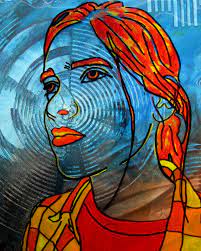
- Create an original Bisa Butler Self Portraits using printmaking techniques learned in class
- Use line variation (continuous, contour, outline), shape types (geometric, organic, free form), and texture (actual, implied, visual) inspired by American Fiber Artist (1973-Present) Bisa Butler
- Use drawing techniques (cross hatching, stippling, scribbling) and design principles (balance, portion, harmony) based on Fiber Art
- Define Portrait (a painting or drawing of the face, head, and shoulders)
Lesson One
Day One, Art Start
1. The Tea (2017) Bisa Butler

2. Read "Bisa Butler: Portraits" by Erica Warren

3. Discussion Questions "Do you think this is a self-portrait? How does this portrait make you feel? Are you interested in the portrait? Do you like the way the artist has arranged the picture? Do you like the way the artist has shown details? Can you predict if a male or female artist created this portrait? What is a portrait? Why do artist paint portraits? Who is the person in the portrait? How old is the person? What does the picture tell you about the time that the subject was made? How do you think the artist felt about the person he or she painted? How do you think the person in the picture is feeling? What is the mood of the person in the picture? How can you tell?"
Lesson Activities
1. Choose 12" X 15" Drawing Paper
2. Use graphite pencil to draw line types (contour, outline, continuous) of facial proportions (head, face shoulder) of self portrait
3. Use graphite pencil to add facial features (eyes, nose, mouth, eyebrows) to the positive space (portrait) of the Bisa Butler Self Portraits
Day Two, Art Start
1. Retrieve Bisa Butler Self Portraits for Assigned Tables
2. The Princess (2017) Bisa Butler

3. Discussion Questions "How has the artist arranged the portrait? Do you think the person posted for this portrait? Where is the person looking (at the viewing, away, at something else)? If there is more than one person in the picture, are they touching? What could this mean? What does the background and the objects in the background of the picture tell us? How much space has the artist left around the person? How is the space being used? What view of the person is pictured? Is the portrait realistic or is the portrait abstract? What shapes can you see in this portrait? Are the lines in the portrait straight or curved? How often does the artist repeat certain colors or shapes within the portrait?"
Lesson Activities
1. Add adornments (piercings, tattoos, hairstyles) to the positive space (portrait) of the self portrait
2. Add costumes (jewelry, clothing, make up) to the positive space (portrait) of the self portraits
3. Use black sharpie marker to outline the face features (eyes, nose, mouth) and facial proportions (head, face, shoulder) of the Bisa Butler Self Portraits
Day Three, Art Start
1. Retrieve Bisa Butler Self Portrait for Assigned Table
2. Set Up Studio Area (acetate, sharpie markers, pens)
Lesson Activities
1. Use primary colors (red yellow blue) to fill in the positive space (clothing, jewelry, facial features) of the self portrait
2. Use primary colors (red blue yellow) to fill in the negative space (background) of the self portrait
3. Use value (lightness, darkness) to add shadows (reflective shadow, cast shadow) and highlights (reflective light, light source) to the Bisa Butler Self Portraits
Artist Examples


 Student Examples



Tuesday, August 2, 2022
MARK ROTHKO COLOR FIELDS
Mark Rothko Color Fields

Learning Targets
I can...
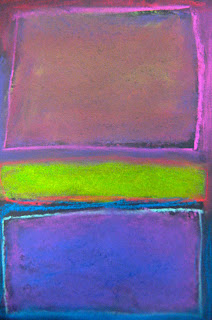
- Create an original Mark Rothko Color Fields using drawing techniques learned in class
- Use color combinations (analogous, complementary, monochromatic), shape variation (geometric, organic), and line types (horizontal, vertical, diagonal) inspired by American Painter (1903-1970) Mark Rothko
- Use value (lightness, darkness) and design principles (gradation, movement, composition) based on Abstract Expressionism
- Define Monochromatic (using only one color)
Lesson One
Day One, Art Start


Lesson Activities
Day Two, Art Start

Lesson Activities
Day Three, Art Start
Lesson Activities
Artist Examples



Student Examples 


Friday, December 17, 2021
PASTEL PEACOCKS
Pastel Peacocks

Learning Targets
I can...
- Create an original Pastel Peacock using drawing techniques learned in class
- Use metallic colors (bronze, silver, gold), line variation (horizontal, vertical, diagonal), and space(positive, negative) inspired by English Painter (1660-1716) Marmaduke Cradock
- Use types of texture (actual, implied, tactile) and design principles (composition, proportion, variation) based on London Art
- Define Texture (the feel or appearance of a surface)
Lesson One
Day One, Art Start
1. A Peacock and Other Birds In A Landscape (1700) Marmaduck Cradock

2. Read The Spooky Tail of Prewitt Peacock by Bill Peet

3. Discussion Questions "What are female peacocks called? Why do we say that peacocks and peahens are omnivores? What is another name for a group of peacocks and peahens? What is special about peacocks? What countries are native to peacocks? Did the artist fill the composition? Did the artist take the time and effort to make the color vibrant? Why are peacocks important to the Indian culture? Did you know that there is even a color called peacock blue? What do peacocks represent in different culture? Why is this bird colorful?"
Lesson Activities
1. Choose 12" X 15" Drawing Paper
2. Draw foreground (peacock), middle ground (feathers), and background (wallpaper) of the peacock drawings
3. Use drawing techniques (blending, smudging, smearing) to add layers to subject matter (bird) of Pastel Peacocks
Day Two, Art Start
1. Retrieve Pastel Peacock for Assigned Table
2. A Peacock and Peahen With Other Ornamental Fowl by a Lake (1660) Marmaduck Cradock

3. Discussion Questions "What factors influenced the artist as a child that impacted his art career? What are some characteristics from this artwork that sets it apart from other artists work? What is the symbolism found within his work? What are some indicators that provide he is an important artist? What are some different types of art produced at different stages of his life? What makes you think this artist is a great artist? How did the artist become interested in peacocks? Does his work change your view of the world?"
Lesson Activities
1. Add thin layers of pastel to the foreground (bird), middle ground (feathers), and background (wallpaper) of the peacock drawings
2. Use drawing techniques (blending, smudging, smearing) to add details (beak, eyes, eyelashes) to the peacock drawings
3. Use drawing techniques (blending, smudging, smearing) to add texture (implied actual visual) to the Pastel Peacocks
Day Three, Art Start
1. Retrieve Pastel Peacock for Assigned Table
2. Set Up Studio Area (paint brushes, watercolor, felt tip pen)
Lesson Activities
1. Use iridescent colors (green blue purple) to fill in the positive space (peacock) of the peacock drawings
2. Use iridescent colors (green blue purple) to fill in the negative space (background) of the peacock drawings
3. Use tint (white) and shade (black) to add the illusion of depth within the Pastel Peacocks
Artist Examples
 Student Examples


 Posts
Posts

