Tuesday, October 4, 2022
YELLENA JAMES COMPOSITIONS
Yellena James Compositions

Learning Targets
I can...
- Create an original Yellena James Composition using drawing techniques learned in class
- Use shape variation (geometric, organic, free form), line types (horizontal, vertical, diagonal), and pattern (swirls, dots, waves) inspired by Contemporary Artist (1977-Present) Yellena James
- Use painting methods (luminosity, opaque, transparent) and design principles (composition, gradation, repetition) based on Contemporary Art
- Define Composition (all elements working together to produce a work of art)
Lesson One
Day One, Art Start
1. Vitals (2022) Yellena James

2. Read Star, Branch, Spiral, Fan: Learn To Draw From Nature's Perfect Design Structures by Yellena James

3. Discussion Questions "What sort of edges do you see in this piece? Do you see anything repeating within this painting? What kind of balance do you see in this piece? Would you say this work is symmetrical or asymmetrical? Is the artwork the same on both sides? Is the paint blending together? What kind of edge is that? What rhythm and motion do you see within this painting? Where do you see these colors in the world? Where do you see form in the world? What lines can you see in this painting? How do we see this artwork in our daily lives?"
Lesson Activities
1. Choose 12" X 15" Painting Paper
2. Draw three line types (horizontal, vertical, diagonal) for the positive space (foreground) of the abstract compositions
3. Outline the three line types (horizontal, vertical, diagonal) with black oil pastels for the positive space (foreground) of the Yellena James Compositions
Day Two, Art Start
1. Retrieve Yellena James Compositions for Assigned Table
2. Thrivee (2022) Yellena James

3. Discussion Questions "What is abstract art? What do you think abstract means? Can you recognize anything in this painting? Which work is abstract? What makes these paintings alike? Is art the Ida or is art the final product? What do you see? What does this work of art remind you of? What do you think this work of art is made of? Where would you display this work of art? Does this work follow any mathematical principles? What types of math tools- geometry, permutation, etc.- do you think were used? Are both of these artworks three dimensional solids? How would you describe the pattern? How many faces does it have? What is the space of each face?"
Lesson Activities
1. Use drawing techniques (contour, outline, continuous) to add basic shapes (geometric, organic, free form) to the positive space (foreground) of the abstract compositions
2. Use drawing techniques (contour, outline, continuous) to add basic shapes (geometric, organic, free forms) to the negative space (background) of the abstract compositions
3. Use drawing techniques (contour, outline, continuous) to add details (pattern, repetition, texture) to the Yellena James Compositions
Day Three, Art Start
1. Retrieve Yellena James Compositions for Assigned Tables
2. Set Up Studio Area (paint brushes, tempera paint, water buckets)
Lesson Activities
1. Use complementary colors (red green; blue orange; purple, yellow) to fill in the positive shape (foreground) of the abstract compositions
2. Use complementary colors (red green; blue orange; purple, yellow) to fill in the negative space (background) of the abstract compositions
3. Add design details (geometric shapes, decorative borders, patterns) to the positive space (foreground) of the Yellena James Compositions
Artist Examples


 Student Examples


Thursday, September 22, 2022
IRANIAN TEAPOTS
Iranian Teapots

Learning Targets
I can...
- Create an original Iranian Teapot using collage techniques learned in class
- Use line types (horizontal, vertical, diagonal), shape variation (geometric, organic, free form), and texture (metal, fabric, paper) inspired by the Persian Empire
- Use printmaking techniques (embossing, stamping, relief) and design principles (repetition, emphasis, composition) based on 18th Century Art
- Define Embossed (a raised pattern on the surface of metal, leather, textiles, paper, or other substances)
Lesson One
Day One, Art Start
1. Vintage Middle East Persian Copper Hand Engraved Water Pitcher Ewer Teapot

2. Read Teatime Around The World by Denyse Waissbluth & Chelsea O'Bryne

3. Discussion Questions "Why is color important in art? How does color help create a mood in a work of art? Who do you think this artwork was created for? Why do you say that? How do you think this artwork was made? How can you connect this artwork to your own life? Was this intended to be a work of art or not? Why do you think that? How does that impact your understanding of the artwork? What are the values and beliefs of the culture in which this artwork was made?"
Lesson Activities
1. Choose 12" X 15" Drawing Paper
2. Use pencil to draw the basic shapes (oval, cylinder, circle) of one of the three sized (small, medium, large) teapot drawings
3. Use a pencil to draw the basic shapes (oval, cylinder, circle) of parts (handles, lid, spout) of the Iranian Teapots
Day Two, Art Start
1. Retrieve Iranian Teapot for Assigned Table
2. Vintage Copper Turkish Teapot Tea Kettle Pot for Stove Top Decorative White Fancy Hammered Persian Moroccan Glasses

3. Discussion Questions "What does this artwork teach us about the past? What was happening in history when this artwork was made? How does that change your understanding of the artwork? How might your interpretation of this artwork be different from someone in another culture? What is beautiful about this artwork? Who do you know that would really like this artwork? Why would they like it? How might you feel differently about the world after looking at this artwork? How do you personally relate to or connect with this artwork? What symbols do you notice in this artwork?"
Lesson Activities
1. Use metallic colors (copper, gold, silver) to outline the positive space (teapot) and details (spout, handle, lid) of the teapot drawings
2. Fill in the positive space (teapots) with neutral colors (black, white, grey) for the teapot drawings
3. Fill in the negative space (background) with complementary colors (red, green; blue, orange; yellow, purple) for the Iranian Teapots
Day Three, Art Start
1. Retrieve Iranian Teapot for Assigned Table
2. Set Up Studio Area (glue sticks, cotton balls, scissors)
Lesson Activities
1. Use permanent marker to fill in the positive space (teapots) with patterns (stripes, zig zags, polka dots0 of the teapot drawings
2. Use permanent marker to fill in the negative space (background) with patterns (stripes, zig zags, polka dots) of the teapot drawings
3. Add highlights (reflective light, light source) and shadows (cast shadow, reflective shadow) for the Iranian Teapots
Artist Examples


 Student Examples


Friday, July 16, 2021
MIXED MEDIA GERMAN PRETZELS
Mixed Media German Pretzels

Learning Targets
I can...
Create an original Mixed Media German Pretzel using weaving techniques learned in class
Use complementary colors (green red; blue orange; yellow purple), line types (contour line, curved line, arched line), and value (lightness, darkness) inspired by England Illustrator (2013-Present) Lorin Cinar
Use color techniques (hue, tint, shade) and design principles (composition, movement, repetition) based on Contemporary Art
Define Loom (device used to weave cloth and tapestry)
Lesson One
Day One, Art Start
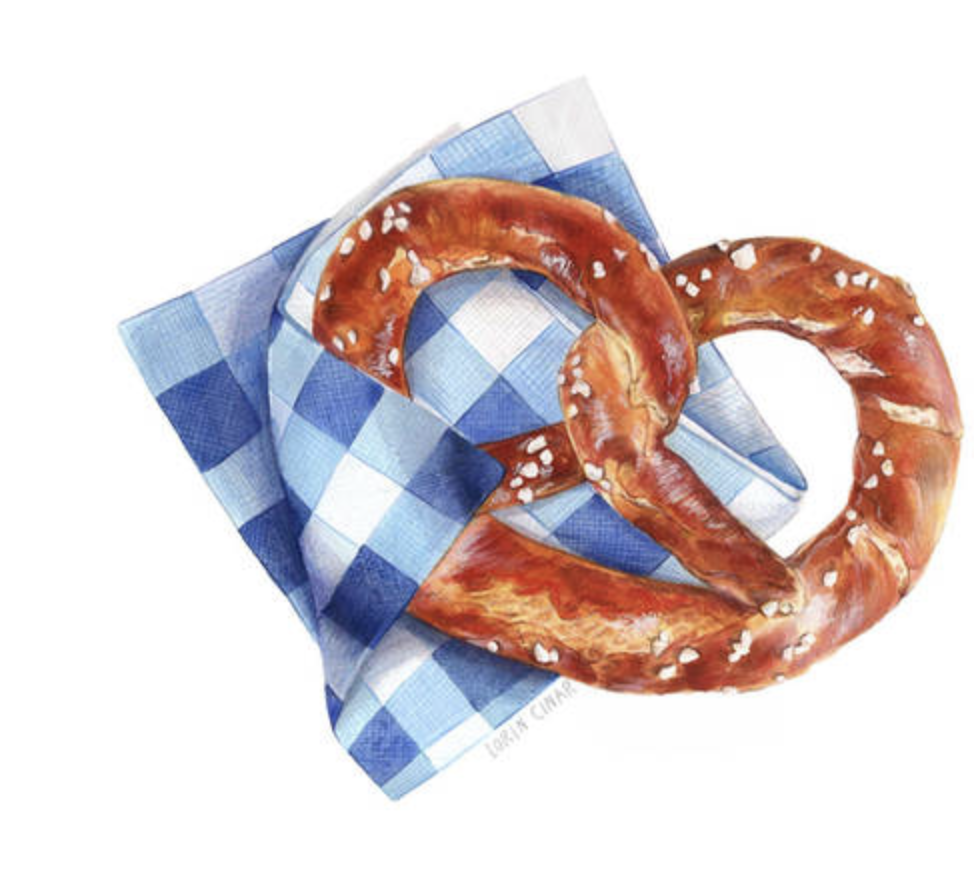
1. Pretzel Illustration (2013) Lorin Cinar
2. Read Pretzels by the Dozen: Truth and Inspiration with a Heart-Shaped Twist by Angela Hunt

3. Discussion Questions "Would you like to eat a pretzel bigger than your head? When did pretzels first become popular? What types of pretzels can be found in Germany? How did the artist use brown tints to create value on their pretzels? How did the artist use striped paper to weave a paper tablecloth background? Where is the pretzel believed to have originated and by whom? When is National Pretzel Day in the United States? In the United States, which state makes majority of pretzels? What was the size of the world's largest pretzel? What spicy condiment is often topped with these yummy treats? What are pretzels without salt called?"
Lesson Activities
1. Choose 12" X 15" Painting Paper
2. Draw three thumbnail sketches of candy corn using observational drawing skills (outline, contour, continuous) for pretzel paintings
3. Add details (shadows, reflective light) to negative space (background) of Mixed Media German Pretzels
Day Two, Art Start
1. Retrieve Mixed Media German Pretzels for Assigned Table
2. Pretzel Illustration (2013) Lorin Cinar

3. Discussion Questions "If this artwork could talk, what would it say? If you could ask this artwork a question, what would you ask it? How might your interpretation of this artwork be different form someone in another culture? What does this artwork teach us about the past? Was this intended to be a work of art or not? Why do you think that? How does that impact your understanding of the artwork? If you could change this artwork, how would you change it? Who do you know that would really like this artwork? Why would they like it? What do you think you should be learning about when looking at this artwork? How can you connect this artwork to your own life? Do you personally connect or relate to this picture? Why does this artwork remind you of? What would it feel like to be in this artwork?"
Lesson Activities
1. Use drawing techniques (contour, outline, continuous) to add basic shapes (cone, triangle, rectangle) to pretzel paintings
2. Use design principles (composition, repetition, gradation) to fill in the positive space (pretzels) of the pretzel paintings
3. Use drawing techniques (composition, repetition, gradation) to add details (shadows, reflective light, table) to Mixed Media German Pretzels
Day Three, Art Start
1. Retrieve Mixed Media German Pretzels for Assigned Table
2. Set Up Studio Area (oil pastels, construction paper, glue sticks)
Lesson Activities
1. Use complementary colors (red green; blue orange; purple yellow) to fill in the positive space (pretzels) of the pretzel paintings
2. Use complementary colors (red green; blue orange; yellow purple) to fill in the negative space (background) of the pretzel paintings
3. Add design details (shadows, reflective light, table) to the negative space (background) of the Mixed Media German Pretzels
Artist Examples
 Student Examples


Monday, July 12, 2021
YAYOI KUSAMA MUSHROOMS
Yayoi Kusama Mushrooms

Learning Targets
I can...
- Create an original Yayoi Kusama Mushrooms using drawing techniques learned in class
- Use biomorphic shapes (irregular, round, life form), line variations (horizontal, vertical, diagonal), and complementary colors (red green; blue orange; yellow purple) inspired by Japanese Contemporary Artist (1929-Present) Yayoi Kusama
- Use collage techniques (overlapping, layering, cropping) and design principles (composition, balance, repetition) based on Contemporary Art
- Define Infinity Nets (a painting composed of tiny dots and marks)
Lesson One
Day One, Art Start
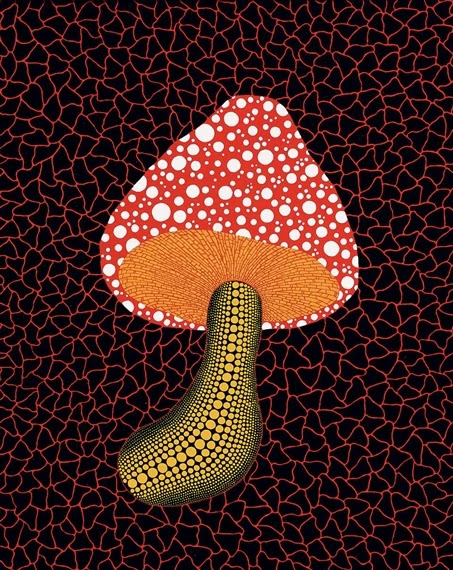
1. Mushrooms (1995) Yayoi Kusama

2. Read Yayoi Kusama From Here To Infinity by Sarah Suzuki

3. Discussion Questions "Who is Yayoi Kusama? Why does she use dots? How did she become an artist? When did she start making art? What is she inspired by? What happens when two colored dots overlap? Does it create a new color? What is Nihonga Painting? What is the psychological or spiritual significance of dots? What is the biggest misconception about art? How old was the artist when she created her first dot picture? Are the dots carefully placed or random? Do the polka dots go in a line? What are the size are the polka dots?"
Lesson Activities
1. Use drawing techniques (layering overlapping cropping) to make a composition for the Yayoi Kusama Mushrooms
2. Use drawing techniques (layering overlapping cropping) to add the parts (stems, tops) for the mushrooms of the mushroom collages
3. Add design details (polka dots, hieroglyphs, biomorphic shapes) to the positive space (mushroom) of the Yayoi Kusama Mushrooms
Day Two, Art Start
1. Retrieve Yayoi Kusama Mushrooms For Assigned Table
2. Mushrooms (2005) Yayoi Kusama

3. Discussion Questions "Why are mushrooms so colorful? What are some differences between mushrooms? What types of shapes can you use to break up your drawing? What colors are mushrooms? What is the meaning behind a mushroom? What types of mushrooms are there? How many kinds of mushrooms are there? What is your favorite type of mushroom? Do you know any interesting facts about mushrooms? What is the strangest mushroom you have seen? What kinds of mushrooms are dangerous? Why are mushrooms so large or small?"
Lesson Activities
1. Use value (reflective, highlights, shadows) to add contrast to positive space (mushrooms) of Yayoi Kusama Mushrooms
2. Use value (cast shadow, reflective light, highlights) to add contrast to negative space (background) of Yayoi Kusama Mushrooms
3. Use implied texture to add details (polka dots, hieroglyphs, biomorphic shapes) to positive space (mushrooms) of Yayoi Kusama Mushrooms
Day Three, Art Start
1. Retrieve Yayoi Kusama Mushrooms for Assigned Table
2. Set Up Studio Area (scissors, glue sticks, pencils)
Lesson Activities
1. Use complementary colors (red green; blue orange; yellow purple) to fill in the positive space (mushrooms) of Yayoi Kusama Mushrooms
2. Use complementary colors (red green; blue orange; yellow purple) to fill in the negative space (mushrooms of Yayoi Kusama Mushrooms
3. Use metallic colors (gold silver bronze) to outline the line types (horizontal, vertical, diagonal) of the positive space (mushrooms) of the Yayoi Kusama Mushrooms
Artist Examples


 Student Examples




Tuesday, March 10, 2020
WINSLOW HOMER LIGHTHOUSE DRAWINGS
Winslow Homer Lighthouse Drawings

Learning Targets
I can...- Create an original Winslow Homer Lighthouse Drawing using drawing techniques learned in class
- Use complimentary colors (red, green; blue, orange; yellow, purple), shape variation (geometric, organic), and space (positive, negative) inspired by American Illustrator (1836-1910) Winslow Homer
- Use drawing techniques (blending, smearing, smudging) and design principles (movement, repetition, proportion) based on Realism
- Define Mood (atmosphere, state of mind, or feelings generated from an image)
Lesson One
Day One, Art Start
1. Lighthouse Hill (1927) Edward Hopper

Lesson Activities
1. Use observational drawing techniques (composition, light source, reflective light) to draw the basic shapes (tower, main building, base) of lighthouse drawings2. Add basic shapes (triangle, circle, rectangle) to add windows, doorways, and balconies to lighthouse drawings
3. Add decorative details (onion dome, tower, base columns) to Winslow Homer Lighthouse Drawings
Day Two, Art Start
1. Retrieve Winslow Homer Lighthouse Drawing for Assigned Table2. Lighthouse Village (Cape Elizabeth, Maine) (1929) Edward Hopper

Lesson Activities
1. Use complimentary colors (red, green; blue, orange; purple, yellow) to fill in the positive space (lighthouse) of the lighthouse drawings2. Use complimentary colors (red, green; blue, orange; purple, yellow) to fill in the negative space (background) of the lighthouse drawings
3. Add intricate embellishments to the decorative details (onion dome, tower, base column) of ones Winslow Homer Lighthouse Drawings
Day Three, Art Start
1. Retrieve Winslow Homer Lighthouse Drawing for Assigned Table2. Set Up Studio Area (colored pencils, fine tip pens, sharpeners)
Lesson Activities
1. Add highlights (light source, reflective light) to positive space (lighthouse) of the lighthouse drawings2. Add shadows (cast shadow, shadow) to negative space (background) of the lighthouse drawings
3. Add high contrast (shaded areas) and light/medium contrast (light areas) within the Winslow Homer Lighthouse Drawings
Artist Examples


 Student Examples


 Posts
Posts

