Friday, October 21, 2022
WINTER CITYSCAPES
Winter Cityscapes

Learning Targets
I can...
- Create an original Winter Cityscape using collage techniques learned in class
- Use line types (horizontal, vertical, diagonal), shape variation (geometric, organic, free form), and value (lightness, darkness, tints, shades) inspired by Impressionist Painter (1839-1899) Alfred Sisley
- Use cityscape elements (horizon line, foreground, middle ground, background) and designs principles (composition, movement, proportion) based on Impressionism
- Define Cityscape (the visual appearance of an urban area)
Lesson One
Day One, Art Start
1. Snow On The Road, Louveciennes (Chemin De La Machine) (1874) Alfred Sisley

2. Read A Winter Walk In The City by Cathy Goldberg Fishman

3. Discussion Questions "What strikes you most about this landscape? What mood does it evoke? What is the main idea of this painting? What is the focal point? Where is the highest contrast and sharpest edge? Is there a dominant color temperature in the landscape? What are the dominant atmospheric effects? What are the elements in the landscape? Where is the lightest and darkest part of the painting? What do you find inspiring about winter?"
Lesson Activities
1. Use pencil to draw basic shapes (geometric, organic, free form) of the positive space (buildings) of the winter cityscapes
2. Use line types (expressive, directional, contour) to add details (windows, doors, decorations) to the winter cityscapes
3. Use line types (expressive, directional, contour) to add details (clouds formations, raised highways, snowflakes) to the negative space (background) of the Winter Cityscapes
Day Two, Art Start
1. Retrieve Winter Cityscapes for Assigned Table
2. Garden In Louveciennes In The Snow (1874) Alfred Sisley

3. Discussion Questions "Would you like living in a city? What are some advantages to of living in a city What are some disadvantages to living in a city? What is your favorite city to visit? What part of this city do you like the best? What do you ink could be done to improve living conditions in the cities? What are some differences between living int he city and living in the country? If you had grown up in a different city how would your life have been different? What monuments of your city do you consider the most impressive? How would you describe the architecture in your city? what would you do if you were in charge of the city? How would you improve it? What changes would you make? Would you enjoy designing a new city?"
Lesson Activities
1. Use color combinations (analogous, secondary, intermediate) to fill in the positive space (buildings) of the winter cityscapes
2. Use color combinations (analogous, secondary, intermediate) to fill in the negative space (background) of the winter cityscapes
3. Use line types (expressive, directional, contour) to fill in the positive space (building) with designs (features, windows, doors, decorations) of the Winter Cityscapes
Day Three, Art Start
1. Retrieve Winter Cityscapes for Assigned Table
2. Set Up Studio Area (water bucket, paint brushes, oil pastels)
Lesson Activities
1. Add highlights (light source, reflective light) to the positive space (building) of the winter cityscapes
2. Add shadows (cast shadow, reflective shadow) to the negative space (background) of the winter cityscapes
3. Use stop motion program (iMotion, FlipaClip, Stop Motion) to add an animation to the Winter Cityscapes
Artist Examples


 Student Examples


Tuesday, January 4, 2022
CRAB PRINTS
Crab Prints Learning Targets
I can...
- Create an original Crab Print using drawing techniques learned in class
- Use shape variation (geometric, organic, free form), line types (horizontal, vertical, diagonal), and space (positive, negative) inspired by Post-Impressionist Painter (1853-1890) Vincent Van Gogh
- Use painting techniques (double loaded brush, absorption, palette) and design principles (balance, composition, gradation) based on Post Impressionism
- Define Still Life (placement or arrangement of visual elements in a work of art)
Lesson One
Day One, Art Start
1. Two Crabs (1889) Vincent Van Gogh

2. Read Crab Cake: Turning The Tide Together by Andrea Tsurumi

3. Discussion Questions "Why is Van Gogh considered a great artist? Why is Vancent Van Gogh's starry Night considered beautiful? WasVincent Van Gogh in complete control of his painting? Which piece of Vincent Van Gogh's artwork speaks out more to you? Which artworks did Vincent van Gogh sell in his lifetime? In what city did Van Gogh attend the Academy of Fine Art? Which artist is Van Gogh associated with? Which of these paintings shows the swirl technique Van Gogh used? What is this painting called?"
Lesson Activities
1. Choose 12" by 15" Drawing Paper
2. Add three dimensional shapes (cylinder, pyramid, sphere) to the composition of arranged objects (fruits, dishes, fabric) of the still life works
3. Add horizon line to to the background (table, fruit, dishes) to separate the subject matter (crab) from the wallpaper of the Crab Prints
Day Two, Art Start
1. Retrieve Crab Prints for Assigned Table
2. A Crab On Its Back (1887) Vincent Van Gogh

3. Discussion Questions "How have you used formal elements such as line, tone, color, and shape? What materials did you use and why? Did they work successfully? What meaning, theme, or message did you want to convey? Were you successful? Are you happy with your final piece? Are any elements or qualities you like in particular? Does your final work the way you thought it would initially? How effective is it? Is there anything you would change?"
Lesson Activities
1. Use earth tones (yellow brown green) to fill in the positive space (crab) of the still life works
2. Use earth tones (yellow brown green) to fill in the negative space (background) of the still life works
3. Use painting tools (brayer, palette knife, paint brush) to add patterns (floral, silk, wood) to the Crab Prints
Day Three, Art Start
1. Retrieve Crab Prints for Assigned Table
2. Set Up Studio Area (tempera paint, water bucket, paint brushes)
Lesson Activities
1. Add highlights (reflective light, light source) to the subject matter (fruit bowl, glassware, crab) of the still life works
2. Add shadows (cast shadow, shadow) to the negative space (background) of the still life works
3. Outline details (pattern, floral, objects) of the negative space (background) and middle ground (fabric, table) of the Crab Prints
Artist Examples


 Student Examples
Wednesday, December 16, 2020
CHAMELEON COLLAGES
Chameleon Collages

Learning Targets
I can...
- Create an original Chameleon Collage using drawing techniques learned in class
- Use neon colors (pink blue orange yellow), space (positive negative) and value (lightness darkness) inspired by American Artist (1993-Present) Nick Gustafson
- Use collage techniques (overlapping laying cropping) and design principles (composition proportion repetition) based on Contemporary Art
- Define Expressive (conveying a thought or feeling in an image)
Lesson One
Day One, Art Start
1. Rainbow Chameleon (2014) Nick Gustafson

2. Read A Color Of His Own by Leo Leoni

3. Discussion Questions "What two colors make green? What two colors make purple? What two colors mark orange? How are chameleons different from other animals? Why does the chameleon change himself to match something else? Do you change when you go different places? How? Do you act the same way with your friends as you do with your parents or teachers? Are you still the same person, even if you don't act the same? Have you ever change how you look or act on purpose? Why? Was it difficult? Is a chameleon changing color the same as you changing how you act or dress?"
Lesson Activities
1. Use a pencil to draw shape variation (geometric organic) of animal parts (tail, feet, eyes) of chameleon collages
2. Use line types (horizontal vertical diagonal) to add facial features (eyes nose tongue) of chameleon collages
3. Use line types (horizontal vertical diagonal) to add details (scales, stripes, dots) to Chameleon Collages
Day Two, Art Start
1. Retrieve Chameleon Collages for Assigned Table
2. Colorful Chameleon (2019) Nick Gustafson

3. Discussion Questions "Does the Chameleons plan work? Are leaves similar to chameleons? Have you ever tried to stay in one place instead of changing and going somewhere new? What is it like going to new places? Is it easier to say in the same place and not change? Is change scary? Why? Can change be good? What is the different between a good change and a bad one? Why did the two chameleons did to stay together? Why do people make friends? Are friends important? Is it important to have a friend who is similar to you? Do you think the chameleon could have been friends with other animals? Do you think they would have cared about his changing colors? What makes someone a good friend? What do you think is important for friendship? Why are your friends your friends? How are you and your friends alike? How are you different? Is it hard to be friends with someone very different from you? Why or why not?"
Lesson Activities
1. Use neon colors (pink blue orange yellow) to fill in the positive space (chameleon) of the chameleon collages
2. Use neon colors (pink blue orange yellow) to fill in the negative space (background) of the chameleon collages
3. Use line types (horizontal vertical diagonal) to fill in the positive space (chameleon) of the Chameleon Collages
Day Three, Art Start
1. Retrieve Chameleon Collages for Assigned Table
2. Set Up Studio Area (neon paint, paintbrush, water buckets)
Lesson Activities
1. Add highlights (light source, reflective light) to positive space (chameleon) of chameleon collages
2. Add shadows (cast shadow, shadow) to negative space (background) of chameleon collages
3. Use stop motion program (iMotion, FlipaClip, Stop Motion) to add an animation to ones Chameleon Collages
Artist Examples


 Student Examples


Thursday, December 10, 2020
JUKEBOX DRAWINGS
Jukebox Drawings

Learning Targets
I can...
- Create an original Jukebox Drawing using observational techniques learned in class
- Use metallic colors (bronze copper silver), line types (curved arched parallel), and value (lightness darkness) inspired by Jukebox Inventor (1864-1936) Louis Glass
- Use drawing techniques (perspective parallel lines horizon line) and design principles (composition proportion repetition) based on Antique Art
- Define Expressive (conveying a thought or feeling in an image)
Lesson One
Day One, Art Start
1. Jukebox AMI Modell JAJ 200 (1959) Automatic Musical Instruments Incorporated, Grand Rapids, Michigan (USA)

2. Listen To Don't Rock The Jukebox by Alan Jackson
3. Discussion Questions "Do you think can name any popular Jukebox songs? In which year was the first jukebox installed in a San Francisco salon? Which of the following was not one of the three major jukebox manufacturers? Which decade were Jukeboxes the most popular? When was the heyday of the jukebox? What technology do modern jukeboxes use? How do records work? Where is the nearest jukebox to you? Where should you look? If you could design a modern jukebox today, what would like look like? What technology would you choose for it? How much would it cost to play a song? When and where was the jukebox invented? Who invented the jukebox in 1927? How old is the jukebox? How many songs are in a jukebox?"
Lesson Activities
1. Choose 8" X 12" Drawing Paper
2. Add line types (contour outline sketching) to positive space (foreground) of the jukebox drawings
3. Outline positive space (jukebox) with metallic colors (gold silver copper bronze) of the jukebox drawings
Day Two, Art Start
1. Retrieve Jukebox Drawings for Assigned Table
2. Wurlitzer Model 1015 Jukebox (1946-1947) Henry Ford

3. Discussion Questions "How do people express meaning through music? How do people interpret meaning in music? How does music reflect the time and place in which it was created? What factors influence an artist's work? How can music or art communicate a theme? How do artists tell stories and convey messages in their work? How did this music make you feel? How would you describe this artwork? Where do we experience music? What music do you enjoy playing for fun? How does music and art evoke emotions? How do the fine arts use conflict and harmony to help show emotion? How do we experience conflict and harmony through the different arts disciplines?"
Lesson Activities
1. Use metallic colors (bronze silver gold) to fill in the positive space (foreground) of the jukebox drawings
2. Use metallic colors (bronze silver gold) to fill in the negative space (background) of the jukebox drawings
3. Use metallic colors (gold silver bronze) to outline the negative space (background) of the Jukebox Drawings
Day Three, Art Start
1. Retrieve Jukebox Drawings for Assigned Table
2. Set Up Studio Area (pencils erasers metallic paint)
Lesson Activities
1. Add highlights (light source, reflective light) to fill in the positive space (foreground) of the jukebox drawings
2. Add shadows (reflective shadows, cast shadow) to fill in the negative space (background) of the jukebox drawings
3. Add details to positive space (foreground) and negative space (background) of Jukebox Drawings
Artist Examples


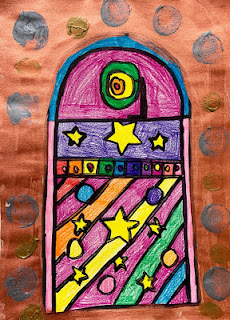

 Student Examples


Monday, October 26, 2020
JAMES RIZZI CITYSCAPES
James Rizzi Cityscapes

Learning Targets
I can...
- Create an original James Rizzi Cityscape using drawing techniques learned in class
- Use color combinations (analogous, secondary, intermediate), shape variation (geometric organic free form) and space (positive negative) inspired by Pop Artist (1950-2011) James Rizzi
- Use art element: line (expressive, directional, contour) and design principles (composition, gradation, proportion) based on Pop Art
- Define Cityscapes (the visual appearance of a city or urban area)
Lesson One
Day One, Art Start
1. City Of Dreams City of Dreams (1993) James Rizzi

2. Read The Adventures of Taxi Dog by Debra Sol Barracca

3. Discussion Questions "Who is the artist that created this work? Which decade did the Pop Art Movement begin? What was special about James Rizzi's prints? What are we learning by doing this project? Did Rizzi ever do commercial work? What was one artist that inspired Rizzi? What setting was often in his artwork? What types of colors are featured in Pop Art? What animals can be found in his art? How did Rizzi come up with his three dimensional style of art? Which piece of artwork is the most famous? What type of artist was James Rizzi?"
Lesson Activities
1. Use pencil to draw basic shapes (geometric, rectangle, oval) of the buildings of ones expressive cityscapes
2. Use line types (expressive, directional, contour) to add details (facial features, windows, doors) to ones expressive cityscapes
3. Use line types (expressive, directional, contour) to add details (cloud formations, raised highway, sun) to negative space (background) of James Rizzi Cityscapes
Day Two, Art Start
1. Retrieve James Rizzi Cityscapes for Assigned Table
2. Winter (1988) James Rizzi

3. Discussion Questions "Would you like living in a city? What are some of the advantages of living in a city? What are some disadvantages to living in a city? What is your favorite city to visit? What part of this city do you like the best? What do you think could be done to improve living conditions in the cities? What are some differences between living in the city and living in the country? If you had grown up in a different city how would your life have been different? What monuments of your city do you consider the most impressive? How would you describe the architecture in your city? What would you if you were in charge of the city? How would you improve it? What changes would you make? Would you enjoy designing a new city?"
Lesson Activities
1. Use color combinations (analogous, secondary, intermediate) to fill in the positive space (buildings) of ones expressive cityscapes
2. Use color combinations (analogous, secondary, intermediate) to fill in the negative space (background) of ones expressive cityscapes
3. Use line types (expressive, directional, contour) to fill in the positive space (buildings) with designs (facial features, windows, doors) for James Rizzi Cityscapes
Day Three, Art Start
1. Retrieve James Rizzi Cityscapes for Assigned Table
2. Set Up Studio Area (water bucket, paintbrushes, oil pastel)
Lesson Activities
1. Add highlights (light source, reflective light) to positive space (buildings) of expressive cityscapes
2. Add shadows (cast shadow, shadow) to negative space (background) of expressive cityscapes
3. Use stop motion program (iMotion, FlipaClip, Stop Motion) to add an animation to James Rizzi Cityscapes
Artist Examples


 Student Examples


 Posts
Posts

