Showing posts with label historical reference. Show all posts
Monday, April 2, 2018
MONET FLOWER GARDEN
Monet Flower Garden

Learning Targets
I can...- Create a Monet Flower Garden using techniques learned in class
- Use geometric shapes (circle, triangle, oval), visual texture (grass, stone, wood) and line variation (horizon line, outline, diagonal line) inspired by French Impressionist (1840-1926) Claude Monet
- Understand historical places (Garden of Giverny, Rijnsburg Windmill, Rouen Cathedral) and design principles (repetition, competition, balance) based on Impressionism
- Define Landscape (a picture showing coutryside or land scenery)
Lesson One
Day One Art Start
1. Flower Beds at Vetheuil (1878) Claude Monet
Lesson Activities
1. Choose 12" by 15" Watercolor Paper2. Draw a horizon line in the middle of the white watercolor paper
3. Add scenery (ocean, blue sky, wooden fence in garden) to background of Monet Garden
Day Two, Art Start
1. Retrieve Monet Flower Garden for Assigned Table2. Flowers by the Pond (1915) Claude Monet

Lesson Activities
1. Add flowers (roses, carnations, tulips, irises, sunflowers) to middle ground of garden2. Add patio (chairs, table, flag pole) to foreground of Monet Flower Garden
3. Use black sharpie marker to outline foreground, middle ground, and background of garden
Day Three, Art Start
1. Retrieve Monet Flower Garden for Assigned Table2. Set Up Studio Area (watercolor, buckets, colored pencils)
Lesson Activities
1. Use watercolor to fill in positive space of flower garden2. Use watercolor to fill in negative space of flower garden
3. Add highlights/shadows with colored pencil to Monet Flower Garden
Artist Examples


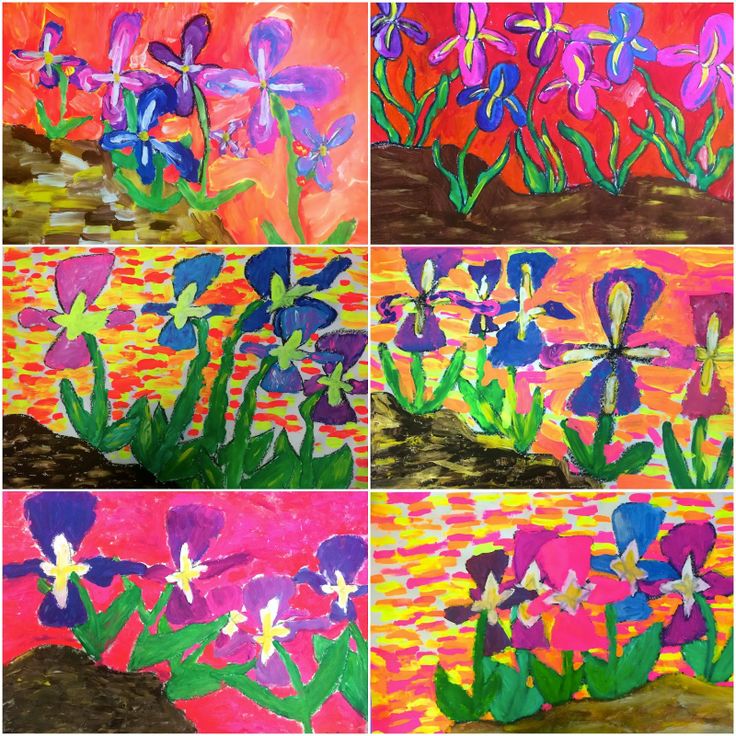

Student Examples


CASTLE IN THE SKY
Castle In The Sky

Learning Targets
I can...- Create a Castle In The Sky using techniques learned in class
- Use geometric shapes (triangles, rectangles, squares), visual texture (block, brick, stone, wood) and form (two dimensional, three dimensional) inspired by 5th Century Neushwanstein Castle in Germany
- Make multicultural connections (exterior architecture, art careers, functional objects) and design principles (composition, balance, repetition) relating to Medieval Art
- Define Architecture (art of designing and constructing buildings)
Lesson One
Day One, Art Start
1. Neushwanstein Castle in Germany
2. Read Knight and the Dragon by Romie dePaola
3. Discussion Questions "Do you remember a time when you went to the beach and played in the sand? Did you ever make a sand castle? What types of tools did you use to create it? What would make the best sand castle- height, sturdiness, or level of detail? What are some materials (rocks, sticks, moats) that can be used to protect castles from the waves? What is the difference between a palace and a castle?"
Lesson Activities
1. Retrieve 12" by 15" Drawing Paper2. Draw a horizon line toward the bottom of the white paper
3. Use geometric shapes (rectangles, squares, triangles) to add building parts (towers, wall, doors)
Day Two, Art Start
1. Retrieve Castle In The Sky for Assigned Table2. Research Top Hundred Medieval Castles from educational resources

3. Discussion Questions "How would you build a castle in a whole day? Why were castles built in medieval times? What were the first castles made of? What was the castle keep and what was its purpose? What was the title of the person in charge of affairs within the castle?"
Lesson Activities
1. Use line variation (vertical, horizontal, diagonal) to add texture (bricks, stone, metal)
2. Add architectural features (flags, moat, draw bridge) to medieval castle
3. Use eraser to remove any guidelines from outlined Castle In The Sky
Day Three, Art Start
1. Retrieve Castle In The Sky for Assigned Table
2. Set Up Studio Area (colored pencils, sharpeners, erasers)
Lesson Activities
1. Use earth tones (brown, red, black) to fill in positive space of medieval castle
2. Use earth tones (green, blue, white) to fill in negative space of medieval castle
3. Add highlights/shadows to positive/negative space of Castle In The Sky
Artist Examples


Sunday, February 18, 2018
LANDMARK RENDITIONS
Landmark Renditions

Learning Targets
I can...- Create a Landmark Rendition using techniques learned in class
- Use texture (stone, straw, cement), form (two dimensional, three dimensional), and space (foreground middle ground, background) to replicate World Famous Monuments
- Use geographic connections (cultural identity, countries/continents, manmade structures) and design principles (proportion, unity, movement) relating to Public Art
- Define Landmarks (building or place of historical, aesthetic, or cultural importance used to mark and important stage or turning point in time)
Lesson One
Day One, Art Start
1. To Those Who Made The Supreme Sacrifice. Bellows Falls, Vermont (1971) Lee Friedlander

Lesson Activities
1. Use recognizable geometric shapes (rectangle, circle, triangle) to outline world landmark2. Use black sharpie markers to trace over geometric shapes of landmark renditions
3. Use rubber erasers to remove any pencil lines behind the thick black lines
Day Two, Art Start
1. Retrieve Landmark Rendition for Assigned Table2. Lego Landmarks- 35 Monumental Sculptures

3. National Geographic Suitcase Portfolios & Passports


Lesson Activities
1. Use watercolor techniques to fill in the positive space (building, monument, landmark)2. Use watercolor techniques to fill in the negative space (sky, clouds, trees, background)
3. Add decorative details (columns, towers, domes) to Landmark Renditions
Day Three, Art Start
1. Retrieve Landmark Rendition for Assigned Table2. Set Up Studio Area (rulers, pencils, erasers)
Lesson Activities
1. Outline decorative details (columns, towers, domes) with Permanent Black Marker2. Outline patterns (stripes, spirals, meanders) with metallic sharpie markers
3. Cut Out & Add a ornate frame to Famous Landmark Renditions
Artist Examples


Student Examples


Saturday, November 11, 2017
NATIVE AMERICAN STORY NECKLACES
NATIVE AMERICAN STORY NECKLACES

Learning Targets
I can...- Create a Story Necklace using manufacturing techniques (uniformity, thickness, sandstones) learned in class
- Use form (two dimensional, three dimensional), shape (biomorphic, anthropomorphic), and color (metallic-bronze, copper, gold) relating to Native American Art
- Make social studies connections (adornments, religious implications, indigenous people) and use design principles (unity, variety, emphases) inspired by the 16th Century Old Copper Complex
- Define Fetishes (necklace designed to illustrate story, history, and legend with carved creatures)
Lesson One
Day One, Art Start
1. Old Copper Complex (4000 to 1000 BCE) Native American Societies


2. The Star People: A Lakota Story by S.D. Nelson

3. Reflective Discussion "Large Deposits of pure native copper are on the North Shore of Lake Superior, Isle Royale, and Keweenaw Peninsula of Michigan. Copper Deposit reports were recorded by the earliest French explorers (1608) of the Great Lake Region in Champlain. These explorers found native copper made by Algonquin Indians and sent these artifacts to King Henry IV of France. The first indigenous peoples who mined and utilized this copper were labeled the "Old Copper Complex" or "Old Copper Culture" by archeologists."
Lesson Activities
1. Use hand building techniques (rolling, kneading pressing) to make FIVE wampum beads
2. Use jewelry making techniques (rubbing, peeling, pressing) to make ONE elaborate pendant that represents a cultural tale, loved one, or an aboriginal legend
3. Create a small "artifact" (fish hook, spear point, gorget) to be incorporated into the final design of the Story Necklace
Reminder:
- Initials & Home Teacher on Plastic Bag
Day Two, Art Start
1. Retrieve Story Necklace for Assigned Table
2. How The Raven Stole The Sun (Tales of the People) by Maria Williams & Felix Vigil
3. Discussion Questions "Have you ever thought about who the first metal miners and workers in North America were? What metal did they mine, where did they mine it, and what did they do with the metal?"
Lesson Activities
1. Use a jewel setter to add texture (channel bead, fabric, polish) to the FIVE wampum beads
2. Use a jewel setter to add texture (crystals, fancy stoles, polish) to the ONE elaborate pendant
3. Incorporate the small "artifact" (fish hook, spear point, gorget) into the Story Necklace using weaving techniques (stitch, woven, chain)
Day Three, Art Start
1. Retrieve Story Necklace for Assigned Table
2. Set Up Studio Area (Tooth Picks, Leather Cord, Rub n Buff)
Lesson Activities
1. Use Rub n Buff to paint the FIVE wampum beads a metallic copper color
2. Use Rub n Buff to paint the ONE elaborate pendant a metallic copper color
3. Use a leather cord to incorporate the small "artifact" (fish hook, spear point, gorget), elaborate pendant, and wampum bead into a personal Story Necklace
Artist Examples


Student Examples


Subscribe to:
Posts
(
Atom
)


 Posts
Posts

