Wednesday, August 27, 2025
ONE POINT SHAPE PERSPECTIVES
One Point Shape Perspectives Learning Targets

I can...
- Create an original One Point Shape Perspectives using drawing techniques learned in class
- Use shape variation (geometric, organic, free form), line types (horizontal, vertical, diagonal), and form (two dimensional, three dimensional) inspired by Impressionist Painter (1848-1894) Gustave Caillebotte
- Use core drawing techniques (scale, simple forms, spatial relationships) and design principles (proportion, variation, contrast) based on Impressionism
- Define Vanishing Point (a point where parallel lines appear to converge in the distance)
Lesson One
Day One, Art Start
1. The Bridge Of Europe (1876-1877) Gustave Caillebotte

2. Read The Mysteries of Harris Burdick by Chris Van Allsburg

3. Discussion Questions "Which direction are the lines facing in all the examples (vertical, horizontal, perspective, diagonal)? Do you see any lines that do not follow these rules? What art skills, subject area, or big idea is being taught? How does this art skill translate into an everyday life skill? Which sides of the object would be visible and which sides of the object would be hidden? What knowledge do my students need to possess to create a one point perspective drawing? Are there cultures that did not use linear perspective? Where do you think the road goes to in the distance? What happens to things as they get further away from you? Where would you have to look to see the very end of a long hallway? How can we make our drawings look like they have depth? Why do things in the distance look smaller than things that are close to you? Do you see any lines that look like they are going far, far away?"
Lesson Activities
1. Use three geometric shapes (cylinder, cone, pyramid) to represent a mood (happy, angry, sad) for the shape perspectives
2. Use tints (white grey black) to fill in the positive space (foreground, three dimensional shapes) for the shape perspectives
3. Use tints (white grey black) to fill in the negative space (background) of the One Point Shape Perspectives
Day Two, Art Start
1. Retrieve One Point Shape Perspectives for Assigned Tables
2. Paris Street, Rainy Day (1877) Gustave Caillebotte

3. Discussion Questions "What colors are being used in this artwork? Which area of the artwork is emphasized by the artist? Which part of the art is most important? How did the artist use space? How did the artist use balance? How did the artist use proportion? How would you describe this artwork to someone who has never seen it? What do we know about the artist after viewing this artwork? Who do you think this artwork was created for? Why do you say that? How do you think that artist feels about the final product? How do you think this artwork was made? Why do you think this artwork was made? Why do you think this artist created this work? What emotions do you notice in this artwork? What emotions do you feel when looking at this? How do you think the artist was feeling when he created this artwork? How did the artist use line, shape, and color to contribute to the mood or meaning? What title would you give this artwork?"
Lesson Activities
1. Add three different lines (horizontal, vertical, diagonal) to add visual interest in the shape perspectives
2. Use colored construction paper to fill in the positive space (foreground, three dimensional shapes) of the shape perspectives
3. Use colored construction paper to fill in the negative space (background) of the One Point Shape Perspectives
Day Three, Art Start
1. Retrieve One Point Shape Perspectives for Assigned Tables
2. Set Up Studio Area (paper cut outs, rulers, geometric shape templates, pencils, erasers)
Lesson Activities
1. Use black sharpie markers to outline the three dimensional shapes (cylinder, cone, pyramid) and line types (horizontal, vertical, diagonal) of the shape perspectives
2. Use color combinations (analogous, secondary, complementary) to fill in the positive space (foreground, three dimensional shapes) of the shape perspectives
3. Use color combinations (analogous, secondary, complementary) to fill in the negative space (background) of the One Point Shape Perspectives
Artist Examples


 Student Examples


Friday, November 19, 2021
DESERT LANDSCAPE
Desert Landscapes

Learning Targets
I can...
- Create an original Desert Landscapes using drawing techniques learned in class
- Use form (two dimensional, three dimensional), shape variation (geometric, organic), and line types (parallel, straight, curved) inspired by Orientalist Painter (1853-1907) Eugene Girardet
- Use drawing techniques (observational, perspective, contour) and design principles (composition, movement, gradation) based on Realism
- Define Horizon Line (point where the earth meets the sky)
Lesson One
Day One, Art Start
1. Dans Les Hauts Plateaux, Apres Lorage (1853) Eugene Girardet

2. Read Desert Voices by Byrd Bayor

3. Discussion Questions "Where is the painted desert located? How many miles long is the painted desert? What happened to some of the trees here? What are the three concepts in landscape paintings? What are the basic elements in this landscape painting? What strikes you the most about this landscape? What mood odes it evoke? What is the main idea of this painting? Is there a dominant atmospheric effect? Is there a dominant color temperature in the landscape? What is the focal point? What is the main idea of this painting?"
Lesson Activities
1. Use a ruler, compass, or straightedge to draw the scenery (background, foreground, middle ground) of the landscape painting
2. Add details (building, animals, plants) within the scenery (foreground, middle ground, background) of the landscape paintings
3. Use colored sharpies to outline the scenery (foreground, middle ground, background) of the Desert Landscapes
Day Two, Art Start
1. Retrieve Desert Landscapes for Assigned Tables
2. Flight Into Egypt (1853) Eugene Girardet

3. Discussion Questions "What can you see? what do you think the meaning behind this image is? How does this image make you feel? What do you like about the image? What are some art laments and principles you can see? How does the artist use brushes or tools to show all the vials elements in his paintings? How will you compose your section? How will your section fit into the big picture? How is this painting inspiring your own work?"
Lesson Activities
1. Add patterns (swirls, stars, stripes) into the scenery (foreground, middle ground, background) of the landscape paintings
2. Use complimentary colors (green red, blue orange, purple yellow) to fill in the scenery (foreground, middle ground, background) of the landscape paintings
3. Use complimentary colors (green red, blue orange, purple yellow) to fill in the scenery (foreground, middle ground, background) of the landscape paintings
Day Three, Art Start
1. Retrieve Desert Landscapes for Assigned Tables
2. Set Up Studio Area (washable markers, black sharpies, felt pens)
Lesson Activities
1. Add highlights (sunlight, reflection) within the scenery (foreground, middle ground, background) of the landscape paintings
2. Add shadows (cast shadow, reflective shadow) within the scenery (foreground, middle ground, background) of the landscape paintings
3. Add details (animals, people, buildings) within the scenery (foreground, middle ground, background) of the Tropical Landscapes
Artist Examples


 Student Examples


TROPICAL LANDSCAPES
Tropical Landscapes

Learning Targets
I can...
- Create an original Tropical Landscape using drawing techniques learned in class
- Use shape variation (geometric, organic), line types (horizontal, vertical, diagonal), and space (positive, negative) inspired by French Post-Impressionist (1848-1903) Paul Gauguin
- Use painting techniques (double loaded brush, absorption, palette) and design principles (balance, composition, gradation) based on Post Impressionism
- Define Horizon Line (point where the earth meets the sky)
Lesson One
Day One, Art Start
1. Tahitian Landscape Two (1848) Paul Gauguin

2. Read The Color of the Night Paul Gauguin by Helene Kerillis

3. Discussion Questions "Where do we come from? What are we? Where are we going? What was Paul Gauguin's full name? When was Paul Gauguin born? Where was Paul Gauguinborn? Where did Paul Gauguin paint Tropical Vegetation? What types of symbols did Paul Gauguin use in his work? Why did the artist overall simplify subject matter? What were some of his greatest artistic finluenes that came from art and aesthetics? What happened after finishing the painting "Where Do We Come From? What Are We? Where are we going?" What is the title of this painting?"
Lesson Activities
1. Use a ruler, compass, or straightedge to draw the scenery (foreground, middle ground, background) of the landscape painting
2. Add details (building, people, plants) within the scenery (foreground, middle ground, background) of the landscape painting
3. Use colored sharpies to outline the scenery (foreground, middle ground, background) of the Tropical Landscapes
Day Two, Art Start
1. Retrieve Tropical Landscapes for Assigned Table
2. Mountains In Tahiti (1848) Paul Gauguin

3. Discussion Questions "What can you see? What do you think the meaning behind this image is? How does this image make you feel? What do you like about the image? What are some art elements and principles you can see? How does the artist use brushes or tools to show all the visual elements in his paintings? How will you compose your section? How will your section fit into the big picture? How is this painting inspiring your own work?"
Lesson Activities
1. Add patterns (swirls, stars, stripes) into the scenery (foreground, middle ground, background) of the landscape paintings
2. Use complimentary colors (green red, blue orange, yellow purple) to fill in the scenery (foreground, middle ground, background) of the landscape paintings
3. Use complimentary colors (green red, blue orange, yellow purple) to fill in the scenery (foreground, middle ground, background) of the Tropical Landscapes
Day Three, Art Start
1. Retrieve Tropical Landscapes for Assigned Table
2. Set Up Studio Area (washable markers, black sharpies, felt pens)
Lesson Activities
1. Add highlights (sunlight, reflection) within the scenery (foreground, middle ground, background) of the landscape paintings
2. Add shadows (cast shadow, reflective shadow) within the scenery (foreground, middle ground, background) of the landscape paintings
3. Add details (animals, people, buildings) within the scenery (foreground, middle ground, background) of the Tropical Landscapes
Artist Examples

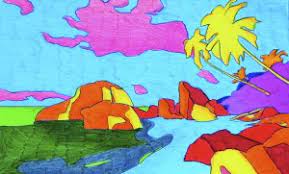


 Student Examples


Tuesday, December 15, 2020
SAILBOAT REFLECTIONS
Sailboat Reflections

Learning Targets
I can...
- Create an original Sailboat Reflection using drawing techniques learned in class
- Use color combinations (secondary primary complementary), line types (horizontal vertical diagonal), and value (lightness darkness) inspired by Realist Painter (1836-1910) Winslow Homer
- Use collage techniques (layering cutting overlapping) and design principles (composition variation proportion) based on Realism
- Define Seascape (a photograph painting or other work of art depicting a sea)
Lesson One
Day One, Art Start
1. Sunset Fires (1880) Winslow Homer

2. Read The Little Sailboat by Lois Lenski

3. Discussion Questions "How do you think this sailboat was made? what do you think was used to make this sailboat? What is a seascape? How do artists create depth in a work of art? What French American art teacher did Winslow Homer study under in New York City? How did Winslow Homer make his living in art for the first two decades of his career? Is what European city did Winslow Homer first have one of his paintings displayed, bringing him International fame? What sort of America has the veteran returned to? In the aftermath of the Civil War, how did Americans look back and look forward? What associations would a wheat field suggest to a Civil War veteran? What does the painting look back and look ahead? During this period, how did Americans promote the reunion of the nation? How did they reconceptualize their sense of national identity?"
Lesson Activities
1. Choose 12" X 15" Painting Paper
2. Use a pencil to draw a horizon line in the middle of the painting paper for boat paintings
3. Add scenery (ocean blue sky wooden fence lilies) to the negative space (background) of the Sailboat Reflections
Day Two, Art Start
1. Retrieve Sailboat Reflections for Assigned Tables
2. The Coral Divers (1885) Winslow Homer

3. Discussion Questions "What color forms within these paintings? How did the artist make the sky look different from the wave since they are both blue? Did you know Homer loved to go finishing when he was a child? What colors do you see in the water? What is the weather like? How did the artist show movement in the water? Does the sea look dangerous? How is a seascape different from a landscape? Do you know that Winslow Homer drew many pictures of the Civil War? Do you know that he lived in Maine, Bermuda, and Cuba? Can you find these places on the map? Have you ever thought about sailing on the sea? Do you think fishermen sailing on the sea encounter any dangers? How does the artist show perspective? How is origami related to mathematics?"
Lesson Activities
1. Add flowers (roses carnations tulips irises sunflowers) to middle ground (lake, ocean) of boat paintings
2. Add boat (sail boat, fishing boat, row boat) to positive space (foreground) of boat paintings
3.Use black sharpie marker to outline foreground (boat) and positive space (foreground) of Sailboat Reflections
Day Three, Art Start
1. Retrieve Sailboat Reflections for Assigned Table
2. Set Up Studio Area (watercolor buckets colored pencils)
Lesson Activities
1. Use earth tones (brown yellow blue green) to fill in the positive space (boat) of the boat paintings
2. Use earth tones (brown yellow blue green) to fill in the negative space (background) of the boat paintings
3. Add highlights (reflective light, light source) and shadows (cast shadow, shadow) with colored pencil to Sailboat Reflections
Artist Examples


 Student Examples


Wednesday, November 4, 2020
WARM SKY COOL SEA
Warm Sky Cool Sea

Learning Targets
I can...
- Create an original Warm Sky Cool Sea using drawing techniques learned in class
- Use line types (horizontal vertical diagonal), color theory (warm colors, cool colors) and space (positive negative) inspired by American Artist (1969-Present) Robin Mead
- Use art element: color (warm colors, cool colors) and design principles (composition movement variation) based on Contemporary Art
- Define Seascape (a photograph or painting depicting the expanse sea)
Lesson One
Day One, Art Start
1. Surfs Up (2020) Robin Mead

2. Read The Boy And The Ocean by Max Lucado

3. Discussion Questions "What is happening in this artwork? What was your first reaction to this artwork? Does your opinion about the artwork change the longer you look at it? How does your eye move through the artwork? What do you think of warm and cool colors? What words and associations do you have for each group? How would you play with warm and cool colors in artwork? What design will you create? What adjectives would you use to describe this painting? How do you think this artwork was made? What emotions do you feel when looking at this? How do you think the artist was feeling when he created this artwork? How did the artist use line, shape, and color to contribute to the mood or meaning? What emotions do you notice in the artwork? What is the story being told, if any?"
Lesson Activities
1. Use observational drawing techniques (composition, light source, reflective light) to drawing the basic shapes (waves, trees, sun rays) of the seascape paintings
2. Add basic shapes (triangle, circle, rectangle) to add details (stars, plants, animals) to positive space (foreground) of seascape paintings
3. Add decorative details (border, glitter, embellishments) to positive space (foreground) of Warm Sky Cool Sea
Day Two, Art Start
1. Retrieve Warm Sky Cool Sea for Assigned Table
2. Offshore (2020) Robin Mead

3. Discussion Questions "What is the title? How does the title contribute to your understanding of the meaning? What symbols do you notice in the artwork? How do you personally relate to or connect with this picture? What does this artwork remind you of? What does this artwork say about the culture in which it was produced? Why do you think you should be learning about or looking at this artwork? What does this painting say about the world in which we live in? What does the artwork teach us about the past? What are the values and beliefs of the culture in which this artwork was made? How might your interpretation of this artwork be different from someone in another culture?"
Lesson Activities
1. Use warm colors (red orange yellow) to fill in the positive space (sky) of the seascape paintings
2. Use cool colors (blue green purple) to fill in the negative space (sea) of the seascape paintings
3. Add intricate embellishments to the decorative details (borders, glitter, stars) of the positive space (sky) of the Warm Sky Cool Sea
Day Three, Art Start
1. Retrieve Warm Sky Cool Sea For Assigned Table
2. Set Up Studio Area (paint brushes, water bucket, tempera paint)
Lesson Activities
1. Add highlights (light source, reflective light) to positive space (seascape) of seascape paintings
2. Add shadows (cast shadow, shadow) to negative space (background) of seascape paintings
3. Add high contrast (shaded areas) and light/medium contrast (light areas) within the Warm Sky Cool Sea
Artist Examples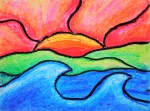


 Student Examples


 Posts
Posts

