Tuesday, November 14, 2023
MATISSE INSPIRED STILL LIFE COLLAGES
Matisse Inspired Still Life Collages
Learning Targets

I can...
- Create an original Matisse Inspired Still Life Collages using drawing techniques learned in class
- Use line types (horizontal, vertical, diagonal), shape variation (geometric, organic, free form), and texture (actual, visual, implied) inspired by French Artist (1869-1954) Henri Matisse
- Use collage techniques (photomontage, assemblage, decoupage, mixed media) and design principles (composition, repetition, balance) based on Modernism
- Define Symmetry (when two or more parts are identical after a flip, slide, or turn)
Lesson One
Day One, Art Start
1. Vase With Two Handles (A Bunch Of Flowers) (1907) Henri Matisse

2. Read Matisse: The King Of Color by Laurence Anholt

3. Discussion Questions "How does the effect of the collage change when layering multiple shapes on top of each other? Can you create your own Matisse inspired artwork with a collage of cut outs? How does Henri Matisse's artwork make you feel? How would this picture make you feel if bright or dark colors were used instead? Who is Henri Matisse? Do you like this painting? How many colors do you see? Do you think what you see is exactly how the room looked when he painted it, with all those colors and patterns going every which way? How many different patterns do you see? How many of the patterns are variations on the bold vertical stripes? Do his pictures make you feel happy?"
Lesson Activities
1. Choose 12" X 15" Painting Paper
2. Use ruler to draw three line types (horizontal, vertical, diagonal) for the interior (window, wallpaper, background) of the still life collage
3. Use oil pastels to add patterns (swirls, dots, stripes) to the negative space (background) of the Matisse Inspired Still Life Collages
Day Two, Art Start
1. Retrieve Matisse Inspired Still Life Collages for Assigned Tables
2. Flowers And Fruit (1909) Henri Matisse

3. Discussion Questions "Where did Henri Matisse grow up? What process or techniques did Matisse use to create his artwork? What materials did Matisse you to create his artwork? What is an art element? Who can share some examples of elements? What is a principle? Who can share some examples of principles?Can you use a book to find information about Henri Matisse? How would you describe his artwork? What are some key features of his artwork? How could you describe the construction of this artwork? What do you think Matisse is trying to say with this artwork? Do you like or dislike his artwork?"
Lesson Activities
1. Add details (fruit, vegetables, cloth, plants) to the negative space (background) of the still life collages
2. Add details (fruit, vegetables, patterns, ribbon) to the positive space (flowers, vases) of the still life collages
3. Use collage materials (fabric, construction paper, scrapbook paper) to add details (tablecloth, curtains, towel) for the Matisse Inspired Still Life Collages
Day Three, Art Start
1. Retrieve Matisse Inspired Still Life Collages for Assigned Tables
2. Set Up Studio Area (oil pastels, scissors, glue sticks, watercolor)
Lesson Activities
1. Use tissue paper to add plants (leaves, flowers, lilacs) within the negative space (background) of the still life collages
2. Use complementary colors (red, green; blue, orange; yellow, purple) too fill in the positive space (foreground) of the still life collages
3. Use complementary colors (red, green; blue, orange; yellow, purple) to fill in the negative space (background) of the Matisse Inspired Still Life Collages
Artist Examples


 Student Examples


Friday, October 6, 2023
DEGAS DANCER COLLAGES
Degas Dancer Collages

Learning Targets
I can...
- Create an original Degas Dancer Collages using drawing techniques learned in class
- Use color combinations (analogous, complementary, secondary), shape variation (geometric, organic, free form), and space (positive, negative) inspired by French Artist (1834-1917) Edgar Degas
- Use collage techniques (paper, digital, mixed media, photomontage) and design principles (proportion, movement, balance) based on Impressionism
- Define Theme (the message the artist wishes to convey through the artwork)
Lesson One
Day One, Art Start
1. The Ballet Class (1871-1874) Edgar Degas

2. Read Degas Painter Of Ballerinas: The Metropolitan Museum Of Art by Susan Goldman Rubin

3. Discussion Questions "Do you think dancers relate to these paintings more than other people might? How does Edgar Degas's painting compare to the rehearsal experience? How did the ballerinas in Edgar Degas's dancers look differently than the dancers today? How does the dancers' costumes compare to the costumes worn today? Do you have a favorite work from the exhibition? What other reason did the artist have for painting ballerinas? What does the ballerina symbolize in Edgar Degas paintings? What is Edgar Degas style in art? What type of painting is the ballet class by Edgar Degas? Why did Edgar Degas start to paint ballerinas? Why is the dance class an important painting?"
Lesson Activities
1. Choose 12" X 15" Drawing Paper
2. Add three dimensional shapes (organic, free form, geometric) to the composition of the positive space (ballerina) for the ballerina collages
3. Add a horizon line in the negative space (background) to separate the positive space (ballerina) from the negative space (stage) in the Degas Dancer Collages
Day Two, Art Start
1. Retrieve Degas Dancer Collages for Assigned Tables
2. Ballet Rehearsal (1873) Edgar Degas

3. Discussion Questions "What do you see in this painting? What do you think of this artwork? How do you think the public received it? Why do you think Degas used that medium? How are images and objects used to convey a story, familiar experience, or connection to the world? How does the length, color, o shape of the ballerina make a difference in conveying the meaning of this artwork? Is this painting of four dancers or one dancer in four positions? What does each part of the body look like in motion? Why do you think the dancers choose the materials he did? After experimenting with our materials, how do you think the dancers clothing from the painting will move when dancing? What other things did Edgar Degas paint? How would you describe the composition? How would you describe the clothing?"
Lesson Activities
1. Use color combinations (analogues, complementary, secondary) to fill in the positive space (foreground) of the ballerina collages
2. Use color combinations (analogue, complementary, secondary) to fill in the negative space (background) of the ballerina collages
3. Use shape stamps to add patterns (floral, silk, wood) and texture plates (wood, leather, metal) to the Degas Dancer Collages
Day Three, Art Start
1. Retrieve Degas Dancer Collages for Assigned Tables
2. Set Up Studio Area (glue sticks, scissors, scrapbook materials)
Lesson Activities
1. Add highlights (reflective light, light source) to the subject matter (ballerina) of the ballerina collages
2. Add shadows (reflective shadow, cast shadow) to the negative space (background) of the ballerina collages
3. Outline details (patterns, objects, images) in the positive space (ballerina) of the Degas Dancer Collages
Artist Examples


 Student Examples


Thursday, September 28, 2023
PICASSO PAPER CUT OUTS
Picasso Paper Cut Outs

Learning Targets
I can...
- Create an original Picasso Paper Cut Outs using drawing techniques learned in class
- Use shape variation (geometric, organic, free form), form (two dimensional, three dimensional), and texture (actual, implied, visual) inspired by Spanish Artist (1881-1972) Pablo Picasso
- Use sculpture techniques (carving, assembling, modeling, casting) and design principles (composition, proportion, balance) based on Cubism
- Define Interconnect (having different parts or things connected or related to each other)
Lesson One
Day One, Art Start
1. Woman (1943) Pablo Picasso

2. Read Picasso Cut Papers by Cythnia Burlingham

3. Discussion Question "Did you know Pablo Picasso painted on vessels? Did you know Pablo Picasso made giant sculptures out of stone, steel, and cardboard? Do you notice how the artist used monochromatic colors to have the face looking in different directions? How many faces can be seen and how does each face feel? How did Cubist artists use collage to discuss the relationship between different people? What two animals did we see that are cut out of the paper? What is the mood in this paper sculpture? What would the impact of this work be if it were in color instead of black and white? How is this artwork similar and different to photographs?"
Lesson Activities
1. Add line types (horizontal, vertical, diagonal) for the proportion (head, neck, shoulder) within the silhouette of the face paper sculptures
2. Turn construction paper into basic shapes (oval face, crescent ears, rectangle neck) for the positive space (face) of the face paper sculptures
3. Use tools (scissors, glue sticks, pencils) to draw facial features (oval eyes, round nose, thin mouth) within the silhouette of the Picasso Paper Cut Outs
Day Two, Art Start
1. Retrieve Picasso Paper Cut Outs for Assigned Tables
2. Chair (1961) Pablo Picasso

3. Discussion Questions "What influenced Pablo Picasso's work? What is Cubism? where did Pablo Picasso grow up? Which political movements was Pablo Picasso associated with? Who invented Cubism with Pablo Picasso? Which political movements was Pablo Picasso associated with? Who invited Cubism with Pablo Picasso? When did Picasso start signing his artwork? How many works of art did Picasso create during his lifetime? How old was Pablo Picasso when he completed his first painting? Which is not a characteristic of Cubism? What is the name of this sculpture? What do you know about one of the greatest artists of the 20th century? What was the first of the most commonly accepted periods of Pablo Picasso's work?"
Lesson Activities
1. Add facial features (eyes, nose, mouth) to the positive space (face) of the silhouette of the face paper sculptures
2. Add details (eye sockets, brow bone, moles) to the facial features (eyes, nose, mouth) of the face paper sculptures
3. Use modeling tools (paddle, brush, grips) to smooth out facial features (eyes, nose, mouth) of the Picasso Paper Cut Outs
Day Three, Art Start
1. Retrieve Picasso Paper Cut Outs for Assigned Tables
2. Set Up Studio Area (scissors, glue sticks, pencils)
Lesson Activities
1. Add color combinations (analogous, complementary, secondary) to the positive space (neck, face, shoulder) of the face paper sculptures
2. Add color combinations (analogous, complementary, secondary) to the negative space (background) of the face paper sculptures
3. Apply Gloss Finish to the face proportions, facial features, and accessories of the Picasso Paper Cut Outs
Artist Examples


 Student Examples


Tuesday, September 26, 2023
ALEXANDER CALDER MIXED MEDIA FISH
Alexander Calder Mixed Media Fish

Learning Targets
I can...
- Create an original Alexander Calder Mixed Media Fish using sculpture techniques learned in class
- Use primary colors (red yellow blue), form (two dimensional, three dimensional), and texture (actual implied visual) inspired by American Sculptor (1898-1976) Alexander Calder
- Use art element: shape (geometric, organic, free form) and design principles (movement, balance, composition) based on Modern Art
- Define Kinetic Art (any art medium that contains moving elements or requires movement from the viewer)
Lesson One
Day One, Art Start
1. Fish (1944) Alexander Calder

2. Read Alexander Calder: The Art Of Invention by The Bellagio Gallery Of Fine Art

3. Discussion Questions "Who is Alexander Calder? Was Alexander Calder always an artist? What is Alexander Calder most famous for? What was Alexander Calder's favorite subject? What was Alexander Calder's favorite drawing material? What was Alexander Calder's thoughts on sculpture? How can art be realized? Which are some of Alexander Calder's key works? How did Alexander Calder transport some of his artworks? What do critics think of Alexander Calder's artwork? How do you think this artwork moves? Do you feel you are caught in a blustery snowstorm? Do you think Alexander Calder captured the magic of fishing in this performance? What do you think of his work? Does it remind you of anything you have seen before? Have you ever tried to make a mobile?"
Lesson Activities
1. Choose Three 12 X 12 Primary Colored Wires
2. Use three composition elements (shape, color, texture) to represent a Michigan Fish (bowfin, goldfish, minnow, catfish, salmon, trout) for the fish sculptures
3. Use line variation (horizontal, vertical, diagonal) as a design principles (movement, composition, balance) of the Alexander Calder Mixed Media Fish
Day Two, Art Start
1. Retrieve Alexander Calder Mixed Media Fish for Assigned Table
2. Finny Fish (1948) Alexander Calder

3. Discussion Questions "Do you think Alexander Calder balanced this mobile? How do you imagine it stands within the space? Has Calder created a whole new art form? What does this stabile remind you of? Why do you suppose Calder gave the stable a descriptive name (red horse) but left the mobile with a specific name? What do you think about his work? Does it remind you of anything you have seen before? Have you ever tried to make a mobile? How did Alexander Calder design a shape for the installation? What identical shape were used in making the mobile? What is going on in this artwork? What was your first reaction when you saw this artwork? What type of colors are used in this artwork?"
Lesson Activities
1. Use compass, protractors, and texture plates to add symmetrical shapes and expressive lines to fish sculptures
2. Use primary colors (red yellow blue) to fill in the positive space (fish) with embellishments (buttons, ribbons, beads, sequins, pipe cleaners) for the fish sculptures
3. Use primary colors (red yellow blue) to fill in the negative space (background) with embellishments (buttons, ribbons, beads, sequins, pipe cleaners) for the Alexander Calder Mixed Media Fish
Day Three, Art Start
1. Retrieve Alexander Calder Mixed Media Fish for Assigned Tables
2. Set Up Studio Area (glue sticks, construction paper, wire, scissors)
Lesson Activities
1. Use scissors to cut out basic shapes (geometric, organic, free form) for the positive space (fish) of the fish sculptures
2. Use scissors to cut out basic shapes (geometric, organic, free form) for the negative space (background) of the fish sculptures
3. Use felt markers to add beautiful patterns (hearts, swirls, dots) to the positive space (fish) of the Alexander Calder Mixed Media Fish
Artist Examples 


 Student Examples


Monday, September 25, 2023
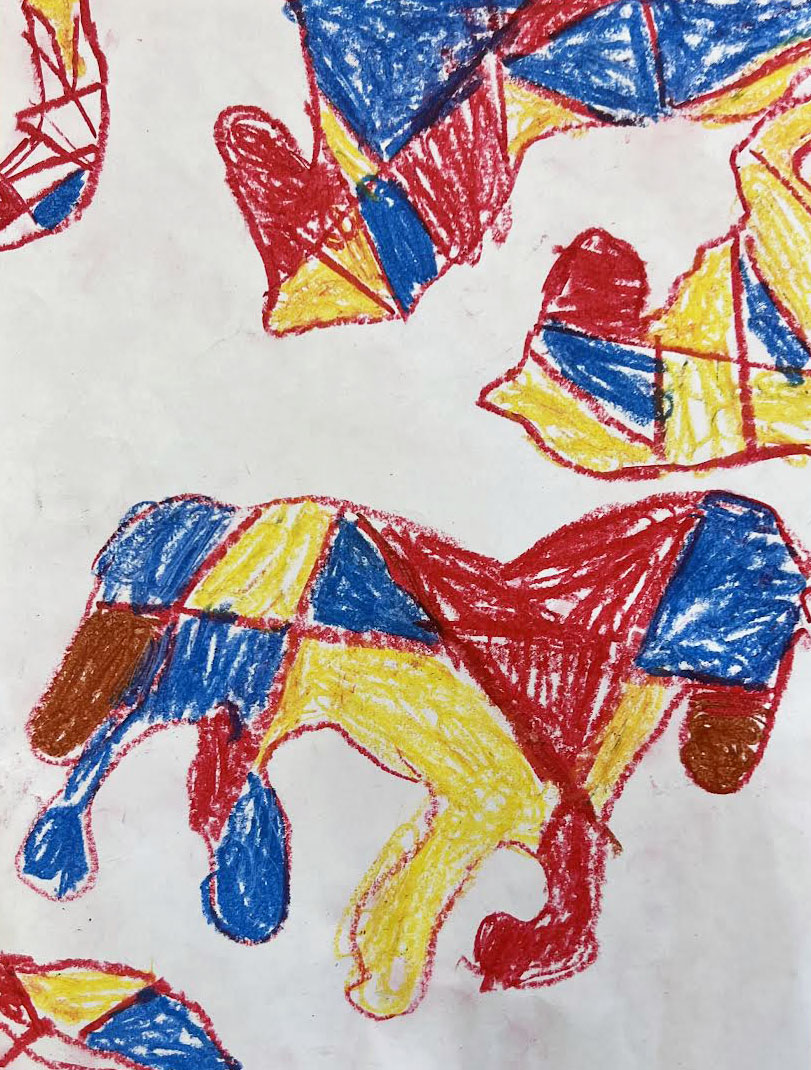
PIET MONDRIAN ANIMALS
Piet Mondrian Animals

Learning Targets
I can...
- Create an original Piet Mondrian Animals using paintings techniques learned in class
- Use line types (horizontal, vertical, diagonal), primary colors (red yellow blue), and shape variation (geometric, organic, free form) inspired by Dutch Artist (1872-Present) Piet Mondrian
- Use art element color (primary colors, red, yellow, blue) and design principles (repetition, composition, contrast) based on Modern Art
- Define Neoplasticism (a style of painting using only vertical lines, horizontal lines, and rectangular shapes in primary colors)
Lesson One
Day One, Art Start
1. Composition No. II (1920) Piet Mondrian

2. Read Piet Mondrian: The Man Who Changed Everything by Waanders Uitgevers Zwolle

3. Discussion Questions "How did Piet Mondrian come to paint this way? How did you choose the placement of colors? What colors do you notice first in the artist's paintings? What she is the largest colored shape? What size is the smallest? What is the most space you have between colored shapes? What is the least? Can you see the shape of a tree in this painting? What makes Piet Mondrian artwork abstract? Is Mondrian thinking about similar things in his artwork? What do you think Piet Modniran is trying to express? How is Piet Mondrian's artwork different from other artists?"
Lesson Activities
1. Choose 12" X 15" Painting Paper
2. Add line types (horizontal vertical diagonal) to the positive space (animal) of the Piet Mondrian Animals
3. Outline line types (horizontal, vertical, diagonal) with neutral colors (black, grey, white) for the positive space (animal) of the Piet Mondrian Animals
Day Two, Art Start
1. Retrieve Piet Mondrian Animals for Assigned Tables
2. Composition A (1923) Piet Mondrian

3. Discussion Questions "Who was Piet Mondrian? What do you notice in this painting Piet Mondrian created? What is Piet Mondrian the founder of? Where was Piet Mondrian born? What shapes did Mondrian mainly use in his paintings? How did Piet Mondrian create straight lines? Who introduced Mondrian to art? How did Piet Mondrian's artwork evolve from 1908 to 1912? What school did Piet Mondrian attend? How did Mondrian's artwork change overtime? What style did Mondrian paint his artwork in? What are movement is Modern Art characterized by? What is the title of this painting?"
Lesson Activities
1. Use primary colors (red yellow blue) to fill in the positive space (animal) of the Piet Mondrian Animals
2. Use primary colors (red yellow blue) to fill in the negative space (background) of the Piet Mondrian Animals
3. Use colored construction paper (blue, red, yellow) to fill in the negative space (background) of the Piet Mondrian Animals
Day Three, Art Start
1. Retrieve Piet Mondrian Animals for Assigned Tables
2. Set Up Studio Area (water bucket, paint brushes, tempera paint)
Lesson Activities
1. Add highlights (reflective light, light source) to fill in the positive space (animal) of the Piet Mondrian Animals
2. Add shadows (reflective shadow, cast shadow) to fill in the negative space (background) of the Piet Mondrian Animals
3. Add details (whiskers, claws, spots, eyelashes) to the positive space (animal) of the Piet Mondrian Animals
Artist Examples
 Student Examples




 Posts

