Tuesday, September 26, 2023
ALEXANDER CALDER MIXED MEDIA FISH
Alexander Calder Mixed Media Fish

Learning Targets
I can...
- Create an original Alexander Calder Mixed Media Fish using sculpture techniques learned in class
- Use primary colors (red yellow blue), form (two dimensional, three dimensional), and texture (actual implied visual) inspired by American Sculptor (1898-1976) Alexander Calder
- Use art element: shape (geometric, organic, free form) and design principles (movement, balance, composition) based on Modern Art
- Define Kinetic Art (any art medium that contains moving elements or requires movement from the viewer)
Lesson One
Day One, Art Start
1. Fish (1944) Alexander Calder

2. Read Alexander Calder: The Art Of Invention by The Bellagio Gallery Of Fine Art

3. Discussion Questions "Who is Alexander Calder? Was Alexander Calder always an artist? What is Alexander Calder most famous for? What was Alexander Calder's favorite subject? What was Alexander Calder's favorite drawing material? What was Alexander Calder's thoughts on sculpture? How can art be realized? Which are some of Alexander Calder's key works? How did Alexander Calder transport some of his artworks? What do critics think of Alexander Calder's artwork? How do you think this artwork moves? Do you feel you are caught in a blustery snowstorm? Do you think Alexander Calder captured the magic of fishing in this performance? What do you think of his work? Does it remind you of anything you have seen before? Have you ever tried to make a mobile?"
Lesson Activities
1. Choose Three 12 X 12 Primary Colored Wires
2. Use three composition elements (shape, color, texture) to represent a Michigan Fish (bowfin, goldfish, minnow, catfish, salmon, trout) for the fish sculptures
3. Use line variation (horizontal, vertical, diagonal) as a design principles (movement, composition, balance) of the Alexander Calder Mixed Media Fish
Day Two, Art Start
1. Retrieve Alexander Calder Mixed Media Fish for Assigned Table
2. Finny Fish (1948) Alexander Calder

3. Discussion Questions "Do you think Alexander Calder balanced this mobile? How do you imagine it stands within the space? Has Calder created a whole new art form? What does this stabile remind you of? Why do you suppose Calder gave the stable a descriptive name (red horse) but left the mobile with a specific name? What do you think about his work? Does it remind you of anything you have seen before? Have you ever tried to make a mobile? How did Alexander Calder design a shape for the installation? What identical shape were used in making the mobile? What is going on in this artwork? What was your first reaction when you saw this artwork? What type of colors are used in this artwork?"
Lesson Activities
1. Use compass, protractors, and texture plates to add symmetrical shapes and expressive lines to fish sculptures
2. Use primary colors (red yellow blue) to fill in the positive space (fish) with embellishments (buttons, ribbons, beads, sequins, pipe cleaners) for the fish sculptures
3. Use primary colors (red yellow blue) to fill in the negative space (background) with embellishments (buttons, ribbons, beads, sequins, pipe cleaners) for the Alexander Calder Mixed Media Fish
Day Three, Art Start
1. Retrieve Alexander Calder Mixed Media Fish for Assigned Tables
2. Set Up Studio Area (glue sticks, construction paper, wire, scissors)
Lesson Activities
1. Use scissors to cut out basic shapes (geometric, organic, free form) for the positive space (fish) of the fish sculptures
2. Use scissors to cut out basic shapes (geometric, organic, free form) for the negative space (background) of the fish sculptures
3. Use felt markers to add beautiful patterns (hearts, swirls, dots) to the positive space (fish) of the Alexander Calder Mixed Media Fish
Artist Examples 


 Student Examples


Tuesday, January 10, 2023
POLISH FOLK ART FLOWERS
Polish Folk Art Flowers Learning Targets

I can...
- Create an original Polish Folk Art Flowers using collage techniques learned in class
- Use color combinations (analogous, complementary, secondary), shape variation (geometric, organic, free form), and value (lightness, darkness) inspired by Canadian Artist (2022-Present) Veronique Charron
- Use paper techniques (folding, cutting, layering, origami) and design principles (repetition, balance, emphasis) based on Polish Folk Art
- Define Łowicz (a flower, rooster, or geometric motif consisting of multiple colors cut out and glued together in layers)
Lesson One
Day One, Art Start
1. Folk Floral 2 Dark (2022) Veronique Charron

2. Read Flowers Bloom In Warsaw by Tae-neon Kim

3. Discussion Questions "What else would you like to learn about Poland? What skills have you used or improved today? What is similar about the pieces? What do you like about these pieces? What do you dislike about these pieces? What do you notice about the colors? What do you notice about the subject matter of the paper cut outs? Are all the paper cut outs symmetrical? Can you think of successful criteria for a piece of Polish Folk Art? What are some buildings that are found in all communities? What are some jobs that people have in a community? What do you see in each picture?"
Lesson Activities
1. Choose 12 X 15 Colored Construction Paper
2. Draw three thumbnail sketches of paper cut outs using drawing techniques (contour, outline, continuous) for the folk art flowers
3. Add symbols (peacocks, doves, roosters, birds, star-shaped medallions, flowers, holiday themes) to the positive space (foreground) of the Polish Folk Art Flowers
Day Two, Art Start
1. Retrieve Polish Folk Art Flowers for Assigned Tables
2. Folk Floral II (2022) Veronique Charron

3. Discussion Questions "Where did the art of Wycinanki come from? ow has the art of Wycinanki developed? What are some examples of symmetrical designs? What are some examples of asymmetrical designs? How do you think this artwork could have been improved? What were the reasons and motivations for this shift in art making? What was Polish Conceptualism? What was your first reaction to this artwork? Why do you think you had that reaction? Does your opinion about the artwork change the longer you look at it? What do you think this artwork was created for? What title would you give this artwork?"
Lesson Activities
1. Use paper techniques (folding, cutting, layering) to add basic shapes (geometric, organic, free form) to the folk art flowers
2. Use paper techniques (folding, cutting, layering) to fill in the positive space (foreground) of the folk art flowers
3. Use paper techniques (folding, cutting, layering) to add details (peacock, doves, roosters, birds, star-shaped medallions, flowers, holiday themes) to the positive space (foreground) of the Polish Folk art Flowers
Day Three, Art Start
1. Retrieve Polish Folk Art Flowers for Assigned Tables
2. Set Up Studio Area (construction paper, scissors, glue sticks)
Lesson Activities
1. Use symbolic colors (white, black, yellow, green, brown) to fill in the negative space (background) of the folk art flowers
2. Use symbolic colors (white, black, yellow, green, brown) to fill in the positive shape (foreground) of the folk art flowers
3. Add design details (star, snow, doves) to the positive space (foreground) of the Polish Folk Art Flowers
Artist Examples


 Student Examples


Wednesday, January 5, 2022
GILLIAN AYRES INSPIRED COLLAGES
Gillian Ayres Inspired Collages

Learning Targets
I can...
- Create an original Gillian Ayres Inspired Collages using drawing techniques learned in class
- Use line types (horizontal, vertical, diagonal), shape variation (geometric, organic), and value (tints, shades) inspired by English Painter (1930-2018) Gillian Ayres
- Use painting techniques (pigment, pointillism, layering) and design principles (garadation, proportion, composition) based on Abstract Expression
- Define Collage (a piece of art made by sticking various materials (photographs, paper, fabric) together)
Lesson One
Day One, Art Start
1. Song Beneath the Stars (2009-2010) Gillian Ayres

2. Read Gillian Ayres by Mel Gooding

3. Discussion Questions "What do you think the artist is thinking about when working in this painting? Do you think the artist will know what the painting will look like when it his finished? How do artists know when an artwork is complete? Do you think this work is inspired by American Abstract Expressionism? What do you think the origin of the titles say about the artwork? How are these titles inspired from historical literature and classical mythology? How do you think the artist feels about painting? Do you think artists should keep changing their style?"
Lesson Activities
1. Choose 12" X 15" Drawing Paper
2. Draw three line types (horizontal, vertical, diagonal) as a line design for the abstract collages
3. Outline three line types (contour continuous outline) with black oil pastels for the Gillian Ayres Inspired Collages
Day Two, Art Start
1. Retrieve Gillian Ayres Inspired Collages for Assigned Table
2. The Seeds That Woke The Clay (2010) Gillian Ayres

3. Discussion Questions "What does art mean to you? What ideas, concerns, or objectives have motivated your work? How would you describe your artistic style? What is success or successful to you? Is there a distinct mood? Does it make you think about anything? Does anything jump out at you? What did the artist say about the piece? How did you start out as an artist? When do you feel your best? Do you struggle with comparison to other artists? If so, how are you able to move past this? What do your paintings reveal about your personality? Where or how do you rediscover inspiration? Who is the artist shown above?"
Lesson Activities
1. Use drawing techniques (contour outline continuous) to add basic shapes (geometric organic) to the positive space (foreground) of the abstract collages
2. Use drawing techniques (contour outline continuous) to add basic shapes (geometric organic) to the negative space (background) of the abstract collages
3. Use drawing techniques (contour outline continuous) to add details (patterns, texture, designs) to the Gillian Ayres Inspired Collages
Day Three, Art Start
1. Retrieve Gillian Ayres Inspired Collages for Assigned Tables
2. Set Up Studio Area (scissors, glue sticks, paper, oil pastels)
Lesson Activities
1. Use complementary colors (red green; blue orange; yellow purple) to fill in the positive space (foreground) of the abstract collages
2. Use complementary colors (red green; blue orange; yellow purple) to fill in the negative space (background) of the abstract collages
3. Add design details (pattern texture designs) to the positive space (foreground) of the Gillian Ayres Inspired Collages
Artist Examples
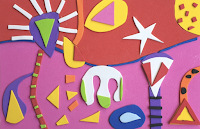

 Student Examples


Monday, November 22, 2021
AUSTRALIAN ABORIGINALS
Australian Aboriginals

Learning Targets
I can...
- Create an original Australian Aboriginal using drawing techniques learned in class
- Use line types (horizontal, vertical, diagonal), shape variation (geometric, organic), and value (tints, shades) inspired by Australian Artist (1926-1998) Rover Thomas
- Use painting techniques (pigment, pointillism, layering) and design principles (gradation, proportion, composition) based on Indigenous Art
- Define Dot Painting (produced by repeated imprints of paint covered brushes, dotting sticks, or instruments onto a surface)
Lesson One
Day One, Art Start
1. Dumbun Owls (1987) Rover Thomas

2. Read Roads Cross: The Paintings of Rover Thomas by National Gallery of Australia

3. Discussion Questions "Who are Australian Aborigines? What styles of storytelling do Australian Aborigines practice? What is the Rainbow Serpent? Do Indigenous people own their own land? Have Indigenous people always owned their own land? Have Indigenous children always been brought up by their families? What kinds of food are available to Indigenous people? What is life-like for Indigenous people today? What is a Monotreme animal? Which two animals are Monotremes? What is a Marsupial mammal? Which three animals are Marsupials? What is a Placental mammal? Which of the following is a Placental mammal? Which Australian bird has a bird head and kills snakes? Which Australian bird is the second largest bird in the world?"
Lesson Activities
1. Choose 8 X 12 Drawing Paper
2. Add line types (contour, outline, perspective) to positive space (animal) of animal drawings
3. Outline line types (contour, outline, perspective) with neutral colors (black, brown, grey) for the Australian Aboriginals
Day Two, Art Start
1. Retrieve Australian Aboriginals for Assigned Table
2. Marlu- Kangaroo Dreaming (1995) Rover Thomas

3. Discussion Questions "What two species of Crocodile live in Australia? Which of the two crocodile species is bigger? How many species of snakes are there in Australia? Which Australian snake is considered the most poisonous? Which is the largest Shark in Australian Waters? Does the artist paint in long brushstrokes? Are the lines curved, straight, thick, or thin? Does the artist use a variety of shapes? What types of shapes do you see? What are the colors that the artist uses? What do you think the black cone is? What do you think the red and yellow shapes around the cone are? What are similarities in the story behind this painting and the ones you have heard before?"
Lesson Activities
1. Use warm colors (red orange yellow) to fill in the positive space (animal) of the animal paintings
2. Use cool colors (green blue purple) to fill in the negative space (background) of the animal paintings
3. Use embellishments (plastic eyes, bubble wrap, brown paper) to fill in the positive space (animal) of the Australian Aboriginals
Day Three, Art Start
1. Retrieve Australian Aboriginals for Assigned Table
2. Set Up Studio Area (tempera paint, popsicle sticks, paint brushes)
Lesson Activities
1. Add highlights (reflective light, light source) to fill in the positive space (animal) of the animal drawings
2. Add shadow (cast shadow, reflective shadow) to fill in the negative space (background) of the animal drawings
3. Add details (whiskers, spots, eyelashes) to the positive space (animal) of the Australian Aboriginals
Artist Examples


 Student Examples


Sunday, August 8, 2021
POLAR BEAR LANDSCAPES
Polar Bear Landscapes

Learning Targets
I can...
- Create an original Polar Bear Landscape using drawing techniques learned in class
- Use neutral colors (white, grey, brown), shape variation (geometric organic), and line types (horizontal, vertical, diagonal) inspired by Canadian Artist (2004-Present) Kal Barteski
- Use painting techniques (wet on wet, dry brush, blending) and design principles (balance movement proportion) based on Contemporary Art
- Define Silhouette (an image of a person, animal, object, or scene represented as a solid shape of a single color)
Lesson One
Day One, Art Start
1. Whatever You Love, You Are (2018) Kal Barteski

2. Read Polar Bears by Gail Gibbons

3. Discussion Questions "What could be better than a cozy, textured polar bear? Do polar bears live in Antarctica? Why do polar bears have white fur? Why do polar bears have such big feeT? Why do polar bears need ice? Do polar bears hibernate? Where do polar bears sleep? Can polar bears Wim well? In which season are polar bears born? What age do polar bears live? How many cubs do mother polar bears have? How big are polar bear cubs when they are born? How does a polar bear keep warm? Why does a polar bear have very wide, large paws? Why does a polar bear have nostrils that it can close?"
Lesson Activities
1. Use three geometric shape (rectangle, oval, circle) to create a three dimensional silhouette of a polar pear for the winter landscapes
2. Add details (eyes, nose, claws) to the three dimensional silhouette of the polar bear for the winter landscapes
3. Outline positive space (polar bear) with neutral colors (black, brown, grey) for the Polar Bear Landscapes
Day Two, Art Start
1, Retrieve Polar Bear Landscapes for Assigned Table
2. The Same But Different (2021) Kal Barteski

3. Discussion Questions "What do you see in this picture? Does your picture have space or distance? Does your picture have a horizon line, one point perspective, or background? How can we create the illusion of depth within our own Polar Bear Landscapes? What do you think was the most important tool the artist used when creating this work? Why are you drawn to this subject? What connections did the artist have to her work? Does this artwork represent something about the artist? Is there an element of the artwork you enjoy working with most? What do you think Kal Barteski meant when creating this artwork?"
Lesson Activities
1. Add finished details (eyes, nose, claws) to the positive space (polar bear) of the winter landscapes
2. Finish outlining positive space (polar bear) with neutral colors (brown, black, grey) for the winter landscapes
3. Add embellishments (salt, glitter, metallic) for the negative space (background) of the Polar Bear Landscapes
Day Three, Art Start
1. Retrieve Polar Bear Landscape for Assigned Table
2. Set Up Studio Area (water bucket, paintbrush, watercolor)
Lesson Activities
1. Finish adding embellishments (salt, glitter, metallic) for the negative space (background) of the Polar Bear Landscapes
2. Add neutral colors (brown black grey) to the three dimensional silhouette (polar bear) of the Polar Bear Landscapes
3. Add value (highlights, shadows) to the positive space (polar bear) of the Polar Bear Landscapes
Artist Examples
 Student Examples


 Posts

