Thursday, November 21, 2024
SEQUIN PAINTINGS
Sequin Paintings

Learning Targets
I can...
- Create an original Sequin Painting using mixed media techniques learned in class
- Use color combinations (analogous, complementary, primary), line types (horizontal, vertical, diagonal), and texture (actual, visual, implied) inspired by Performance Artist (1946-2020) Tina Girouard
- Use textile art (fiber, woven fabric, embroidery, knitwear) and design principles (contrast, repetition, emphasis) based on Post Minimalism
- Define Sequin (a small, shiny disk sewn as one of many onto clothing or canvas for decoration)
Lesson One
Day One, Art Start
1. Hibiscus (1995) Tina Giroaurd

2. Watch A Brief History Of Sequins by The Great British Sewing Bee

3. Discussion Questions "Why do humans beings have a need for art or visual art forms? What is the purpose of a ritual? Did you know sequins were invented in 1960 by two American women who sold the idea to an English company? Did you know the trend of sequins on clothes started in an Egyptian tomb? Did you know Michael Jackson, King Tut, and Leonardo Da Vinci had sequin pendants? Would you wear clothing made entirely from sequins? How do artists use various mediums to explore complex themes of identity, spirituality, social justice, and global issues? Are there places you should not wear sequin clothing? Did you know Leonardo Da Vinci sketched plans for a sequin making machine? Did you know the ruby slippers from Wizard Of Oz were made out of sequins?"
Lesson Activities
1. Use neutral colors (black, grey, white) to fill in the positive space (foreground, subject matter) for the sequin paintings
2. Use white lines (thin, thick, curved) to add patterns (stripes, waves, dots) to the positive space (foreground, subject matter) of the sequin paintings
3. Use black lines (thin, thick, curved) to add patterns (stripes, waves dots) to the negative space (background) of the Sequin Paintings
Day Two, Art Start
1. Retrieve Sequin Paintings for Assigned Tables
2. Pink Floral (Lily Pad) (1990) Tina Girouard

3. Discussion Questions "How do artists work? How has the practice of the artist changed overtime? What role do artist shave in society? What is integral to the work of an artist? What is the background of the work? What are do you most identify with? What is your strongest memory of your childhood? What is your favorite artwork? Which two colors are used in negative space photographs? What does it captivate, in terms of emotions, to the audience of negative space? What are the three basic elements of composition needed in drawing? What is positive space in art? Which is the difference between positive and negative space? Which is easier to understand between the two different spaces? Which do you think is more important the positive space of the negative space? Can you see all hidden images in the designs below?"
Lesson Activities
1. Use color combinations (analogous, complementary, secondary) to fill in the positive space (foreground, subject matter) with sequins for sequin paintings
2. Use color combinations (analogous, complementary, secondary) to fill in the negative space (background) with sequins for the sequin paintings
3. Use drawing techniques (blending layering overlapping) to add contrast to the composition of the Sequin Paintings
Day Three, Art Start
1. Retrieve Sequin Paintings for Assigned Tables
2. Set Up Studio Area (canvas, sequins, glue sticks, hot glue, pencils)
Lesson Activities
1. Add highlights (reflective light, light source) to the positive space (foreground, subject matter) of the sequin paintings
2. Add shadows (cast shadow, shadow) to the negative space (background, middle ground) of the sequin paintings
3. Add overlapping shapes (circles, ovals, round shapes) to the positive space (foreground, subject matter) of the Sequin Paintings
Artist Examples


 Student Examples


Wednesday, September 27, 2023
BANKSY STYLIZED STENCILS
Banksy Stylized Stencils

Learning Targets
I can...
- Create an original Banksy Stylized Stencils using drawing techniques learned in class
- Use neutral colors (black, grey, white), shape variation (geometric, organic, free form), and space (positive, negative) inspired by Street Artist (1974-Present) Banksy
- Use printmaking techniques (screen print, engraving, wood cut, etching) and design principles (repetition, balance, scale) based on Public Art
- Define Street Art (art displayed in public on surrounding buildings, streets, trains, and publicly viewed surfaces)
Lesson One
Day One, Art Start
1. Child With Kite Fridge (2008) Banksy

2. Read Banksy: The Man Behind The Wall by Will Ellsworth-Jones

3. Discussion Questions "What is the difference between street art, graffiti, and a mural? Why do you think Banksy wants to stay anonymous? Can you still Graffiti art? How do graffiti artists support themselves? What is a street artist you may have heard of? Should artists use art to share opinions of events that are happening in the world? What messages do you think Banksy is sending through this painting? What is he saying about elderly and the young in society? What do you think Banksy is saying about society and wealthy people, through this piece of art? What do you think of this art? Why do you think the artist painted this picture? What moral or message could be behind this picture? What kind of person do you think the artist is? Should street at be legalized? What would happen for Banksy to consider his art a success? What would happen if Banksy painted a mural in your town or city?"
Lesson Activities
1. Use pencil to draw shape variation (geometric, organic, free form) of the selected object (keys, shoes, balloons) of the Banksy Stylized Stencils
2. Use shape variation (geometric, organic, free form) to fill in the positive space (object) with neutral colors (black, grey, white, brown) of the Banksy Stylized Stencils
3. Use shape variation (geometric, organic, free form) to fill in the negative space (background) with neutral colors (black, grey, white brown) of the Banksy Stylized Stencils
Day Two, Art Start
1. Retrieve Banksy Stylized Stencils for Assigned Tables
2. Girl With Balloon (2004) Banksy

3. Discussion Questions "Which area of the artwork is most important? How did this artist use space? How did the artist use balance? How did the artist use proportion? How does your eye move through the artwork? What choice did the artist make to make that happen? Why did you remember what you remembered? Why did you forget what you forgot? How would you describe this artwork to someone who has never seen it? What elements of this painting seem real? What adjectives would you use to describe this artwork? What verbs would you use to describe this artwork? What elements seem dreamlike or imaginary? What is strange about this artwork? What is exciting about this artwork? What do we know about the artist after viewing this artwork? Why do you think the artist created this artwork?"
Lesson Activities
1. Use neutral colors (black, grey, white) to fill in the positive space (foreground) of the Banksy Stylized Stencils
2. Use neutral colors (black, grey, white) to fill in the negative space (background) of the Banksy Stylized Stencils
3. Use line types (horizontal, vertical, diagonal) to fill in the negative space (background) of the Banksy Stylized Stencils
Day Three, Art Start
1. Retrieve Banksy Stylized Stencils for Assigned Tables
2. Set Up Studio Area (speed ball ink, brayers, paint brushes)
Lesson Activities
1. Add highlights (reflective light, light source) to the positive space (foreground) of the Banksy Stylized Stencils
2. Add shadows (cast shadow, shadows) to the negative space (background) of the Banksy Stylized Stencils
3. Add relief pieces (styrofoam pieces, cardboard, poster board) to the positive space (foreground) of the Banksy Stylized Stencils
Artist Examples


 Student Examples


Friday, August 25, 2023
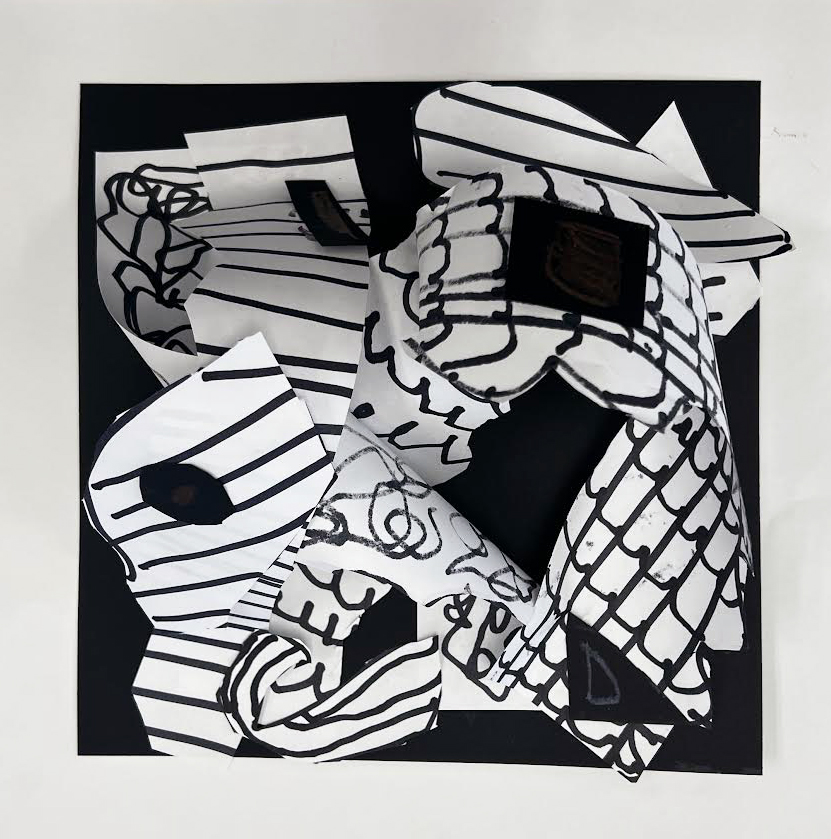
CHARLES MCGEE PAPER SCULPTURES
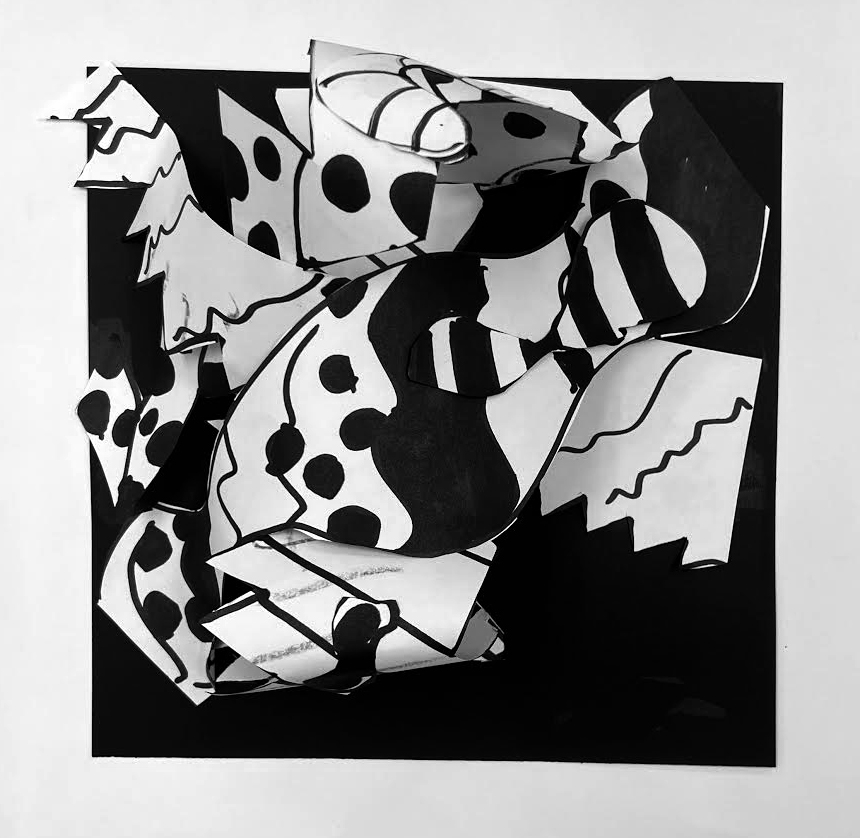
Charles McGee Paper Sculptures
Learning Targets
I can...
- Create an original Charles McGee Paper Sculpture using drawing techniques learned in class
- Use neutral colors (black, white, grey), shape variation (geometric, organic, free form), and form (two dimensional, three dimensional) inspired by Michigan Artist (1924-2021) Charles McGee
- Use principle of design: pattern (zentangles, swirls, nature, stripes) and design principles (emphasis, repetition, contrast) based on Contemporary Art
- Define Relief (a wall mounted sculpture in which the three-dimensional elements are raised from a flat base)
Lesson One
Day One, Art Start
1. Rhapsody In Black And White (2008) Charles McGee

2. Read Charles McGee: 2008 Eminent Artist by Michelle Perron of Kresge Arts In Detroit

3. Discussion Questions "Does this remind you of a color or black and white movie overall? Is this low-key or high-key colors? What colors does he use to give a sense of sailing? What can you recognize in this artwork? What is a ritual? Does the artist make artwork for ritual purposes? Why do you think he used these images? What is line? Can you see line in this artwork? When you look at the artwork is the back and white areas balanced? Can you see a rectangular form in the composition? Does the rectangular box look like it is in front or behind the drawn objets? Have you ever looked at clouds and seen animas or different recognizable things? If you look at this artwork, do you see things that remind you of anything? What is value? What colors display different values? How does McGee create the lace-like imagery?"
Lesson Activities
1. Choose 12" by 12" Colored Construction Paper
2. Use three compositional elements (shape, color, texture) to represent a memory, place, or event for paper sculptures
3. Use line variation (stripes, swirls, dots, curls) as a design principles (balance, movement, repetition) with the Charles McGee Paper Sculptures
Day Two, Art Start
1. Retrieve Charles McGee Paper Sculptures for Assigned Tables
2. Regeneration (Drawing For Ford Hospital Installation) (2005) Charles McGee
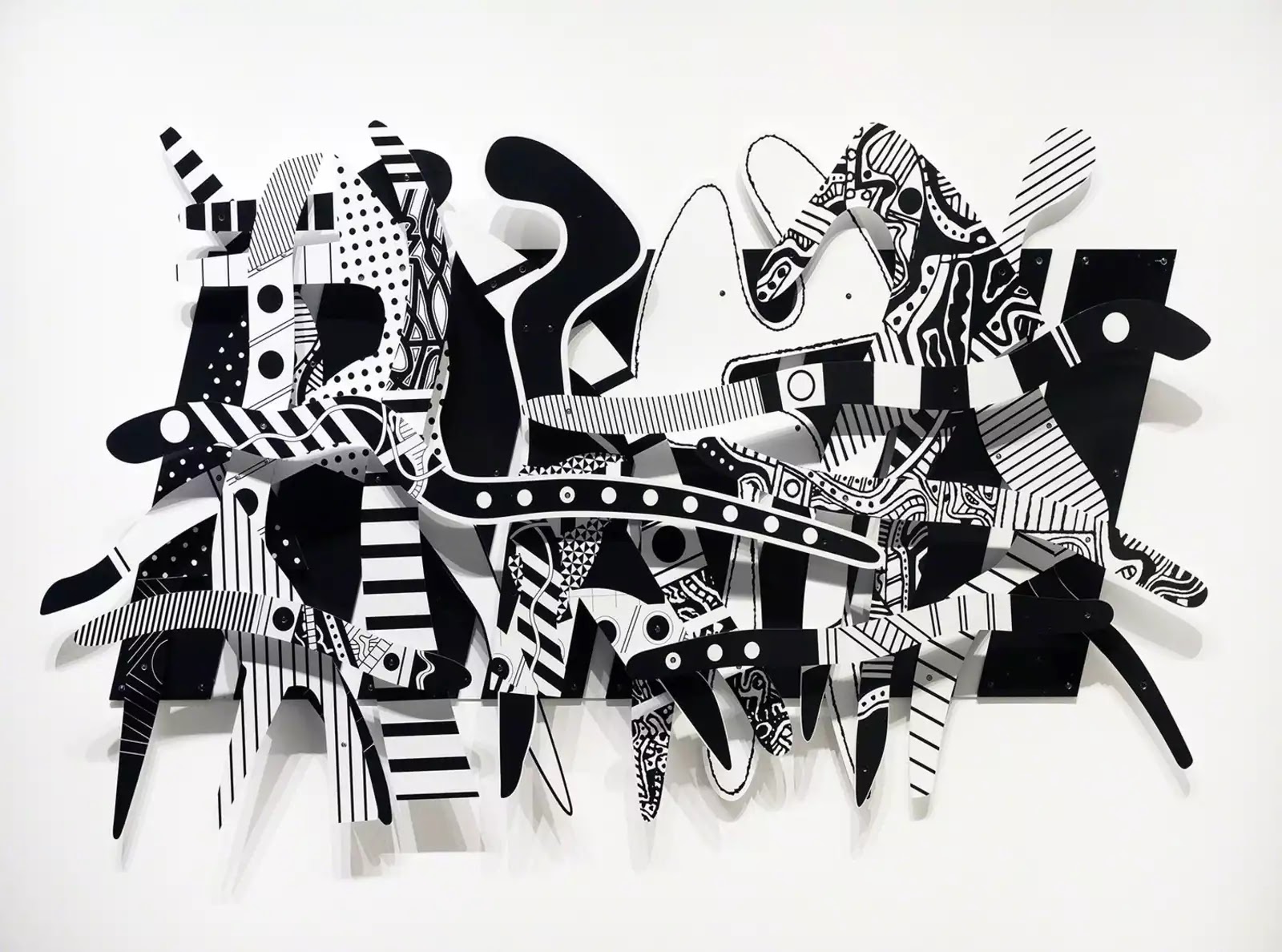
3. Discussion Questions "Can you see what figures are in the foreground and background within the central human forms? What is abstraction? How are the human forms abstract in this artwork? What is texture? How does McGee create texture on the forms? How can artists create textures on two-dimensional art? What do you think the title of the work means? What is the difference between these two paintings? What do you think the name of the paintings mean? Why did McGee paint snakes as if he was looking at them from above? What cultures can you compare McGee's artwork too? Why do you think the artist might use snakes in his artwork? What is significant about these colors?"
Lesson Activities
1. Use compasses, protractors, and texture plates to add symmetrical shapes and expressive lines to the paper sculptures
2. Use complementary colors (red, green; blue, orange; yellow, purple) to fill in the negative space (background) of the paper sculptures
3. Use complementary colors (red, green; blue, orange; yellow, purple) to fill in the positive space (foreground) of the Charles McGee Paper Sculptures
Day Three, Art Start
1. Retrieve Charles McGee Paper Sculptures for Assigned Tables
2. Set Up Studio Area (glue sticks, construction paper, markers)
Lesson Activities
1. Use scissors to cut out two dimensional symmetrical shapes (circle, triangle, rectangle, oval) to create a three dimensional paper sculpture
2. Glue down three dimensional symmetrical shapes (cone, prism, pyramid, cylinder, cube) to create a simplified paper sculpture
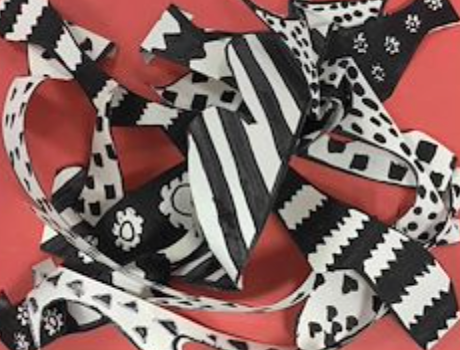
3. Use sharpie markers to add beautiful patterns (hearts, swirls, flowers, dots) to the positive space (foreground) of the Charles McGee Paper Sculptures
Artist Examples

 Student Examples






Wednesday, January 11, 2023
WAYNE THIEBAUD INSPIRED LOLLIPOPS
Wayne Thiebaud Inspired Lollipops Learning Targets

I can...
- Create an original Wayne Thiebaud Inspired Lollipops using drawing techniques learned in class
- Use color combinations (analogous, monochromatic, complementary), shape variation (geometric, organic, free form), and value (lightness, darkness) inspired by American Painter (1920-2021) Wayne Thiebaud
- Use oil pastel techniques (blending, layering, thick application) and design principles (balance, composition, repetition) based on American Art
- Define Repetition (repeating a single element many times in a design)
Lesson One
Day One, Art Start
1. Six Lollipops (1964) Wayne Thiebaud

2. Read Oliver's Lollipop by Allison Wortche

3. Discussion Questions "Have you ever seen a scene like this? What seems unusual about it? What do you see? What types of lollipops are there? Where are these lollipops? How are the lollipops displayed? How is the painting drawn? How can you tell? What is the painting about? What is happening in the picture? What is the mood here? Why do you say that? How hungry are you? Which fraction or fractions represent this lollipop? How many layers does this lollipop consist of? Which of the choices below are the smallest lollipops? What types of lollipops do you like? what is the shape of your lollipop? How would you decorate your lollipop? What colors are used for this type of lollipop?"
Lesson Activities
1. Choose a 12 X 12 Drawing Paper
2. Use a graphite pencil to draw shape variation (geometric, organic, free form) for the positive space (foreground) of the lollipop paintings
3. Use graphite pencil to draw line types (horizontal, vertical, diagonal) for the positive space (foreground) of the Wayne Thiebaud Inspired Lollipops
Day Two, Art Start
1. Retrieve Wayne Thiebaud Inspired Lollipops for Assigned Tables
2. Seven Suckers (1970) Wayne Thiebaud

3. Discussion Questions "What materials does Wayne Thiebaud use? Who was Wayne Thiebaud influenced by? What color schemes does he use analogous, complementary, or secondary? What kind of artist is Wayne Thiebaud? How about texture- actual, visual, or implied? How do you think these lollipops would feel? Which lollipop is easier to reach? How do the shadows help this artwork to look real? What do you think the message is? Could it be feelings, stories, memories, or just creating good art? What do you see? Where are these lollipops? How are these displayed? How is the painting made? How can you tell? What is the painting about? What is happening? What is the mood here? Why do you say that?"
Lesson Activities
1. Use oil pastels to fill in the positive space (foreground) with color combinations (analogous, complementary, secondary) of the lollipop paintings
2. Use oil pastels to fill in the negative space (background) with color combinations (analogous, complementary, secondary) of the lollipop paintings
3. Add details (background, decorations, wallpaper) to the negative space (background) of the Wayne Thiebaud Inspired Lollipops
Day Three, Art Start
1. Retrieve Wayne Thiebaud Inspired Lollipops for Assigned Tables
2. Set Up Studio Area (oil pastels, glue sticks, pencils)
Lesson Activities
1. Add highlights (light source, reflective light) to the positive space (foreground) and negative space (background) of the lollipop paintings
2. Add shadows (cast shadow, reflective shadow) to the negative shape (background) and positive space (foreground) of the lollipop paintings
3. Add embellishments (glitter, beads, ribbon) to details (background, decorations, wallpaper) of the Wayne Thiebaud Inspired Lollipops
Artist Examples


 Student Examples


Wednesday, September 2, 2020
SNAILS WITH SHADOWS
Snails With Shadows

Learning Targets
I can...
- Create an original Snails With Shadows using drawing techniques learned in class
- Use rainbow order (red orange yellow green blue purple), shape variation (geometric, organic, free form), and space (positive, negative) inspired by Swirl by Swirl: Spirals in Nature by Joyce Sidman
- Use drawing techniques (smudging, blending, smoothing) and design principles (composition, repetition, gradation) based on Illustrations
- Define Spiral (a curved line moving farther away as it revolves around a point)
Lesson One
Day One, Art Start
1. Snail (1966) David Klein

2. Read Swirl by Swirl: Spirals in Nature by Joyce Sidman

3. Discussion Questions "What do snails eat? Why do snails have a shell? What is the largest snail species? How do snails move? What are snails a symbol of? What is the difference between a snail and a slug? Are slugs related to snails? Is a snail's shell its house? Can snails outgrow or leave their shells? What happens if a snail's shell gets cracked? Are land snails related to the animals that make seashells? Do snails do anything for the ecosystem? Can snails see, hear, or smell? Why are snails so slimy? What is the biggest snail in the world? What is the smallest snail in the world? How long do snails live?"
Lesson Activities
1. Choose 12" by 15" Drawing Paper
2. Draw three thumbnail sketches of snails using observational drawing skills (contour, outline, continuous) for snail drawings
3. Add details (shadows, reflective light) to negative space (background) of Snails With Shadows
Day Two, Art Start
1. Retrieve Snails With Shadows for Assigned Table
2. Snails (2012) David Klein

3. Discussion Questions "Are snails nocturnal? Why do snails leave slime behind them as they travel? Do snails hibernate in the winter? Can snails be found everywhere on Earth? Are there more snails or insects on earth? How many different types of snail species are there that live in the sea, freshwater, or on land? How many teeth do garden snails have? How do snails protect themselves from predictors? What are the characteristics of a snail? Do you know where the snail's eyes are? How big can snails grow?"
Lesson Activities
1. Use drawing techniques (contour, outline, continuous) to add basic shapes (circle, oval, rectangle) to snail drawings
2. Use design principles (composition, repetition, gradation) to fill in the positive space (snail) of the snail drawings
3. Use drawing techniques (contour, outline, continuous) to add patterns (loops, swirls, waves) to positive space (shell) of Shadows With Snails
Day Three, Art Start
1. Retrieve Shadows With Snails for Assigned Table
2. Set Up Studio Area (oil pastel, eraser, pencils)
Lesson Activities
1. Use rainbow order (red orange yellow green blue purple) to fill in the positive space (snail) of the snail drawings
2. Use neutral colors (black, white, grey) to fill in the negative space (background) of the snail drawings
3. Add design details (shadows, reflective light, table) to negative space (background) of the Snails With Shadows
Artist Examples


 Student Examples


 Posts

