Monday, August 26, 2024
GERGELY DUDAS SEARCH DRAWINGS
Gergely Dudas Search Drawings
Learning Targets

I can...
- Create an original Gergely Dudas Search Drawing using collage techniques learned in class
- Use shape variation (geometric, organic, free form), line types (horizontal, vertical, diagonal), and color combinations (analogous, secondary, primary) inspired by Hungarian Artist (2019-Present) Gergely Dudas
- Use drawing techniques (shading, blending, overlapping) and design principles (composition, repetition, movement) based on Seek And Find Cartoons
- Define Repetition (the use of two or more of the same or similar elements such as colors, shapes, or lines)
Lesson One
Day One, Art Start
1. Find BB-8 (2024) Gergely Dudas

2. Read Bear's Spooky Book Of Hidden Things (2018) Gregory Dudas

3. Discussion Questions "Did you ever play "I Spy with my Little Eye" game? What are your favorite games to play at home and in the classroom? What does "I Spy" mean? Where did "I Spy With My Eye" come from? Have you played I Spy games indoors or outdoors? Have you played the I Spy game with friends, family, or adults? How do you play "I Spy with my little eye?" What are the rules of this game? When you play I Spy, do you use yes or no questions to help find the answer? Does I Spy use number recognition or shape identification for young children? Why would visual perception be an important skill for learning to read? What are some of your interests? What do you notice in your surroundings?"
Lesson Activities
1. Use three geometric shapes (rectangle, oval, circle) to create a three dimensional silhouette of a fall animal (fox, moose, squirrel, deer) for the search compositions
2. Add details (eyes, nose, claws) to the three dimensional silhouettes of a fall animal (fox, moose, squirrel ,deer) for the search compositions
3. Outline the positive space (foreground, animals) with neutral colors (black, grey, white) for the Gergely Dudas Search Drawings
Day Two, Art Start
1. Retrieve Gergely Dudas Search Drawing for Assigned Tables
2. Sheep Among Goats (2024) Gregely Dudas

3. Discussion Questions "What do you notice is different with the shapes, colors, and arrangement within this artwork? What is the same and different about each picture? What colors are being used in this artwork? Which area of the artwork is emphasized by the artist? How would you describe this artwork to someone who has never seen it? How does the artist use rotation and translation to create a search composition? Do you think a circle or oval could fill the search composition? Do any spaces cover the space exactly? How can you explain the movement of one tile to another tile? Did everyone use the same number of shapes in their search compositions? Why might the number of shapes vary between students? How many different arrangements did you discover?"
Lesson Activities
1. Add finishing details (eyes, nose, claws) to the positive space (animal, foreground) of the search compositions
2. Use neutral colors (black, grey, white) to outline the positive space (animal, foreground) of the search compositions
3. Add embellishments (salt, glitter, metallic) for the negative space (background, negative space) of the Gergely Dudas Search Drawings
Day Three, Art Start
1. Retrieve Gergely Dudas Search Drawings for Assigned Tables
2. Set Up Studio Area (colored pencils, erasers, markers, sharpeners)
Lesson Activities
1. Add embellishments (salt, glitter, metallic) for the negative space (background, negative space) of search compositions
2. Add neutral colors (black, white, brown, grey) to the three dimensional silhouettes (animal, foreground) of the Gergely Dudas Search Drawings
3. Add value (lightness, darkness, highlights, shadows) to the positive space (animal, foreground) of the Gergely Dudas Search Drawings
Artist Examples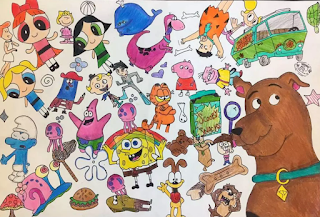


 Student Examples


Tuesday, January 5, 2021
WILLIAM WEGMAN PHOTOMONTAGES
William Wegman Photomontages

Learning Targets
I can...
- Create an original William Wegman Photomontage using drawing techniques learned in class
- Use line types (continuous contour outline), shape variation (geometric organic free form) and value (lightness darkness) inspired by American Artist (1943-Present) William Wegman
- Use collage techniques (overlapping cropping layering) and design principles (composition balance proportion) based on American Art
- Define Photomontage (overlapping or rearranging photographs to create an image)
Lesson One
Day One, Art Start
1. Coach From The Cinderella Portfolio (1994) William Wegman

2. Read "Flo & Wendell Explore" by Dial Books For Younger Readers

3. Discussion Questions "What type of dog did the artist photograph? What do artists use as motivation? What do you like about this photograph? Who or what are the Hardly Boys? How does the artist create these photographs? What do you think is the most difficult scene to photograph? How would you describe this artwork to someone? How did Wegman's skills as a photographer leave a unique mark on the television and art world? What mood could be described in this artwork? What makes Wegman's photography unique? Which two factors made 1979 a miserable time for Wegman? What does this image demonstration his skill of? What should all the photographs have? What do you like about this style?"
Lesson Activities
1. Choose 12" X 15" Drawing Paper
2. Use pencil to draw a contour line of facial proportions (eyes, nose, mouth) of animals for animal collages
3. Use pencil to add facial features (fur, wings, eyelashes) to positive space (animal) of animals for animal collages
Day Two, Art Start
1. Retrieve William Wegman Photomontages from Assigned Table
2. Igor Or Ivan (2001) William Wegman

3. Discussion Questions "What portraits did you especially like or dislike? What do you think a portrait shows about your identity? Why do you identify with that particular cultural group? What do you admire about these photographs? How can you make your own portrait better after looking at other portraits? What is the difference between a portrait and a self portrait? Why is it difficult to draw a portrait? Why is the most outstanding part of your portrait? How can you use close observational skills to draw a portrait?"
Lesson Activities
1. Add adornments (piercings tattoos hairstyle) to positive space (face nose shoulder) of animal collages
2. Add costumes (jewelry, clothing, make up) to positive space (facial features) of animal collages
3. Use black sharpie marker to outline facial features (nose mouth eyes) and clothing (costumes, hats, scarfs) of William Wegman Photomontages
Day Three, Art Start
1. Retrieve William Wegman Photomontages from Assigned Table
2. Set Up Studio Area (scissors, glue, magazines)
Lesson Activities
1. Use multicultural colored pencils to fill in the positive space (clothing jewelry facial features) of animal collages
2. Use watercolor pencils to fill in the negative space (background landscape wallpaper) of the animal collages
3. Use value (lightness darkness) to add shadows and highlights to the William Wegman Photomontages
Artist Examples


 Student Examples


 Posts
Posts

