Monday, August 12, 2024
POP PIXEL PROJECT
Pop Pixel Project

Learning Targets
I can...
- Create an original Pop Pixel Project using collage techniques learned in class
- Use shape variation (geometric, organic, free form), space (positive, negative), and value (lightness, darkness) inspired by South African Artist (1971-Present) Gavin Rain
- Use pointillism (color mixing, small dots, blending) and design principles (repetition, proportion, contrast) based on Neo-Pointillism
- Define Dot (an element that marks the beginning and end of a line)
Lesson One
Day One, Art Start
1. Mona Lisa Portrait (2023) Gavin Rain


3. Discussion Questions "Did you know that the children's book "The Dot" by Peter H. Reynolds has a celebration day? Do you know what radial symmetry is? How do artists make their make today? How has your attitude toward creating changed? Could you share your new outlook with another potential artist? What could a dot become: a face, a sun, or a flower? What could you make with a dot? Is there something that could be improved in this artwork? What could we do for an international dot day? Do you think process or product is more important in art class? What other artists or artworks can you think of that use dots or circles? How can those artists be integrated into the celebration of International Dot Day?"
Lesson Activities
1. Choose five 2" X 2" construction paper circles
2. Use a protractor, straight edge, and compass to draw lines to help divide the sections of each construction paper circle
3. Write name on each 2" X 2" construction paper circle before adding the circles to the Pop Pixel Project
Day Two, Art Start
1. Retrieve Pop Pixel Project for Assigned Tables
2. Marilyn (2014) Gavin Rain

3. Discussion Questions "What can you create with just a dot? How can you make a dot by not making a dot? Can you make a picture by painting little dots? How much space would a hundred dots fill? How many dots do you think the artist used to make this paintings? Why does this artist use dots? How does someone become an artist? When did you start making artwork? What happens when two colored dots overlap? Does it create a new color? What is the psychological or spiritual significance of dots? Are the dots carefully placed or random in this artwork?"
Lesson Activities
1. Fill in positive space (circles) with color combinations (monochromatic, analogous, primary) of the Pop Pixel Project
2. Fill in the negative space (background) with color combinations (monochromatic, analogous, primary) of the Pop Pixel Project
3. Write personal signature on two individual construction paper circles before adding to the final Pop Pixel Project
Day Three, Art Start
1. Retrieve Pop Pixel Project for Assigned Tables
2. Set Up Studio Area (scissors, masking tape, glue sticks, construction paper)
Lesson Activities
1. Outline personal signature three times before adding two individual construction paper circles to the final Pop Pixel Project
2. Use highlights (reflective light, light source) to fill in the positive space (foreground) of the Pop Pixel Project
3. Use shadows (cast shadow, reflective shadow) to fill in the negative space (background) of the Pop Pixel Project
Artist Examples


 Student Examples


Wednesday, August 31, 2022
SEURAT UMBRELLAS
Seurat Umbrellas

Learning Targets
I can...
- Create an original Seurat Umbrella using drawing techniques learned in class
- Use shape variation (geometric, organic, free form), color combinations (analogous, secondary, primary), and value (lightness, darkness) inspired by Post Impressionist Painter (1859-1891) George Seurat
- Use painting forms (abstract, modernism, expressionism, surrealism) and design principles (repetition, gradation, composition) based on Impressionism
- Define Chromoluminarism (a language that uses colors, lines, shapes, and intensity to show emotions in art)
Lesson One
Day One, Art Start
1. Sunday Afternoon On The Island of La Grande Jatte (1884-1886) Georges Seurat

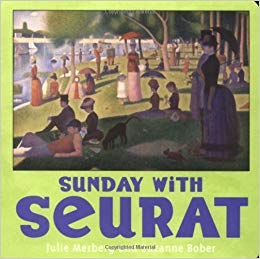
2. Read "Sunday With Seurat" by Julie Merberg & Suzanne Bober

3. Discussion Questions "What sort of object is this? What do you see (in this painting, sculpture)? What else do you see? How would you describe the composition? How would you describe the motion or activity? How would you describe the expression? How would you describe the clothing? Does this work look natural, representational, or is it stylized? Who do you think this person might be? What do you think this object was used for? Why do you think that? What was going on historically, economically, socially during this period? How does this work of art reflect the period? Can you guess what emotion he was trying to show in this artwork? What new colors are created by this optical mixing? What examples of their works can you find? How do these artist use paintbrushes and colors in unique ways? What other materials could be used to create a pointillist picture? How does this make the drawing realistic?"
Lesson Activities
1. Choose 12 X 15 Painting Paper
2. Use graphite paper to draw the horizon line (diagonal, vertical, horizontal) of the umbrella paintings
3. Use graphite pencil to draw line types (horizontal, vertical, diagonal) for the positive space (umbrella) of the Seurat Umbrellas
Day Two, Art Start
1. Retrieve Seurat Umbrellas for Assigned Tables
2. Women With Umbrella (1884) Georges Seurat

3. Discussion Questions "What types of lines are in this painting? What types of colors are used in this painting? How does your eye move through the artwork? What choices did the artist make to make that happen? How would you describe this artwork to someone who has never seen it? What elements of the painting seem real? What elements seem dreamlike or imaginary? What is normal about this painting? If this painting had sound effects, what would they sound like? What do we know about the artist after viewing this artwork? How do you think the artist feels about the final product? How did the artist use line, shape, and color to contribute to the mood or meaning? What title would you I've this artwork? What would it feel like to be in this artwork? How do you personally relate to or connect with this picture?"
Lesson Activities
1. Use watercolor to fill in the positive space (umbrella) with warm colors (red, orange yellow) of the umbrella paintings
2. Use watercolor to fill in the negative space (background) with cool colors (blue, green, purple) of the umbrella paintings
3. Add details (clouds, wind, stars) to the negative space (background) of the Seurat Umbrellas
Day Three, Art Start
1. Retrieve Seurat Umbrellas for Assigned Tables
2. Set Up Studio Area (paint brushes, water buckets, paper towel)
Lesson Activities
1. Add highlights (light source, reflective light) to the positive space (umbrella) of the umbrella paintings
2. Add shadows (cast shadow, shadow) to the negative space (background) of the umbrella paintings
3. Add embellishments (glitter glue, gem stones, yarn) to the positive space (umbrella) of the Seurat Umbrellas
Artist Examples

Student Examples


Monday, November 22, 2021
AUSTRALIAN ABORIGINALS
Australian Aboriginals

Learning Targets
I can...
- Create an original Australian Aboriginal using drawing techniques learned in class
- Use line types (horizontal, vertical, diagonal), shape variation (geometric, organic), and value (tints, shades) inspired by Australian Artist (1926-1998) Rover Thomas
- Use painting techniques (pigment, pointillism, layering) and design principles (gradation, proportion, composition) based on Indigenous Art
- Define Dot Painting (produced by repeated imprints of paint covered brushes, dotting sticks, or instruments onto a surface)
Lesson One
Day One, Art Start
1. Dumbun Owls (1987) Rover Thomas

2. Read Roads Cross: The Paintings of Rover Thomas by National Gallery of Australia

3. Discussion Questions "Who are Australian Aborigines? What styles of storytelling do Australian Aborigines practice? What is the Rainbow Serpent? Do Indigenous people own their own land? Have Indigenous people always owned their own land? Have Indigenous children always been brought up by their families? What kinds of food are available to Indigenous people? What is life-like for Indigenous people today? What is a Monotreme animal? Which two animals are Monotremes? What is a Marsupial mammal? Which three animals are Marsupials? What is a Placental mammal? Which of the following is a Placental mammal? Which Australian bird has a bird head and kills snakes? Which Australian bird is the second largest bird in the world?"
Lesson Activities
1. Choose 8 X 12 Drawing Paper
2. Add line types (contour, outline, perspective) to positive space (animal) of animal drawings
3. Outline line types (contour, outline, perspective) with neutral colors (black, brown, grey) for the Australian Aboriginals
Day Two, Art Start
1. Retrieve Australian Aboriginals for Assigned Table
2. Marlu- Kangaroo Dreaming (1995) Rover Thomas

3. Discussion Questions "What two species of Crocodile live in Australia? Which of the two crocodile species is bigger? How many species of snakes are there in Australia? Which Australian snake is considered the most poisonous? Which is the largest Shark in Australian Waters? Does the artist paint in long brushstrokes? Are the lines curved, straight, thick, or thin? Does the artist use a variety of shapes? What types of shapes do you see? What are the colors that the artist uses? What do you think the black cone is? What do you think the red and yellow shapes around the cone are? What are similarities in the story behind this painting and the ones you have heard before?"
Lesson Activities
1. Use warm colors (red orange yellow) to fill in the positive space (animal) of the animal paintings
2. Use cool colors (green blue purple) to fill in the negative space (background) of the animal paintings
3. Use embellishments (plastic eyes, bubble wrap, brown paper) to fill in the positive space (animal) of the Australian Aboriginals
Day Three, Art Start
1. Retrieve Australian Aboriginals for Assigned Table
2. Set Up Studio Area (tempera paint, popsicle sticks, paint brushes)
Lesson Activities
1. Add highlights (reflective light, light source) to fill in the positive space (animal) of the animal drawings
2. Add shadow (cast shadow, reflective shadow) to fill in the negative space (background) of the animal drawings
3. Add details (whiskers, spots, eyelashes) to the positive space (animal) of the Australian Aboriginals
Artist Examples


 Student Examples


Saturday, November 2, 2019
STIPPLING STILL LIFE
Stippling Still Life

Learning Targets
I can...- Create an original Stippling Still Life using drawing techniques learned in class
- Use primary/secondary/intermediate colors (red, yellow, blue; green, purple, orange), basic
shapes (geometric, organic), and line variation (hatched marks, broken dashed lines) inspired by Post-Impressionist Artist (1859-1891) Georges-Pierre Seurat - Use four shading techniques (hatching, cross-hatching, blending, stippling) and design principles (harmony, rhythm, movement) based on Pointillism
- Define Stippling (a drawing, painting, or engraving using numerous small dots)
Lesson One
Day One, Art Start
1. A Sunday on La Grande Jatte (1884-1886) Georges Seurat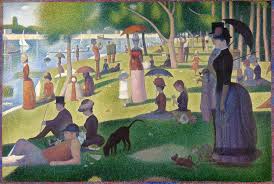
Lesson Activities
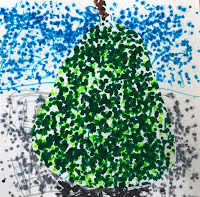
1. Choose 12" by 15" Drawing Paper2. Choose one fruit (apple, pear, orange) to draw the basic shapes (triangle, circle, rectangle, oval) of the stippling still life
3. Add horizon line in the background (table, folded drapery, wallpaper) to separate from the foreground
Reminder:
- Initials & Home Teacher on Back of Paper
Day Two, Art Start

Lesson Activities
Day Three, Art Start
Lesson Activities
Artist Examples


Student Examples




 Posts
Posts

