Wednesday, September 2, 2026
PIANO CAT PAINTINGS
Piano Cat Paintings
Learning Targets

I can...
- Create an original Piano Cat Paintings using painting techniques learned in class
- Use shape variation (geometric, organic, free form), color combinations (analogous, complementary, monochromatic), and line types (horizontal, vertical, diagonal) inspired by African American Artist (1911-1988) Romare Bearden
- Use drawing techniques (overlapping, cropping, outline) and design principle (composition, repetition, variation) based on Harlem Renaissance
- Define Theme (the underlying message, central idea, or deeper meaning that an artist conveys through a creative work)
Lesson One
Day One, Art Start
1. The Piano Lesson (Homage To Mary Lou) (1983) Romare Bearden

2. Read Mrs. Merriwether's Musical Cat by Carol Purdy

3. Discussion Questions "How do artists draw upon symbolism from different cultures to address religion, mythology, history, literature, and everyday life? Is this artist saying that art is the result of both sensual creativity (the sculpture) and strict discipline (painting)? Is the metronome that swings between the two, a mediator? What do you think of the odd inclusion of the carved music stand which contains the brand of the piano? How do the musical notes, organic shapes, and bright colors create a strong sense of movement? How do the musical notes, organic shapes, and bright colors create a strong sense of movement? How did combining images from magazines and colored paper become a turning point in the artist's career? Why were all of the musicians in Romare Bearden's art African American? Could black people and white people attend the same jazz clubs?"
Lesson Activities
1. Choose 12" X 15" Painting Paper
2. Add line types (horizontal, vertical, diagonal) to the positive space (foreground, cat, piano) of the Piano Cat Paintings
3. Outline positive space (foreground, cat, piano) with neutral colors (black, white, grey) of the Piano Cat Paintings
Day Two, Art Start
1. Retrieve Piano Cat Paintings for Assigned Tables
2. Jamming At The Savoy (1981-1982) Romare Bearden

3. Discussion Questions "How do people express meaning through music and art? How do people interpret meaning in music and in art? How does music and art reflect the time and place in which it was created? What factors influence an artist's work? How can music or art communicate a theme? How dod artist tell stories and convey messaging in their work? How did this music or art make you feel? Why are some artist inspired to create art based on music? Why types of lines and colors would someone most likely use to portray upbeat jazz music? What would you say is the connection between music and art? How can art represent music if you cannot physically hear a work of art? How would you describe this artwork? Where do we experience music or art? What music or art do you enjoy playing with for fun? How does music and art evoke emotion? How do we experience conflict and harmony through the different arts disciplines?"
Lesson Activities
1. Use color combinations (analogous, complementary, secondary) to fill in the positive space (foreground, cat, piano) for the Piano Cat Paintings
2. Use color combinations (analogous, complementary, secondary) to fill in the negative space (background) for the Piano Cat Paintings
3. Use neutral colors (black, white, grey) to fill in the negative space (background) for the Piano Cat Paintings
Day Three, Art Start
1. Retrieve Piano Cat Paintings for Assigned Tables
2. Set Up Studio Area (paint brushes, water buck, paint trays)
Lesson Activities
1. Add highlights (reflective light, light source) to fill in the positive space (foreground, cat, piano) of the Piano Cat Paintings
2. Add shadows (reflective shadow, cast shadow, shadow) to fill in the negative space (background) of the Piano Cat Paintings
3. Add details to the positive space (foreground, reflective light, light source) and negative space (background) of the Piano Cat Paintings
Artist Examples


Student Examples
Tuesday, September 30, 2025
CARTOON SKELETONS
Cartoon Skeletons

Learning Targets
I can...
- Create an original Cartoon Skeleton using drawing techniques learned in class
- Use neutral colors (black white grey brown), value (lightness darkness highlights shadows) and space (positive negative) inspired by Contemporary Artist (1995-Present) Michael Paulus
- Use drawing techniques (proportional rules basic forms shading methods) and design principles (composition repetition proportion) based on Contemporary Art
- Define Cartoon (a motion picture using animation techniques to photograph a sequence of drawings rather than real people or objects)
Lesson One
Day One, Art Start
1. Salve Cattus Sine Oris (Hello Kitty) (2025) Michael Paulus

2. Read Bonaparte Falls Apart: A Funny Skeleton Book For Kids and Toddlers by Margery Cuyler

3. Discussion Questions "Have you ever thought of what kind of skeletons might be holding up that weird character? What is the difference between a real skeleton and the cartoon version? Why do artists alter anatomy for an artistic effect? What are the basic shapes and how do they connect to form a skeleton? How can we use measurement and proportion to make our skeleton look realistic? What kind of story can we tell through a skeleton's pose? What do we notice about the skull? Where are the eyes, nose, and mouth located? How do the ribs connect to the spine? What are the key bone landmarks to look for drawing this figure? What are some examples of artists who have explored the skeleton in their work? What did they express through this subject matter? What happens when we combine different drawing or painting media to create our skeletons? What affect can we achieve by contrasting different textures in our artwork? How does understanding the bone structures (skull, spine, rib cage) help us draw people and animals?"
Lesson Activities
1. Choose 12" X 15" Drawing Paper
2. Use pencil to add line types (horizontal vertical diagonal) of subject matter (skull, bones, outline) of the Cartoon Skeletons
3.Use line types (horizontal vertical diagonal) to add details (roses feathers fabric) to the negative space (background) of the Cartoon Skeletons
Day Two, Art Start
1. Retrieve Cartoon Skeleton for Assigned Tables
2. Callidus Canem (Snoopy) (2016) Michael Paulus

3. Discussion Questions "How is photography from inside your body different from a regular photograph? What colors do you see? What kinds of lines can you find? What kind of shapes can you find? What new title would you give this artwork? Why do you think the artist made the artist this way? How would you tell someone about this artwork? What are some photograph techniques you could incorporate into your own artwork? How was Michael Paulus inspired by other artists? Does an artist need firsthand experience to represent it successfully? How might an artwork be interpreted differently at different moments in history? Do you think artists see the world differently than nonwartists? Is being an artist a stewardship? Do artists have a responsibility to share their artwork with the world? Can artists interact with cartoons as subject matter in different ways?"
Lesson Activities
1. Use drawing techniques (blending, smudging, smearing, shading) to add value (highlights shadows contrast) to the Cartoon Skeletons
2. Look at images of photographs of different human bones (skull, teeth, femur, rubs) when adding details (highlights, shadows, contrast) to the Cartoon Skeletons
3. Use permanent markers to add contrast to the positive space (bones, foreground, middle ground) and negative space (background, shadow) of the Cartoon Skeletons
Day Three, Art Start
1. Retrieve Cartoon Skeletons for Assigned Tables
2. Set Up Studio Area (erasers, permanent markers, washable markers, felt tip pens)
Lesson Activities
1. Use drawing techniques (blending, smudging, smearing, shading) to add value (highlights, shadows, contrast) to the Cartoon Skeletons
2. Use drawing materials (kneaded erasers, conte crayons, pencil sharpeners) to blend in the negative space (background) of the Cartoon Skeletons
3. Use drawing materials (kneaded erasers conte crayons pencil sharpeners) to add finishing details (bones, foreground, middle ground) to the Cartoon Skeletons
Artist Examples


 Student Examples


Monday, August 26, 2024
GERGELY DUDAS SEARCH DRAWINGS
Gergely Dudas Search Drawings
Learning Targets

I can...
- Create an original Gergely Dudas Search Drawing using collage techniques learned in class
- Use shape variation (geometric, organic, free form), line types (horizontal, vertical, diagonal), and color combinations (analogous, secondary, primary) inspired by Hungarian Artist (2019-Present) Gergely Dudas
- Use drawing techniques (shading, blending, overlapping) and design principles (composition, repetition, movement) based on Seek And Find Cartoons
- Define Repetition (the use of two or more of the same or similar elements such as colors, shapes, or lines)
Lesson One
Day One, Art Start
1. Find BB-8 (2024) Gergely Dudas

2. Read Bear's Spooky Book Of Hidden Things (2018) Gregory Dudas

3. Discussion Questions "Did you ever play "I Spy with my Little Eye" game? What are your favorite games to play at home and in the classroom? What does "I Spy" mean? Where did "I Spy With My Eye" come from? Have you played I Spy games indoors or outdoors? Have you played the I Spy game with friends, family, or adults? How do you play "I Spy with my little eye?" What are the rules of this game? When you play I Spy, do you use yes or no questions to help find the answer? Does I Spy use number recognition or shape identification for young children? Why would visual perception be an important skill for learning to read? What are some of your interests? What do you notice in your surroundings?"
Lesson Activities
1. Use three geometric shapes (rectangle, oval, circle) to create a three dimensional silhouette of a fall animal (fox, moose, squirrel, deer) for the search compositions
2. Add details (eyes, nose, claws) to the three dimensional silhouettes of a fall animal (fox, moose, squirrel ,deer) for the search compositions
3. Outline the positive space (foreground, animals) with neutral colors (black, grey, white) for the Gergely Dudas Search Drawings
Day Two, Art Start
1. Retrieve Gergely Dudas Search Drawing for Assigned Tables
2. Sheep Among Goats (2024) Gregely Dudas

3. Discussion Questions "What do you notice is different with the shapes, colors, and arrangement within this artwork? What is the same and different about each picture? What colors are being used in this artwork? Which area of the artwork is emphasized by the artist? How would you describe this artwork to someone who has never seen it? How does the artist use rotation and translation to create a search composition? Do you think a circle or oval could fill the search composition? Do any spaces cover the space exactly? How can you explain the movement of one tile to another tile? Did everyone use the same number of shapes in their search compositions? Why might the number of shapes vary between students? How many different arrangements did you discover?"
Lesson Activities
1. Add finishing details (eyes, nose, claws) to the positive space (animal, foreground) of the search compositions
2. Use neutral colors (black, grey, white) to outline the positive space (animal, foreground) of the search compositions
3. Add embellishments (salt, glitter, metallic) for the negative space (background, negative space) of the Gergely Dudas Search Drawings
Day Three, Art Start
1. Retrieve Gergely Dudas Search Drawings for Assigned Tables
2. Set Up Studio Area (colored pencils, erasers, markers, sharpeners)
Lesson Activities
1. Add embellishments (salt, glitter, metallic) for the negative space (background, negative space) of search compositions
2. Add neutral colors (black, white, brown, grey) to the three dimensional silhouettes (animal, foreground) of the Gergely Dudas Search Drawings
3. Add value (lightness, darkness, highlights, shadows) to the positive space (animal, foreground) of the Gergely Dudas Search Drawings
Artist Examples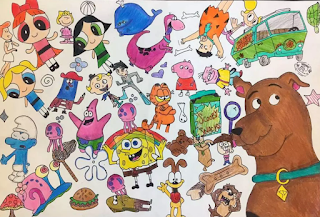


 Student Examples


Tuesday, November 14, 2023
MATISSE INSPIRED STILL LIFE COLLAGES
Matisse Inspired Still Life Collages
Learning Targets

I can...
- Create an original Matisse Inspired Still Life Collages using drawing techniques learned in class
- Use line types (horizontal, vertical, diagonal), shape variation (geometric, organic, free form), and texture (actual, visual, implied) inspired by French Artist (1869-1954) Henri Matisse
- Use collage techniques (photomontage, assemblage, decoupage, mixed media) and design principles (composition, repetition, balance) based on Modernism
- Define Symmetry (when two or more parts are identical after a flip, slide, or turn)
Lesson One
Day One, Art Start
1. Vase With Two Handles (A Bunch Of Flowers) (1907) Henri Matisse
.jpg!Large.jpg)
2. Read Matisse: The King Of Color by Laurence Anholt

3. Discussion Questions "How does the effect of the collage change when layering multiple shapes on top of each other? Can you create your own Matisse inspired artwork with a collage of cut outs? How does Henri Matisse's artwork make you feel? How would this picture make you feel if bright or dark colors were used instead? Who is Henri Matisse? Do you like this painting? How many colors do you see? Do you think what you see is exactly how the room looked when he painted it, with all those colors and patterns going every which way? How many different patterns do you see? How many of the patterns are variations on the bold vertical stripes? Do his pictures make you feel happy?"
Lesson Activities
1. Choose 12" X 15" Painting Paper
2. Use ruler to draw three line types (horizontal, vertical, diagonal) for the interior (window, wallpaper, background) of the still life collage
3. Use oil pastels to add patterns (swirls, dots, stripes) to the negative space (background) of the Matisse Inspired Still Life Collages
Day Two, Art Start
1. Retrieve Matisse Inspired Still Life Collages for Assigned Tables
2. Flowers And Fruit (1909) Henri Matisse

3. Discussion Questions "Where did Henri Matisse grow up? What process or techniques did Matisse use to create his artwork? What materials did Matisse you to create his artwork? What is an art element? Who can share some examples of elements? What is a principle? Who can share some examples of principles?Can you use a book to find information about Henri Matisse? How would you describe his artwork? What are some key features of his artwork? How could you describe the construction of this artwork? What do you think Matisse is trying to say with this artwork? Do you like or dislike his artwork?"
Lesson Activities
1. Add details (fruit, vegetables, cloth, plants) to the negative space (background) of the still life collages
2. Add details (fruit, vegetables, patterns, ribbon) to the positive space (flowers, vases) of the still life collages
3. Use collage materials (fabric, construction paper, scrapbook paper) to add details (tablecloth, curtains, towel) for the Matisse Inspired Still Life Collages
Day Three, Art Start
1. Retrieve Matisse Inspired Still Life Collages for Assigned Tables
2. Set Up Studio Area (oil pastels, scissors, glue sticks, watercolor)
Lesson Activities
1. Use tissue paper to add plants (leaves, flowers, lilacs) within the negative space (background) of the still life collages
2. Use complementary colors (red, green; blue, orange; yellow, purple) too fill in the positive space (foreground) of the still life collages
3. Use complementary colors (red, green; blue, orange; yellow, purple) to fill in the negative space (background) of the Matisse Inspired Still Life Collages
Artist Examples


 Student Examples


 Posts
Posts

