Thursday, August 20, 2026
ART MUSEUM SCULPTURES
Art Museum Sculptures Learning Targets

I can...
- Create an original Art Museum Sculpture using drawing techniques learned in class
- Use shape variation (geometric, organic, free form), form (two dimensional, three dimensional), and texture (actual visual implied) inspired by Chinese American Architect (1917-2019) I.M. Pei
- Use sculpture techniques (carving, casting, assembling, modeling) and design principles (proportion, movement, composition) based on Modern Architecture
- Define Museum (a public or private non-profit institution that collects, preserves, studies, and exhibits works of visual art for entertainment)
Lesson One
Day One, Art Start
1. Louvre Pyramid (1983-1984) I.M.Pei

2. Read The Glass Pyramid: A Story Of The Louvre Museum And Architect I.M.Pei by Jeannie Walker Harvey

3. Discussion Questions "What do museums want people to learn and why? Who are museums hoping to attract and why? Are there any culturally significant objects you would include in your museum? Is there an item passed down from your family or an item from your home country you could include? How can you document the important information about each item? Did you know most museums record the date it was collected, where the artwork came from, and a brief description of the object? How does visiting museums help motivate us to learn more about art history? What are the colors, shapes, and objects you can see without giving any facts? Why is touching artwork forbidden and how do guards protect the work for the future? How can buildings reflect the relationship between people and the environment?"
Lesson Activities
1. Choose Three 12 X 12 Cardboard Sheets
2. Use three compositional elements (shape, color, texture) to represent a memory, place, or event from ones own heritage
3. Use line variation (wavy, straight, curved) as a design principle (balance, movement, repetition) with the Art Museum Sculptures
Day Two, Art Start
1. Retrieve Art Museum Sculptures For Assigned Tables
2. Rock And Roll Hall Of Fame (1995) I.M. Pei

3. Discussion Questions "What do you notice about this art museum building? How would you describe it to someone who has never seen it? What do you see that makes you say that? What details might have been inspired by nature or ancient civilizations? What might this museum suggest about the relationship between local people and their environment? What evidence supports your ideas? What might this suggest about your communities outlook on the natural world? How does each work of art reflect the natural world? How does your building look from different sides? How do visitors walk through this museum? What is the mood of your museum, and how will your building shape reflect that? Will your building be historical and classical, or sleek and modern? How will people enter your museum? What makes your building look like a museum rather than an office building, home, or school?"
Lesson Activities
1. Use compass, protractors, and texture plates to add symmetrical shapes (circle, triangles, squares) to the Art Museum Sculptures
2. Use form (two dimensional, three dimensional) to fill in the positive space (foreground, middle ground) of the Art Museum Sculptures
3. Use form (two dimensional, three dimensional) to fill in the negative space (background) of the Art Museum Sculptures
Day Three, Art Start
1. Retrieve Art Museum Sculptures for Assigned Tables
2. Set Up Studio Area (washable markers, glue sticks, scissors, colored pencils)
Lesson Activities
1. Use scissors to cut out two dimensional symmetrical shapes (circles, triangles, squares) to create a three dimensional Art Museum Sculptures
2. Glue Down three dimensional symmetrical shapes (circles, triangles, squares) to create a three dimensional Art Museum Sculptures
3. Add decorations (old art, newspaper, fabric scraps, colored paper, buttons, collage) to positive space (foreground, middle ground) of the Art Museum Sculptures
Artist Examples


 Student Examples


Monday, March 30, 2026
TREEHOUSE DRAWINGS
Treehouse Drawings Learning Targets

I can...
- Create an original Treehouse Drawings using drawing techniques learned in class
- Use line types (horizontal, vertical, diagonal), shape variation (geometric, organic, free form), and form (two dimensional, three dimensional) inspired by American Artist (1979-Present) Jedediah Corwyn Voltz
- Use perspective techniques (linear, one-point, two-point, three-point, atmospheric) and design principles (proportion, gradation, composition) based on American Art
- Define Architecture (the art or practice of designing and constructing buildings)
Lesson One
Day One, Art Start
1. Corner Store (2024) Jedediah Corwyn Voltz

2. Read Stuck by Oliver Jeffers

3. Discussion Questions "Are the houses below, in, or on top of the tree? How do you know? What shapes do you see in the structure of the houses? How do you access the houses? Is the tree sitting on a horizon line or inside of an area? What details do you notice in each of the houses? What windows do you notice in each of the houses? What is the secret purpose of the treehouse such as launching water balloons or high-tech makers space? What items would you throw up into the treehouse to keep them safe? Is your treehouse made of wood, giant sticks, crystal, or metal? Is the treehouse hidden by thick leaves, vibrant, or standing out as a statement piece? Is the treehouse drawing sitting on top of branches, wrapped around the truck like a spiral, or floating between multiple trees?"
Lesson Activities
1. Use observational drawing techniques (composition, direct light, value) to draw the basic parts (roof, windows, door, base) of the Treehouse Drawings
2. Add shape variation (geometric, organic, free form) to add details (windows, doorways, balcony) to the positive space (foreground, middle ground, treehouse) of the Treehouse Drawings
3. Add shape variation (geometric, organic, free form) to add details (trees, dirt path, puddles) to the negative space (background) of the Treehouse Drawings
Day Two, Art Start
1. Retrieve Treehouse Drawings for Assigned Tables
2. Lorax Camp (2020) Jedediah Corwyn Voltz

3. Discussion Questions "What are some things happening in this artwork? What kind of person would live in this treehouse? What is the treehouse made of (leaves, sticks, mushrooms, magical)? Are there any special doors, windows, or stairs to this house? Does this house have a special feature, like a baloney, a look out, or a secret room? What could be added to this picture with more time? What are some famous examples of biomorphic architecture? How does the shape of the home reflect the inhabitants? How does the treehouse blend in with its environment? What types of lines and shapes are present in your house? How are details like windows, doors, and roofs designed to be functional or imaginative? What was the most challenging part of designing and building your treehouse?"
Lesson Activities
1. Use types of patterns (stripes, swirls, meanders) to fill in the positive space (foreground, middle ground, treehouse) of the Treehouse Drawings
2. Add high contrast (shaded areas, shadows, value) and light/medium contrast (background, light areas, middle ground) to the white space of the Treehouse Drawings
3. Add embellishments (scrap paper, aluminum foil, paper bags)) to the positive space (foreground, treehouse) of the Treehouse Drawings
Day Three, Art Start
1. Retrieve Treehouse Drawings for Assigned Tables
2. Set Up Studio Area (pencils, erasers, markers, rulers)
Lesson Activities
1. Use color combinations (analogous, secondary, neutral) to fill in the positive space (foreground, middle ground, treehouse) of the Treehouse Drawings
2. Use color combinations (analogous, secondary, neutral) to fill in the negative space (background, landscape) of the Treehouse Drawings
3. Add additional types of patterns (stripes, swirls, meanders) to the negative space (background) of the Treehouse Drawings
Artist Examples


 Student Examples


Thursday, August 31, 2023
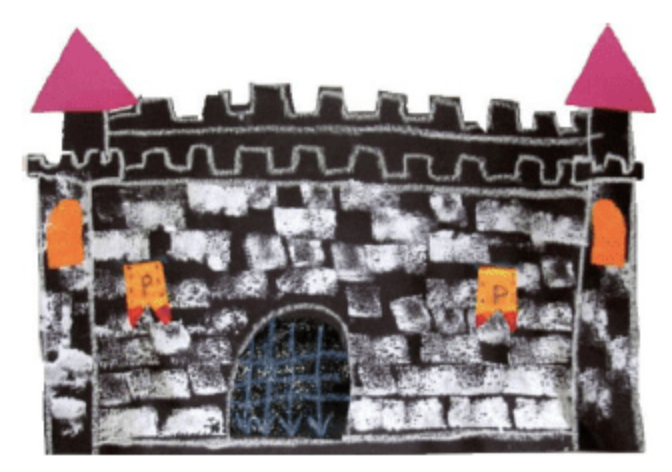
CHARCOAL HOGWARTS CASTLES
Charcoal Hogwarts Castles Learning Targets

I can...
- Create an original Charcoal Hogwarts Castle using drawing techniques learned in class
- Use neutral colors (black, grey, white), form (two dimensional, three dimensional), and value (lightness, darkness, tints, shades) inspired by wizard architects (993) Gordic Gryffindor, Helga Hufflepuff, Rowena Ravenclaw, and Salazar Sytherin
- Use architectural elements (scale, proportion, ornament) and design principles (balance, rhythm, movement) based on the Harry Potter Novel Series by J.K. Rowling
- Define Architecture (the art or practice of designing and constructing buildings)
Lesson One
Day One, Art Start
1. Hogwarts Castle (1993) J.K Rowling

2. Read Harry Potter Novel Series by J.K. Rowling

3. Discussion Questions "What is the architectural style of the Hogwarts Castles? How long did it take to build the Hogwarts Castle model? Where would you believe the Hogwarts Castle is located? Would you enroll at the Hogwarts Castle? Would you want the Hogwarts Castle to be real? Would you visit Alnwick Castle, one of the filming spots used in Harry Potter and the Philosopher's Stone? How do first years get from the Hogsmeade train station to the castle? How many floors are in the Hogwarts castle? How many staircases does Hogwarts Castles have? Who was the wizard architect behind the Hogwarts Castle? What are the functions and architectural elements of these castles?"
Lesson Activities
1. Retrieve 12" X 15" Drawing Paper
2. Draw a horizon line in the negative space (background) of the drawing paper for the castle drawings
3. Use shape variation (geometric, organic, free form) to add building elements (towers, walls, ladders, doors) to the positive space (building) of the Charcoal Hogwarts Castles
Day Two, Art Start
1. Retrieve Charcoal Hogwarts Castles for Assigned Tables
2. Hogwarts Castle Model (2012) J.K. Rowling

3. Discussion Questions "How do artists use geometric shapes to draw their castles? Do artists create patterns on their castles? Doo artists draw castles that take up most of the space on the paper? How do artists use horizon lines to create depth within a drawing? How do these castles connect to fairytale stories or architecture? What were groups of knights that protected the castle called? What are main features of a castle? How were castles built? Have you ever made a castle? What would make the best castle- height, sturdiness, or level of detail? Why were medieval castles built in medieval times? What were the first castles made out of? What was the castles purpose? What is the title of the person in charge of the affair within the castle?"
Lesson Activities
1. Use line variation (vertical, horizontal, diagonal) to add texture (bricks, stones, metal) to the positive space (castle) of the Charcoal Hogwarts Castles
2. Add architectural features (flag, moat, draw bridge, windows) to the positive space (castle) of the castle drawings
3. Use eraser to remove any guidelines from the positive space (building) of the Charcoal Hogwarts Castles
Day Three, Art Start
1. Retrieve Charcoal Hogwarts Castles for Assigned Tables
2. Set Up Studio Area (charcoal, erasers, pencils, white charcoal)
Lesson Activities
1. Use neutral colors (black, grey, white) to fill in the positive space (building) of the castle drawings
2. Use neutral colors (black, grey, white) to fill in the negative space (background) of the castle drawings
3. Add highlights (reflective light, light source) and shadows (cast shadow, shadow) to the positive space (building) of the Charcoal Hogwarts Castles
Artist Examples
 Student Examples


Wednesday, August 30, 2023
ADOBE CHALK LANDSCAPES
Adobe Chalk Landscapes

Learning Targets
I can...
- Create an original Adobe Chalk Landscapes using drawing techniques learned in class
- Use color combinations (analogous, secondary, intermediate), shape variation (geometric, organic, free form), and value (lightness, darkness, tints, shades) inspired by American Artist (1909-2000) William Lumpkins
- Use perspective techniques (vanishing points, illusion of depth, three dimensional shapes) and design principles (proportion, alignment, contrast) based on Transcendental Painting Group
- Define Adobe (a building material made from earth and organic materials)
Lesson One
Day One, Art Start
1. Early Snow (1970) William Lumpkins

2. Read If You Live With The Hopi by Anne Kamma

3. Discussion Questions "What does the Awatovi pueblo reveal about the history of the Hopi nation? What do you notice about these homes (wigwam, cabin, tent, apartment, brick house, adobe home, wood house, grass house)? What do you think it would be like on the inside? Do any of these homes look like your house? What is architecture? What is the difference between adobe and pueblo houses? What is a pueblo? What is the environment like in the Mesa Verge region? How do we learn about the past? What is the meaning behind an adobe house? What are elements and design principles were used to make this architecture? What do you think about this architecture?"
Lesson Activities
1. Use three dimensional shapes (rectangle, square, triangle) to create the positive space (foreground) of the adobe house drawings
2. Add house details (porch, roof, pillars, ladders) to the roof, levels, and foundation of the adobe house drawings
3. Outline adobe house drawings with a neutral color (black, brown grey, white) for the negative space (background) of the Adobe Chalk Landscapes
Day Two, Art Start
1. Retrieve Adobe Chalk Landscapes for Assigned Tables
2. Pueblo Architecture And Modern Adobes: The Residential Designs Of William Lumpkins by Joseph Traugott

3. Discussion Questions "What do you see in this picture? What do you see in this house? What do you think William Lumpkins meant when creating this artwork? Does your picture have space or distance? Does your picture have an horizon line, one point perspective, or background? How can we create the illusion of depth within our own Adobe Chalk Landscapes? What do you think this artwork represents? Why are you drawn to this subject? What do you think was the most important artist tool when creating this work? What connection did the artist have to this work? Does this artwork represent something about the artist?"
Lesson Activities
1. Add finishing details (porch, roof, pillars) to the roof, levels, and foundation of the Adobe Chalk Landscapes
2. Finish an outline using line types (horizontal, vertical, diagonal) for the positive space (house) of the adobe house drawings
3. Add motifs (tiny windows, trees, ladders) and patterns (stripes, swirls, circles) for the Adobe Chalk Landscapes
Day Three, Art Start
1. Retrieve Adobe Chalk Landscapes for Assigned Tables
2. Set Up Studio Area (oil pastels, chalk, erasers, pencils)
Lesson Activities
1. Finish adding motifs (hidden faces, tiny windows, colorful spirals) and patterns (stripes, swirls, circles) for the Adobe Chalk Landscapes
2. Add color combinations (analogous, complementary, secondary) to the positive space (house) of the adobe house drawings
3. Add value (lightness, darkness, highlights, shadows) to the positive space (house) of the Adobe Chalk Landscapes
Artist Examples


 Student Examples


Tuesday, November 30, 2021
WATERCOLOR CASTLES
Watercolor Castles

Learning Targets
I can...
- Create an original Watercolor Castle using drawing techniques learned in class
- Use shape variation (geometric organic), line variation (horizontal, vertical, diagonal) and space (positive negative) inspired by Impressionist Painter (1840-1926) Claude Monet
- Use different types of patterns (swirls, stripes, floral) and design principles (composition, proportion, gradation) based on Impressionism
- Define Architecture (the practice of designing and constructing buildings)
Lesson One
Day One, Art Start
1. The Portal at Midday (1893) Claude Monet

2. Read Castles by Gillian Osband

3. Discussion Questions "How did the artist use geometric shapes to draw their castle? Did the artist create at least one pattern on their case? Did the artist use watercolor effectively? Did the artist draw a castle that takes up most of the space on the paper? Did the artist add horizon lines to give the artwork depth? How do these castles connect to fairytale stories or architecture? What were the group of knights that protected the castle called? What are the main features of a castle? How were castles built?"
Lesson Activities
1. Retrieve 12" X 15" Drawing Paper
2. Draw a horizon line in the negative space (background) of the white paper for the Watercolor Castles
3. Use geometric shapes (rectangle, squares, triangles) to add buildings parts (towers, walls, doors) to the positive space (building) of the Watercolor Castles
Day Two, Art Start
1. Retrieve Watercolor Castles for Assigned Table
2. Rouen Cathedral, Study of the Portal (1892) Claude Monet

3. Discussion Questions "Have you ever made a castle? What types of tools did you use? What would make the best castle- height, sturdiness, or level of detail? What are some materials (rocks, sticks, moats) that can be used to protect castles from the waves? What is the different between a palace and a castle? How would you build a castle in a whole day? Why were castles built in medieval times? What were the first castles made out of? What was the castle keep and what was its purpose? What was the title of the person in charge of the affairs within the castle?"
Lesson Activities
1. Use line variation (vertical, horizontal, diagonal) to add texture (bricks, stone, metal) to the positive space (castle) of the Watercolor Castles
2. Add architectural features (flag, moat, draw bridge) to the medieval castles of the Watercolor Castles
3. Use eraser to remove any guidelines from the positive space (building) of the Watercolor Castles
Day Three, Art Start
1. Retrieve Watercolor Castles for Assigned Table
2. Set Up Studio Area (colored pencil, sharpeners, erasers)
Lesson Activities
1. Use earth tones (brown red black) to fill in the positive space (building) of the castle drawings
2. Use earth tones (green blue white) to fill in the negative space (background) of the castle drawings
3. Add highlights (reflective light, light source) and shadows (cast shadow, shadow) to the positive space (building) of the Watercolor Castles
Artist Examples


 Student Examples



 Posts

