Thursday, September 22, 2022
GRUMPY MONKEY COLLAGES
Grumpy Monkey Collages

Learning Targets
I can...
- Create an original Grumpy Monkey Collage using drawing techniques learned in class
- Use line types (contour, outline, continuous), shape variation (geometric, organic, free form), and texture (implied, actual, visual) inspired by American Author (2018-Present) Suzanne Lang
- Use collage techniques (layering, cropping, overlapping) and design principles (composition, variation, emphasis) based on American Art
- Define Expression (describe ideas, facts, or feelings through an arrangement of forms, sounds, or words)
Lesson One
Day One, Art Start
1. America Goth Monkey (2018) Susan Clyne

2. Read Grumpy Monkey by Suzanne Lang

3. Discussion Questions "What can we do to help manage our anger? What does anger or irritability look like? When you are angry can you understand another person? Are we reasonable or realistic when we are angry? How can we change those situations? If anger was a color, what color would it be? If anger was a sound, what sound would it be? How have you calmed yourself down when you were feeling angry? How can you express concerns without getting angry? What are some solutions you have when you feel angry?"
Lesson Activities
1. Choose 12" X 15" Drawing Paper
2. Add line types (contour, outline, perspective) to the positive space (animal) of the monkey collages
3. Outline line types (contour, outline, perspective) with the neutral colors (black, brown, grey) for the Grumpy Monkey Collages
Day Two, Art Start
1. Retrieve Grumpy Monkey Collages for Assigned Tables
2. The Monkey With The Pearl Earring (2017) Susan Clyne

3. Discussion Questions "How many species of monkeys are there? Did the artist paint in long brush strokes? Are the lines curved, straight, or thin? Does the artist use a variety of shapes? What types of shapes do you see? What are the colors that the artist uses? What do you think the artwork is about? What are the similarities in the story behind this artwork? Have you heard these stories before? Why are monkeys angry? Why are monkeys considered angry creatures?"
Lesson Activities
1. Use analogous colors (blue purple red) to fill in the positive space (monkey) of the monkey collages
2. Use analogous colors (blue purple red) to fill in the negative space (background) of the monkey collages
3. Use embellishments (plastic eyes, bubble wrap, brown paper) to fill in the positive space (monkey) of the Grumpy Monkey Collages
Day Three, Art Start
1. Retrieve Grumpy Monkey Collages for Assigned Tables
2. Set Up Studio Area (scissors, glue sticks, oil pastels)
Lesson Activities
1. Add highlights (reflective light, light source) to fill in the positive space (monkey) of the monkey collages
2. Add shadows (cast shadow, reflective shadow) to fill in the negative space (background) of the monkey collages
3. Add details (eyelashes, fur, claws) to the positive space (monkey) of the Grumpy Monkey Collages
Artist Examples

Student Examples


Wednesday, December 1, 2021
MIXED MEDIA SLOTHS
Mixed Media Sloths Learning Targets

I can...
- Create an original Mixed Media Sloth using drawing techniques learned in class
- Use shape variation (geometric, organic), analogous colors (blue purple red) and line types (horizontal vertical diagonal) inspired by American Illustrator (2013-Present) Victoria Borges
- Use collage techniques (readymade, clippings, composing) and design principles (composition, balance, variation) based on American Art
- Define Balance (the distribution of the visual weight of objects, colors, texture, and space)
Lesson One
Day One, Art Start
1. Sloth Sayings III (2020) Victoria Borges

2. Read Slowly, Slowly, Slowly, Said the Sloth by Eric Carle

3. Discussion Questions "How many species of sloths are there? Why are sloths so slow? How far can a sloth travel in a day? Why do sloths leave the sheltered canopy and go to the ground? What do sloths eat? How much food do sloths consume? How long do sloths sleep? What is the biggest threat to a sloth? What are sloths considered lazy creatures? What does a sloth's scientific name mean in Greek? How much faster are sloths swimming than walking? What is an arboreal habitat made up of? How long can it take for a sloth to digest a single meal? Are sloths the world's slowest mammals?"
Lesson Activities
1. Choose 8" X 12" Drawing Paper
2. Add line types (contour, outline, perspective) to the positive space (animal) of the sloth drawings
3. Outline line types (contour, outline, perspective) with the neutral colors (black, brown, grey) for the Mixed Media Sloths
Day Two, Art Start
1. Retrieve Mixed Media Sloths for Assigned Table
2. Sloth Sayings IV (2020)Victoria Borges

3. Discussion Questions "How many species of sloths are there? Did the artist paint in long brush strokes? Are the lines curved, straight, or thin? Does the artist use a variety of shapes? What types of shapes do you see? What are the colors that the artist uses? What do you think the artwork is about? What are the similarities in the story behind this artwork? Have you heard these stories before?"
Lesson Activities
1. Use analogous colors (blue purple red) to fill in the positive space (animal) of the sloth drawings
2. Use analogous colors (blue purple red) to fill in the negative space (background) of the sloth drawings
3. Use embellishments (plastic eyes, bubble wrap, brown paper) to fill in the positive space (animal) of the Mixed Media Sloths
Day Three, Art Start
1. Retrieve Mixed Media Sloths for Assigned Table
2. Set Up Studio Area (scissors, glue sticks, construction paper)
Lesson Activities
1. Add highlights (reflective light, light source) to fill in the positive space (animal) of the sloth drawings
2. Add shadow (cast shadow, reflective shadow) to fill in the negative space (background) of the sloth drawings
3. Add details (eyelashes, fur, claws) to the positive space (animal) of the Mixed Media Sloths
Artist Examples


 Student Examples


Wednesday, March 25, 2020
CHRISTOPHER MARLEY INSPIRED SYMMETRICAL DESIGNS
Christopher Marley Inspired Symmetrical Designs

Learning Targets
I can...- Create an original Christopher Marley Inspired Symmetrical Design using computer techniques learned in class
- Use metallic colors (bronze, silver, gold), texture types (smooth, bumpy, rough), and form (two dimensional, three dimensional) inspired by American Artist (1969-Present) Christopher Marley
- Use mathematical connections (dividing sections, concentric circles, linear symmetry) and design principles (balance, composition, contrast) based on Expressive Art
- Define Radial Design (a design that includes any lines, shapes, or colors that starts in the center and radiates outwards in a circular way)
Lesson One
Day One, Art Start
1. Caternarius Prism (2020) Christopher Marley

Lesson Activities
1. Use bug template to trace simple/compound shapes of insects for symmetrical designs2. Use a black sharpie marker to outline simple/compound shapes of insects for symmetrical designs
3. Use metallic colors (bronze, silver, gold) to fill in the negative space (background) of the Christopher Marley Inspired Symmetrical Designs
Day Two, Art Start
1. Retrieve Christopher Marley Inspired Symmetrical Designs for Assigned Table2. Lambert Prism (2019) Christopher Marley

Lesson Activities
1. Use metallic colors (bronze, silver, gold) to fill in the positive space (insects) of the symmetrical designs2. Use tools (dotting styluses, dowels, erasers, toothpicks, nails, sewing pins) to add patterns (swirls, dots, stripes) to positive space (insects) of the symmetrical designs
3. Use neutral colors (white, black, grey) to add contrast to positive space (insects) of the Christopher Marley Inspired Symmetrical Designs
Day Three, Art Start
1. Retrieve Christopher Marley Inspired Symmetrical Designs for Assigned Table2. Set Up Studio Area (metallic paint, hot glue, ruler, pencil)
Lesson Activities
1. Use drawing techniques (blending, contrast, shading) to add details to the positive space (insects) of the symmetrical designs2. Use drawing techniques (blending, contrast, shading) to add details to the negative space (background) of the symmetrical designs
3. Add design details (border, scenery, typography) to negative space (background) of the symmetrical designs
Artist Examples


 Student Examples


Friday, February 9, 2018
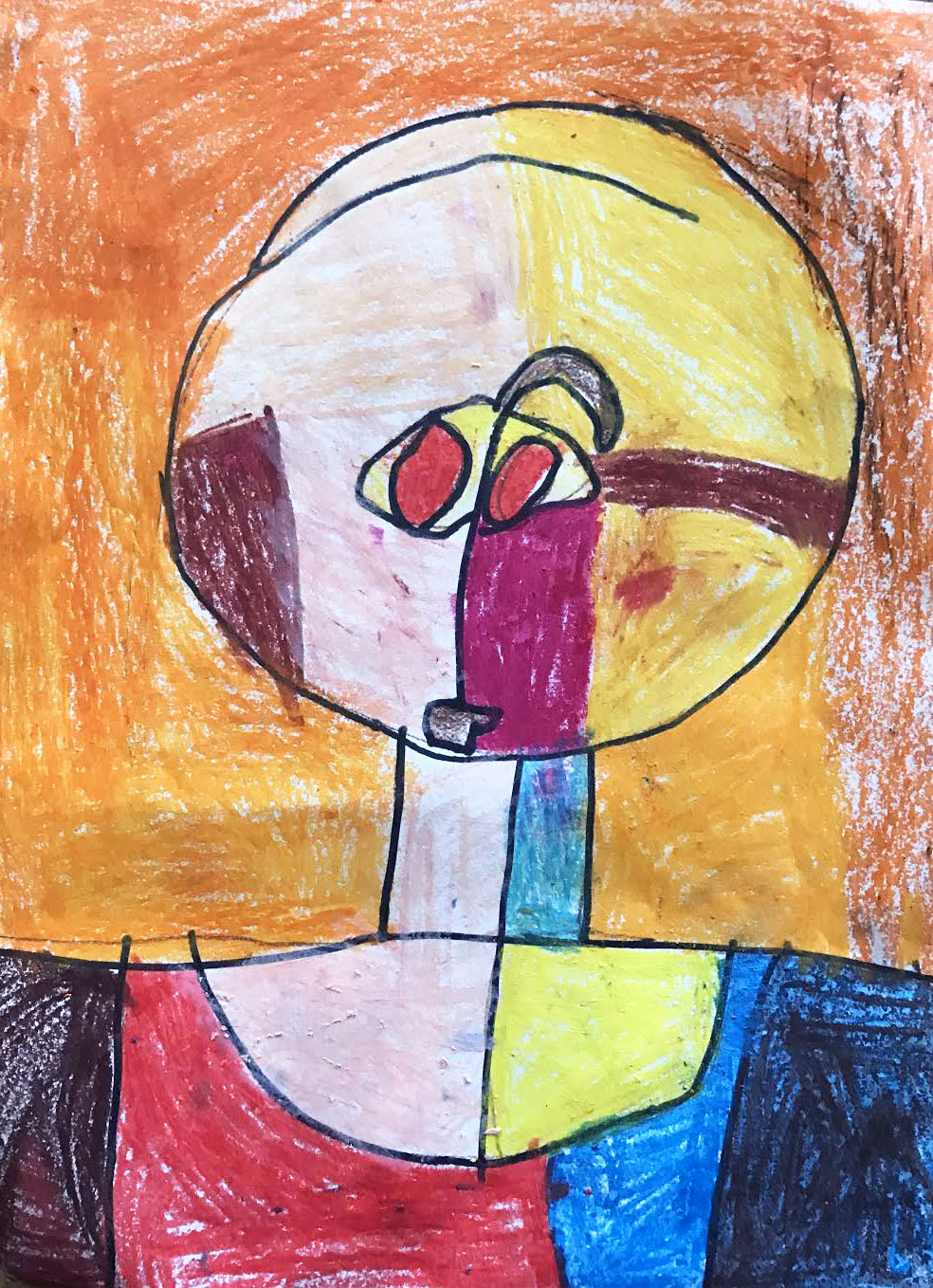
KINDERGARTEN KLEES
Kindergarten Klees

Learning Targets
I can...- Create a Kindergarten Klee using mixing techniques learned in class
- Use line variation (intersecting horizontal vertical), geometric shapes (circle rectangle square), and color (warm colors complimentary colors) inspired by Swiss Artist (1879-1940) Paul Klee
- Use color theory (color relation, mixing techniques, reflective schemes) and design principles (composition, contrast, placement) based on Abstract Art
- Define Portrait (a picture depicting the face, head, and shoulder)
Lesson One
Day One, Art Start

Lesson Activities
- Initials & Home Teacher on Back of Paper
Day Two, Art Start


Lesson Activities
Day Three, Art Start
Lesson Activities
Artist Examples


Student Examples




 Posts

