Tuesday, May 19, 2026
DIAMOND MURAL
Diamond Mural Learning Targets

I can...
- Create an original Diamond Mural using drawing techniques learned in class
- Use shape variation (geometric, organic, free form), color combinations (neutral, warm/cool colors, analogous colors), and space (positive, negative) inspired by American Artist (1989-Present) Maya Nayuk
- Use mathematical concepts (measurements, patterns, functions, tessellations) and design principles (repetition, composition, proportion) based on American Art
- Define Cross Stitch Pattern (a grid-based guide that tells an artist where to place x-shaped stitches on fabric to create a pattern)
Lesson One
Day One, Art Start
1. Kilim 1 (2024) Maya Hayuk

2. Read Mathterpieces: The Art Of Problem Problem Solving by Greg Paprocki

3. Discussion Questions "Why would a human invent shapes, patterns, or tessellations? What if buildings were only made from one shape (triangles, circles, ovals, swaures)? How do artists use mathematics (geometric, tessellations, symmetry) to create artwork? How do design principles (repetition, balance, harmony) help to create a mural? How does a mural represent a school community and why would a school community create a mural? Why would an artist simplify an image into patterns, shapes, or pixels? How can your individual contributions strengthen a community artwork? What do you find difficult about working inside a grid or pattern system? How do these geometric shapes (circles, triangles, squares, rectangles) create a bigger picture? Did you know the artist used mandalas, Rorschach tests, and pysanka as visual inspiration for her artwork? What happens when you look at artwork up close compared to far away? Is Maya Hayuk's artwork more mathematical or emotional? Why do contemporary muralists often use geometric abstraction?"
Lesson Activities
1. Choose 5 2" X 2" construction paper diamonds
2. Use a protractor, straight edge, and compass to draw lines to help divide the sections of each construction paper diamond
3. Write name/positive message on each 2" X 2" construction paper diamond before adding the diamonds to the Diamond Mural
Day Two, Art Start
1. Retrieve Diamond Mural for Assigned Tables
2. Hammer Projects: Maya Hayuk (2024) Maya Mayuk

3. Discussion Questions "What are some similarities and differences between these examples of previous murals? How does an artist handle revisions to the design of a mural? How do artists create digital mockups or sketches to visualize the mural on the wall? What type of mural does the artist specialize in: realism, abstract, or illustrative? What is your experience with public art? Do you think this method would be helpful for drawing other things? How do artists make their artwork today? Is there something that could be improved in this artwork? How does someone become an artist? When did the artist start making artwork? What happens when two geometric shapes (triangles, squares, ovals, diamonds) overlap? Does the geometric shapes (triangles, squares, ovals, diamonds) create a new color?"
Lesson Activities
Day Three, Art Start
Lesson Activities
Artist Examples


 Student Examples


Tuesday, August 19, 2025
ALEXANDER CALDER PRIMARY PAINTINGS
Alexander Calder Primary Paintings Learning Targets

I can...
- Create an original Alexander Calder Primary Painting using drawing techniques learned in class
- Use line types (horizontal, vertical, diagonal), shape variation (geometric, organic, free form), and space (positive, negative) inspired by American Artist (1898-1976) Alexander Calder
- Use primary colors (red, yellow, blue) and design principles (composition, balance, movement) based on Modern Art
- Define Abstract Art (form of art does not represent objects or scenes from the real world in a recognizable way)
Lesson One
Day One, Art Start
1. Black Dots (1974) Alexander Calder

2. Read One And Other Numbers With Alexander Calder by Phaidon

3. Discussion Questions "Did you know Alexander Calder was an American artist known for his pioneering work in kinetic sculpture and mobiles? Did you know he worked as an engineer before studying art and creating signature abstract sculptures? How is this artwork different from the images you have seen of traditional paintings? Does this artwork still look like it might move or would want to move? How would this artwork look if it could move? If you could travel back in time to visit with the artist in the studio, what do you think you would see? If you could travel back in time to visit with the artist, what do you think he would say? Is the subject recognizable, abstract, or realistic? Was Alexander Calder's simple composition in his artwork considered a good representation of abstract art?"
Lesson Activities
1. Choose 12" X 15" Drawing Paper
2. Add geometric shapes (triangles, circles, square, rectangles) to the composition of the Alexander Calder Primary Paintings
3. Add line types (horizontal, vertical, diagonal) in the negative space (background) of the Alexander Calder Primary Paintings
Day Two, Art Start
1. Retrieve Alexander Calder Primary Paintings for Assigned Tables
2. Jungle (1971) Alexander Calder

3. Discussion Questions "What is the difference between aesthetic theories? Can artwork be explained by more than one aesthetic theory? How does an artist's intent influence the interpretation of the artwork? Why is it important to understand the time period of an artist when looking at their artwork? How can personal artwork be inspired by ideas explored by past artists? Why is problem solving an integral part of the art making process? How can students use general knowledge and art knowledge to further develop personal art making? What is abstract art? What do you think abstract means? Can you recognize anything in this painting? What emotion is being conveyed in this painting? Which artwork is abstract? Which work is abstract? What does this artwork remind you of? What do you think this artwork is made of? Does this work follow any mathematical principles?"
Lesson Activities
1. Use primary colors (red yellow blue) to fill in the positive space (foreground, geometric shapes) of the Alexander Calder Primary Paintings
2. Use primary colors (red yellow blue) to fill in the negative space (background, geometric shapes) of the Alexander Calder Primary Paintings
3. Use shape variation (geometric, organic, free form) to fill in the positive space (foreground, geometric shapes) of the Alexander Calder Primary Paintings
Day Three, Art Start
1. Retrieve Alexander Calder Primary Paintings for Assigned Tables
2. Set Up Studio Area (tempera paint, paint brushes, watercolor)
Lesson Activities
1. Add highlights (reflective light, light source) to the subject matter (geometric shapes, foreground) of the Alexander Calder Primary Paintings
2. Add shadows (cast shadow, shadow) to the negative space (background, geometric shapes) of the Alexander Calder Primary Paintings
3. Outline details (geometric shapes, line thickness) in the positive space (foreground, geometric shapes) of the Alexander Calder Primary Paintings
Artist Examples 


 Student Examples


Thursday, October 26, 2023
DUMP TRUCK PAINTINGS
Dump Truck Paintings

Learning Targets
I can...
- Create an original Dump Truck Painting using drawing techniques learned in class
- Use shape variation (geometric, organic, free form), line types (horizontal, vertical, diagonal), and texture (visual, actual, implied) inspired by American Artist (2009-Present) Desiree Bender
- Use painting techniques (overlapping, layering, cropping) and design principles (composition, movement, repetition) based on American Art
- Define Texture (the feel or appearance of a surface)
Lesson One
Day One, Art Start
1. Mean Green (2009) Desiree Bender

2. Read Design In Motion: The Recycling Truck Project by Google Arts & Culture

3. Discussion Questions "What do you think of the saying "one person's trash another's treasure"? How would you describe your dream job? In what ways, could a vehicle be considered a work of art? What is the most artistic vehicle you have ever seen? Why should drivers begin decorating dump trucks? Why would someone spend so much money to decorate a truck? What impacts the way the while's are decorated? What purpose does this kind of public folk art serve? What feelings do the decorative design on these vehicles invoke? Why do you think so? Based on the images you see, what material do you are used to decorate the vehicle? Do you know anything about truck art? How man people are employed in workshops for truck art?"
Lesson Activities
1. Choose 12" X 15" Drawing Paper
2. Use geometric shapes (triangles, circles, rectangles) to draw exterior (outside) of the dump truck paintings
3. Use geometric shapes (triangles, circles, rectangles) to draw the main parts (wheels, cab, headlights) of the Dump Truck Paintings
Day Two, Art Start
1. Retrieve Dump Truck Paintings for Assigned Tables
2. Patterned Flight (2009) Desiree Bender

3. Discussion Questions "What type of transportation machines can you name? How are dump truck vehicles designed? What is the primary purpose of a dump truck? How do the different regions impact the way the vehicles are decorated? Based on the images you see, what kinds of materials do you think are used to decorate the vehicle? What value does this artwork have in society? What is the most important thing about dump trucks? What does the text teach us about the artist? What does the text teach us about the dump trucks? What are the important parts of a dump truck?"
Lesson Activities
1. Use line types (horizontal, vertical, diagonal) to outline the neutral colors (black, grey, white) of the dump truck paintings
2. Add decorative patterns (dots, swirls, stripes) to the positive space (dump truck) of the dump truck paintings
3. Add line types (horizontal, vertical, diagonal) to the negative space (background) of the dump truck paintings
Day Three, Art Start
1. Retrieve Dump Truck Paintings for Assigned Tables
2. Set Up Studio Area (tempera paint, paint brushes, water buckets)
Lesson Activities
1. Use warm colors (red orange yellow) to fill in the positive space (dump truck) of the dump truck paintings
2. Use cool colors (green blue purple) to fill in the negative space (background) of the dump truck paintings
3. Add highlights (reflective light, light source, lightness) to the positive space (foreground) of the Dump Truck Paintings
Artist Examples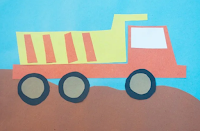


 Student Examples


Monday, September 25, 2023
PIET MONDRIAN ANIMALS
Piet Mondrian Animals

Learning Targets
I can...
- Create an original Piet Mondrian Animals using paintings techniques learned in class
- Use line types (horizontal, vertical, diagonal), primary colors (red yellow blue), and shape variation (geometric, organic, free form) inspired by Dutch Artist (1872-Present) Piet Mondrian
- Use art element color (primary colors, red, yellow, blue) and design principles (repetition, composition, contrast) based on Modern Art
- Define Neoplasticism (a style of painting using only vertical lines, horizontal lines, and rectangular shapes in primary colors)
Lesson One
Day One, Art Start
1. Composition No. II (1920) Piet Mondrian

2. Read Piet Mondrian: The Man Who Changed Everything by Waanders Uitgevers Zwolle

3. Discussion Questions "How did Piet Mondrian come to paint this way? How did you choose the placement of colors? What colors do you notice first in the artist's paintings? What she is the largest colored shape? What size is the smallest? What is the most space you have between colored shapes? What is the least? Can you see the shape of a tree in this painting? What makes Piet Mondrian artwork abstract? Is Mondrian thinking about similar things in his artwork? What do you think Piet Modniran is trying to express? How is Piet Mondrian's artwork different from other artists?"
Lesson Activities
1. Choose 12" X 15" Painting Paper
2. Add line types (horizontal vertical diagonal) to the positive space (animal) of the Piet Mondrian Animals
3. Outline line types (horizontal, vertical, diagonal) with neutral colors (black, grey, white) for the positive space (animal) of the Piet Mondrian Animals
Day Two, Art Start
1. Retrieve Piet Mondrian Animals for Assigned Tables
2. Composition A (1923) Piet Mondrian

3. Discussion Questions "Who was Piet Mondrian? What do you notice in this painting Piet Mondrian created? What is Piet Mondrian the founder of? Where was Piet Mondrian born? What shapes did Mondrian mainly use in his paintings? How did Piet Mondrian create straight lines? Who introduced Mondrian to art? How did Piet Mondrian's artwork evolve from 1908 to 1912? What school did Piet Mondrian attend? How did Mondrian's artwork change overtime? What style did Mondrian paint his artwork in? What are movement is Modern Art characterized by? What is the title of this painting?"
Lesson Activities
1. Use primary colors (red yellow blue) to fill in the positive space (animal) of the Piet Mondrian Animals
2. Use primary colors (red yellow blue) to fill in the negative space (background) of the Piet Mondrian Animals
3. Use colored construction paper (blue, red, yellow) to fill in the negative space (background) of the Piet Mondrian Animals
Day Three, Art Start
1. Retrieve Piet Mondrian Animals for Assigned Tables
2. Set Up Studio Area (water bucket, paint brushes, tempera paint)
Lesson Activities
1. Add highlights (reflective light, light source) to fill in the positive space (animal) of the Piet Mondrian Animals
2. Add shadows (reflective shadow, cast shadow) to fill in the negative space (background) of the Piet Mondrian Animals
3. Add details (whiskers, claws, spots, eyelashes) to the positive space (animal) of the Piet Mondrian Animals
Artist Examples
 Student Examples


Friday, January 13, 2023
PABLO PICASSO INSPIRED GUITARS
Pablo Picasso Inspired Guitars Learning Targets

I can...
- Create an original Pablo Picasso Inspired Guitar using collage techniques learned in class
- Use line types (horizontal, vertical, diagonal), monochromatic colors (light blue, dark blue), and value (tints, shades, hues) inspired by Spanish Painter (1881-1973) Pablo Picasso
- Use drawing skills (perspective, observational, contour) and design principles (balance, composition, repetition) based on Cubism
- Define Distort (elongate parts and shorten others to reposition an object)
Lesson One
Day One, Art Start
1. Guitar, Sheet Music, And Glass (1912) Pablo Picasso

2. Read The Three Musicians: A Children's Book Inspired By Pablo Picasso by Veronique Massenot

3. Discussion Questions "What is cubism? Who is Pablo Picasso? Why is Pablo Picasso important? Does this artwork show an understanding of cubism style by showing still life from multiple views or factoring planes? Did the artist create interest through value, contrast, various textures, and collage elements? Did the artist create variety using both white and black charcoal? How did cubism influence 20th century art culture? Which stages of art did Pablo Picasso create? Why was the Blue Period given its name? When was the Old Guitarist painted? What sort of shapes do you recognize in this work of art? Where do you see curved lines? Where do you see straight lines? what objects do you see? What does this artwork show?"
Lesson Activities
1. Use shape variation (geometric, organic, free form) to draw the musical instrument (guitar) on the positive space (foreground) of the guitar collages
2. Use a straight edge or ruler to add line types (horizontal, vertical, diagonal) to the positive space (foreground) of the guitar collages
3. Use black sharpie marker to outline the positive shape (foreground) and negative shape (background) of the Pablo Picasso Inspired Guitars
Day Two, Art Start
1. Retrieve Pablo Picasso Inspired Guitar for Assigned Tables
2. Guitar (1913) Pablo Picasso

3. Discussion Questions "How is Pablo Picasso's depiction of a guitar similar to a real guitar? How does Pablo Picasso's depiction of the guitar differ from a real guitar? What might be the idea of Cubism? What shapes can you identity in the guitar you have chosen? How do we come up with completely new and original things? Have you drawn something never seen before? Do you have a new perspective after looking at this artwork? What is a different way of seeing this same artwork? What differences do you notice between the Spanish and French compared to Russian Cubism? What choices would you have made if you were Pablo Picasso? How can you distinguish the parts of the Three Musicians? How would you use warm and cool colors? How would you use monochromatic colors?"
Lesson Activities
1. Use monochromatic colors (light blue, dark blue) to fill in the positive space (foreground) of the guitar collages
2. Use monochromatic colors (light blue, dark blue) to fill in the negative shape (background) of the guitar collages
3. Fill in the white space found within the positive space (foreground) and negative space (background) of the Pablo Picasso Inspired Guitars
Day Three, Art Start
1. Retrieve Pablo Picasso Inspired Guitars for Assigned Tables
2. Set Up Studio Area (glue sticks, construction paper, pencils)
Lesson Activities
1. Use line variation (horizontal, vertical, diagonal) to add patterns (swirls, florals, stripes) to the positive space (foreground) of the guitar collages
2. Add tint (white) to fill in the positive space (foreground) with highlights (reflective light, light source) of the guitar collages
3. Add shade (black) to fill in the negative space (background) with shadows (cast shadow, reflective shadow) of the Pablo Picasso Inspired Guitars
Artist Examples


 Student Examples


 Posts

