Thursday, November 21, 2024
SEQUIN PAINTINGS
Sequin Paintings

Learning Targets
I can...
- Create an original Sequin Painting using mixed media techniques learned in class
- Use color combinations (analogous, complementary, primary), line types (horizontal, vertical, diagonal), and texture (actual, visual, implied) inspired by Performance Artist (1946-2020) Tina Girouard
- Use textile art (fiber, woven fabric, embroidery, knitwear) and design principles (contrast, repetition, emphasis) based on Post Minimalism
- Define Sequin (a small, shiny disk sewn as one of many onto clothing or canvas for decoration)
Lesson One
Day One, Art Start
1. Hibiscus (1995) Tina Giroaurd

2. Watch A Brief History Of Sequins by The Great British Sewing Bee

3. Discussion Questions "Why do humans beings have a need for art or visual art forms? What is the purpose of a ritual? Did you know sequins were invented in 1960 by two American women who sold the idea to an English company? Did you know the trend of sequins on clothes started in an Egyptian tomb? Did you know Michael Jackson, King Tut, and Leonardo Da Vinci had sequin pendants? Would you wear clothing made entirely from sequins? How do artists use various mediums to explore complex themes of identity, spirituality, social justice, and global issues? Are there places you should not wear sequin clothing? Did you know Leonardo Da Vinci sketched plans for a sequin making machine? Did you know the ruby slippers from Wizard Of Oz were made out of sequins?"
Lesson Activities
1. Use neutral colors (black, grey, white) to fill in the positive space (foreground, subject matter) for the sequin paintings
2. Use white lines (thin, thick, curved) to add patterns (stripes, waves, dots) to the positive space (foreground, subject matter) of the sequin paintings
3. Use black lines (thin, thick, curved) to add patterns (stripes, waves dots) to the negative space (background) of the Sequin Paintings
Day Two, Art Start
1. Retrieve Sequin Paintings for Assigned Tables
2. Pink Floral (Lily Pad) (1990) Tina Girouard

3. Discussion Questions "How do artists work? How has the practice of the artist changed overtime? What role do artist shave in society? What is integral to the work of an artist? What is the background of the work? What are do you most identify with? What is your strongest memory of your childhood? What is your favorite artwork? Which two colors are used in negative space photographs? What does it captivate, in terms of emotions, to the audience of negative space? What are the three basic elements of composition needed in drawing? What is positive space in art? Which is the difference between positive and negative space? Which is easier to understand between the two different spaces? Which do you think is more important the positive space of the negative space? Can you see all hidden images in the designs below?"
Lesson Activities
1. Use color combinations (analogous, complementary, secondary) to fill in the positive space (foreground, subject matter) with sequins for sequin paintings
2. Use color combinations (analogous, complementary, secondary) to fill in the negative space (background) with sequins for the sequin paintings
3. Use drawing techniques (blending layering overlapping) to add contrast to the composition of the Sequin Paintings
Day Three, Art Start
1. Retrieve Sequin Paintings for Assigned Tables
2. Set Up Studio Area (canvas, sequins, glue sticks, hot glue, pencils)
Lesson Activities
1. Add highlights (reflective light, light source) to the positive space (foreground, subject matter) of the sequin paintings
2. Add shadows (cast shadow, shadow) to the negative space (background, middle ground) of the sequin paintings
3. Add overlapping shapes (circles, ovals, round shapes) to the positive space (foreground, subject matter) of the Sequin Paintings
Artist Examples


 Student Examples


Monday, August 26, 2024
GERGELY DUDAS SEARCH DRAWINGS
Gergely Dudas Search Drawings
Learning Targets

I can...
- Create an original Gergely Dudas Search Drawing using collage techniques learned in class
- Use shape variation (geometric, organic, free form), line types (horizontal, vertical, diagonal), and color combinations (analogous, secondary, primary) inspired by Hungarian Artist (2019-Present) Gergely Dudas
- Use drawing techniques (shading, blending, overlapping) and design principles (composition, repetition, movement) based on Seek And Find Cartoons
- Define Repetition (the use of two or more of the same or similar elements such as colors, shapes, or lines)
Lesson One
Day One, Art Start
1. Find BB-8 (2024) Gergely Dudas

2. Read Bear's Spooky Book Of Hidden Things (2018) Gregory Dudas

3. Discussion Questions "Did you ever play "I Spy with my Little Eye" game? What are your favorite games to play at home and in the classroom? What does "I Spy" mean? Where did "I Spy With My Eye" come from? Have you played I Spy games indoors or outdoors? Have you played the I Spy game with friends, family, or adults? How do you play "I Spy with my little eye?" What are the rules of this game? When you play I Spy, do you use yes or no questions to help find the answer? Does I Spy use number recognition or shape identification for young children? Why would visual perception be an important skill for learning to read? What are some of your interests? What do you notice in your surroundings?"
Lesson Activities
1. Use three geometric shapes (rectangle, oval, circle) to create a three dimensional silhouette of a fall animal (fox, moose, squirrel, deer) for the search compositions
2. Add details (eyes, nose, claws) to the three dimensional silhouettes of a fall animal (fox, moose, squirrel ,deer) for the search compositions
3. Outline the positive space (foreground, animals) with neutral colors (black, grey, white) for the Gergely Dudas Search Drawings
Day Two, Art Start
1. Retrieve Gergely Dudas Search Drawing for Assigned Tables
2. Sheep Among Goats (2024) Gregely Dudas

3. Discussion Questions "What do you notice is different with the shapes, colors, and arrangement within this artwork? What is the same and different about each picture? What colors are being used in this artwork? Which area of the artwork is emphasized by the artist? How would you describe this artwork to someone who has never seen it? How does the artist use rotation and translation to create a search composition? Do you think a circle or oval could fill the search composition? Do any spaces cover the space exactly? How can you explain the movement of one tile to another tile? Did everyone use the same number of shapes in their search compositions? Why might the number of shapes vary between students? How many different arrangements did you discover?"
Lesson Activities
1. Add finishing details (eyes, nose, claws) to the positive space (animal, foreground) of the search compositions
2. Use neutral colors (black, grey, white) to outline the positive space (animal, foreground) of the search compositions
3. Add embellishments (salt, glitter, metallic) for the negative space (background, negative space) of the Gergely Dudas Search Drawings
Day Three, Art Start
1. Retrieve Gergely Dudas Search Drawings for Assigned Tables
2. Set Up Studio Area (colored pencils, erasers, markers, sharpeners)
Lesson Activities
1. Add embellishments (salt, glitter, metallic) for the negative space (background, negative space) of search compositions
2. Add neutral colors (black, white, brown, grey) to the three dimensional silhouettes (animal, foreground) of the Gergely Dudas Search Drawings
3. Add value (lightness, darkness, highlights, shadows) to the positive space (animal, foreground) of the Gergely Dudas Search Drawings
Artist Examples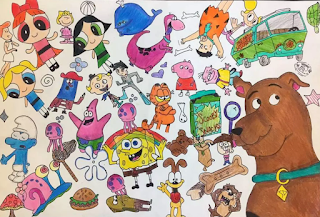


 Student Examples


Wednesday, August 21, 2024
HENS WITH CHICKS COLLAGES
Hens With Chicks Collages

Learning Targets
I can...
- Create an original Hens With Chicks Collages using drawing techniques learned in class
- Use shape variation (geometric organic free form), line types (horizontal vertical diagonal), and texture (actual, visual, implied) inspired by Chicks and Chickens by Gail Gibbons
- Use collage techniques (layering, cutting, tearing) and design principles (balance, composition, emphasis) based on Illustration
- Define Texture (the perceived surface quality of a work of art)
Lesson One
Day One Art Start
1. Rooster, Hen, and Chicken with Spiderwort (1830-1833) Katsushika Hokusai

2. Read Chicks and Chickens by Gail Gibbons

3. Discussion Questions "What is the symbolic meaning behind a chicken? How does a chicken represent owning land and owning a home? What similarities do you notice from the beginning of the book to the end of the book? What differences do you notice? What would you do if you woke up one night to find the shadow of a giant chicken in your bedroom door? Is this mischievous giant chicken a friend or a foe? What words can you use to describe the hens or chickens? What are baby hens called? What noises do chickens make?"
Lesson Activities
1. Choose 12 X 15 Painting Paper
2. Draw foreground (hen), middle ground (chicks), and background (nests) of the chicken collages
3. Use painting techniques (blending, smudging, layering) to add layers to the subject matter (chickens) of the Hens With Chicks Collages
Day Two, Art Start
1. Retrieve Hens With Chicks Collages for Assigned Tables
2. Flock Of Chickens (1835) Katsushika Hokusai

3. Discussion Questions "What do you know about chickens? What kinds of sounds do chickens make? Where do chickens live? How are baby chickens born? How long does it take for an egg to thatch? Would you like to watch a baby chick being hatched? Are there similarities and differences between these chickens? What feather color, egg color, and feather texture can you identify? Can you determine if the picture represents a rooster, hen, or chick? Which breed of chicken would you choose? What characteristics do these chickens have that are similar or different from one another?"
Lesson Activities
1. Add thin layers of paint to the foreground (hen), middle ground (chicks), and background (wallpaper) of the chicken collages
2. Use painting techniques (blending, smudging, layering) to add details (beaks, eyes, eyelashes) to the chicken collages
3. Use painting techniques (blending, smudging, layering) to add texture (implied, actual, visual) of the Hens With Chicks Collages
Day Three, Art Start
1. Retrieve Hens With Chicks Collages for Assigned Table
2. Set Up Studio Area (glue sticks, scissors, collage materials)
Lesson Activities
1. Use cool colors (blue green purple) to fill in the negative space (background) of the chicken collages
2. Use warm colors (red orange yellow) to fill in the positive space (foreground) of the chicken collages
3. Use tint (white) and shade (black) to add the illusion of depth within the Hens With Chicks Collages
Artist Examples
 Student Examples


Thursday, September 14, 2023
AUTUMN HARVEST PATTERNS
Autumn Harvest Patterns

Learning Targets
I can...
- Create an original Autumn Harvest Pattern using drawing techniques learned in class
- Use line types (horizontal, vertical, diagonal), shape variation (geometric, organic, free form), and space (positive, negative) inspired by American Artist (1947-Present) Janice Schupak Frishopf
- Use observational drawing techniques (perspective, proportion, measurements) and design principles (contrast, composition, variation) based on Contemporary Art
- Define Shape (a closed space made when a line connects to itself)
Lesson One
Day One, Art Start
1. Winter Squash (2023) Janice Schupak Frishopf

2. Read Legally Blind Belmont Artist Celebrates 10 Years Of Creating Dancing Colors by Joanna Tzouveils

3. Discussion Questions "Why is art important? What role does art play in our society? What value is placed upon artist and their art? Why? What makes something a work of art? Is art defined by boundaries? If so, what are they and how have they changed over the course of history? What is the role of the artist? How has this role changed over time? Who decides what a work of art means- the artist, the critic, the viewer? How do history and the passage of time affect the meaning of an artwork? What are the most important skills an artist can have? What materials and tools do artists use to create art today? Have the tools changed overtime? Where do artists find inspiration? What is the difference between working alone and collaborating on an artwork with fabricators, audiences, or others? What are the subjects, issues, and themes important to artists working today? What role does beauty play in contemporary art? Does a work of art need to be beautiful? Why or why not? Who decides what is beautiful?"
Lesson Activities
1. Use geometric shapes (oval circle rectangle) to draw an assorted vegetables (beans, corn, squash) for the harvest drawings
2. Use geometric shapes (oval circle rectangle) to draw details (stem, leaves, table) for the harvest drawings
3. Use line types (horizontal, vertical, diagonal) to draw the positive space (beans, corn, squash) and details (stem, leaves, table) of the Autumn Harvest Patterns
Day Two, Art Start
1. Retrieve Autumn Harvest Patterns for Assigned Tables
2. Autumn Carnival (2023) Janice Schupak Frishpof

3. Discussion Questions "Why is contemporary art important? Which area of the artwork is emphasized by the artist? Which area of the artwork is most important? How did the artist use proportion? How did the artist use line, shape, and color to contribute to the mood or meaning? What symbols do you notice in the artwork? How can you connect this artwork to your own life? What does this artwork remind you of? How might you feel differently about the world after looking at this artwork? What do you want to remember about this artwork? Who do you know that would really like this artwork? Why would they like it? What is beautiful about this artwork? What does this artwork teach us about the past?"
Lesson Activities
1. Use line types (horizontal, vertical, diagonal) to add details (stems, leaves, tables) to the positive space (beans, corn, squash) of the harvest drawings
2. Use oil pastels to fill in the positive space (beans, corn, squash) with neutral colors (black white grey) for the harvest drawings
3. Use oil pastels to fill in the negative space (background) with neutral colors (black white grey) for the Autumn Harvest Patterns
Day Three, Art Start
1. Retrieve Autumn Harvest Patterns for Assigned Tables
2. Set Up Studio Area (construction paper, oil pastels, charcoal)
Lesson Activities
1. Add vegetable parts (brown stem, green leaves, shell) with neutral colors (black white grey) for harvest drawings
2. Use texture techniques (erase, cloth, sponge) to add details (stem, leaves, table) to the harvest drawings
3. Add highlights (reflective light, light source) and shadows (cast shadow, shadow) to the negative space (background) of the Autumn Harvest Patterns
Artist Examples


 Student Examples


 Posts

