Tuesday, October 7, 2025
MUMMY EYES
Mummy Eyes Learning Targets

I can...
- Create an original Mummy Eyes using drawing techniques learned in class
- Use color combinations (neutral, analogous, complementary), shape variation (geometric, organic, free form), and space (positive, negative) inspired by mummification of Ancient Egypt
- Use collage techniques (assemblage, layering, decoupage) and design principles (composition, contrast, proportion) based on Old Kingdom Period
- Define Mummification (preserving a person, and in some instances, animals for the afterlife)
Lesson One
Day One, Art Start
1. Coffin Of Padi-Heru (200 BCE to 100 BCE) Ptolemaic Period

2. Read Mummies, Pyramids, Pharaohs: A Book About Ancient Egypt by Gail Gibbons

3. Discussion Questions "Did you know Egyptians perfected the art of mummification 5000 years ago? What is a mummy? What can we learn from mummies? Can you describe any symbols, hidden cues, or secret messages in this artwork? Do you see the mummy's name written on the wrappings? Does that help us know who the mummy was? What kinds of special objects or treasures did the Egyptians place inside the tomb with a mummy? How is the art of the mummy (like the artwork on the sarcophagus) connected to ancient Egyptian's beliefs about life after death? Why do you think ancient Egyptians drew gods, goddesses, and special symbols on the mummy's coffin? Can you find any small, magical charms, called amulets? What do you think these amulets were for? What would you want to put in the tomb you are building for this mummy?"
Lesson Activities
1. Choose 12" X 15" Drawing Paper
2. Use pencil to draw shape variation (geometric, organic, free form) of the eye parts (iris, pupil, eyelids, tear duck) of the Mummy Eyes
3. use pencil to draw shape variation (geometric, organic, free form) of the face parts (teeth, nose, eye brows) of the Mummy Eyes
Day Two, Art Start
1. Retrieve Mummy Eyes for Assigned Tables
2. Mask Of Tutankhamun (1336 BCE - 1327 BCE) Howard Carter

3. Discussion Questions "What makes these artworks fit into Ancient Art? What are some similarities and difference between the artwork of this mummy and other artwork in history? If you could ask the person inside the mummy one question, what would you ask? What are some symmetrical designs you notice in this artwork? What would be your mummy's favorite Halloween candy? What superpower would your mummy have? What costume would your mummy wear on Halloween? What colored are the bandages of the mummy if they could be any color? What color are the mummy's eyes in this artwork? What patterns or designs could you add to the mummy's bandages? What kind of place would your mummy live in? Is your mummy a friendly mummy or a spooky mummy?"
Lesson Activities
1. Use color combinations (analogous, complementary, neutral) to fill in the positive space (mummy eyes, mummy face) of the Mummy Eyes
2. Use color combinations (analogous, complementary, neutral) to fill in the negative space (background) of the Mummy Eyes
3. Use line types (horizontal, vertical, diagonal) to fill in the positive space (mummy eyes, mummy face) of the Mummy Eyes
Day Three, Art Start
1. Retrieve Mummy Eyes for Assigned Tables
2. Set Up Studio Area (glue sticks, scissors, black construction paper)
Lesson Activities
1. Add highlights (reflective light, light source) to the positive space (mummy face, mummy eyes) of the Mummy Eyes
2. Add shadows (cast shadow, shadow) to the negative space (background, middle ground) of the Mummy Eyes
3. Use neutral colors (black, grey, white, brown) to fill in the positive space (mummy face, mummy cloth) of the Mummy Eyes
Artist Examples


 Student Examples


Thursday, September 1, 2022
ROYAL EGYPTIAN CATS
Royal Egyptian Cats
Learning Targets

I can...
- Create an original Royal Egyptian Cats using collage techniques learned in class
- Use primary colors (red, yellow, blue), shape variation (geometric, organic, free form), and texture (metallic, wood, sand) inspired by 4th Century (3000 BC- 100 AD) Prehistoric Egypt
- Use mixed media techniques (paper batik, papyrus drawing, cartouche) and design principles (composition, repetition, emphasis) based on Ancient Egypt
- Define Cartouche (a carved tablet or drawing representing a scroll with rolled up ends, using ornamentally, or bearing an inscription)
Lesson One
Day One, Art Start
1. An Egyptian Bronze Cat (332 BC- 30 BC) Royal Ontario Museum

2. The Winged Cat: A Tale of Ancient Egypt by Deborah Nourse Lattimore

3. Discussion Questions "What type of magic powers did Egyptians believe cats had? Why did ancient Egyptians use cats in art and sculptures? Why where cats mummified in ancient Egypt? How have artistic characteristics changed overtime? How do these images of cats different from images of cats today? How does ancient Egypt's commitment to the notion of perfection demonstrated by the preservation of past artistic styles? What type of Egyptian art and artifacts can be seen today? How important are these places in modern Egypt? Do people live in, work in, and visit these places?"
Lesson Activities
1. Choose 12" X 15" Drawing Paper
2. Use basic shapes (semi circle, oval, triangle) to draw recognizable parts of the cat paintings
3. Add feline parts (claws, teeth, whiskers, nose) to the recognizable parts of the Royal Egyptian Cats
Day Two, Art Start
1. Retrieve Royal Egyptian Cats for Assigned Table
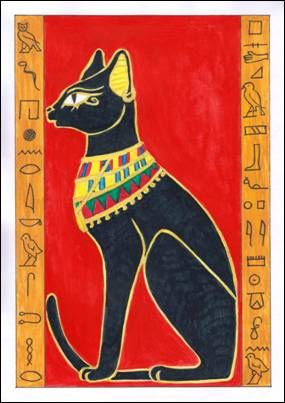
2. Bastet Egyptian Protector Goddess (3000 BC- 100 AD) Prehistoric Egypt

3. Discussion Questions "What type of cat did the artist portray? What do artists use as motivation? What do you like about this sculpture? How does this artist use motivation? What do you think the cats are feeling in this sculpture? What do you think is the most difficult scene to draw? How do you describe this artwork to someone? What mood could be describe in this artwork? What does the images demonstrate her skill of? What do you like about this style? What was the punishment for hurting a cat in ancient Egypt? What is the name of the world's richest cat? Which part of a cat is as unique as a human fingerprint?"
Lesson Activities
1. Add patterns (dots stripes lines) to positive space (cat) of the Royal Egyptian Cats
2. Use bright colors (blue green purple) to fill in the positive space (cat) of the cat paintings
3. Use bright colors (red orange yellow) to fill in the negative space (background) of the cat paintings
Day Three, Art Start
1. Retrieve Royal Egyptian Cats for Assigned Table
2. Set Up Studio Area (oil pastels, erasers, pencils)
Lesson Activities
1. Add highlights (reflective light, light source) to the positive space (cat) of the cat paintings
2. Add shadows (cast shadow, reflective shadow) to the negative space (background) of the cat paintings
3. Add repeating patterns (dots, stripes, spots) to the negative space (background) of the Royal Egyptian Cats
Artist Examples
 Student Examples




Wednesday, September 30, 2020
SCARAB SCULPTURES
Scarab Sculptures

Learning Targets
I can...
- Create an original Scarab Sculpture using sculpture techniques learned in class
- Use line types (horizontal vertical diagonal), shape variation (geometric organic free form) and space (positive negative) inspired by Ancient Egypt
- Use art element: form (composite simple grid) and design principles (composition balance proportion) based on Ancient Art
- Define Scarab (an ancient Egyptian gem cut in the form of a beetle with wings and engraved hieroglyphs)
Lesson One
Day One, Art Start
1. Scarab With Separate Wings (712-342) The Brooklyn Museum

2. Read The Scarab's Secret by Christina Balit

3. Discussion Questions "What is the common name for the Egyptian Scarab? What did the scarab beetle represent to the ancient Egyptians? What color was commonly used to paint scarab beetle amulets? To the Ancient Egyptians, what did the ball the scarab pushed represent? Which ancient Egyptian deity, one with a scarab's head, aided in the daily movement of the sun? In which of the following ways was a pectoral scarab typically used? What was the purpose of the ancient Egyptian scarab called the heart scarab? Which pharaoh, father of the famous Ikhnation, was known for issuing several types of commemorative scarabs? Was the scarab charm used only with the deathly in ancient Egypt? What is the meaning of the scarab?"
Lesson Activities
1. Use modeling techniques (hand building forming shapes) to make three dimensional spheres for clay scarab
2. Use assemblages techniques (attaching slip/score smoothing) to connect the three main body parts (head thorax abdomen) of the clay scarab
3. Use addictive techniques (eyes balls long legs wings) to add additional parts to Scarab Sculptures
Day Two, Art Start
1. Retrieve Scarab Sculptures for Assigned Table
2. Winged Scarab Amulet (664-332) The Metropolitan Museum

3. Discussion Questions "Why are insects fo colorful? Which insects is bigger, the male or female? What are some differences between insects? Why are insects symmetrical? What is the most important part of a painting? Why types of shapes can you use to break up your drawing? Which wing looks transparent like you are looking through the wing of an insect? What does the Scarab mean in Egypt? Why did the Egyptians worship scarab beetles? What was the Scarab Beetle used for? What color was a Scarab Beetle?"
Lesson Activities
1. Use assemblage techniques (attaching slip/score smoothing) to connect the details (eyeballs long legs wings) of the clay scarab
2. Add embellishments (beads rainbow wire buttons) to decorate the outside (bug) of the clay scarab
3. Add imprints (texture plates stamps) to outside (bug) of the Scarab Sculptures
Day Three, Art Start
1. Use analogous colors (red blue purple) to fill in the positive space (bug) of the Scarab Sculptures
2. Use analogous colors (red blue purple) to fill in the negative space (wings sun) of the Scarab Sculptures
3. Use metallic colors (gold silver bronze) to outline the line types (horizontal vertical diagonal) of the positive space (bug) of the Scarab Sculptures
Artist Examples


 Student Examples


Monday, August 31, 2020
CROSS HATCHING EGYPTIAN PHARAOHS
Crossing Hatching Egyptian Pharaohs

Learning Targets
I can...
- Create an original Crossing Hatching Egyptian Pharoah using drawing techniques learned in class
- Use solid colors (blue, green, black), form (two dimensional, three dimensional) and value (lightness, darkness) inspired by Egyptian Pharaoh (1321-1342) Tutankhamun
- Use drawing techniques (cross hatching, hatching, short dashes) and design principles (placement, proportion, composition) based on Ancient Egypt
- Define Nemes (pieces of striped head cloth worn by pharaohs in ancient Egypt)
Lesson One
Day One, Art Start
1. Mask of Tutankhamun (1323) Ancient Egypt

2. Read History Opens Windows: The Ancient Egyptians by Jane Shuter

3. Discuss Questions "What is the famous river that flows through Egypt? When was the Ancient Egyptian period? What would you find inside a mummy? What is the name of these hieroglyphics? Which animal l did the Egyptians love? Did the Egyptians make boats out of reeds? Who was the last ruler of Egypt? What is the importance behind the Great Sphinx of Giza? What does the word hieroglyphs mean? What was the first pyramid to be built called? What is the oldest known monumental sculpture in Egypt? How many pyramids consist of the Great Pyramid of Giza? Which ancient Egyptian dynasty was Ramses III the pharaoh of? Which pharaoh was the first historically confirmed female pharaoh? Which female pharaoh had the longest reign? Which pharaoh has the most surviving statues?"
Lesson Activities
1.Use pencil to draw shape variation (geometric, organic) of face parts (head, hair, shoulders, ears, of pharaoh portrait
2. Use line types (wavy, straight, narrow) to add facial features (eyes, eyelashes, eyebrows, hair) of pharaoh portrait
3. Use line types (wavy, straight, narrow) to add details (buttons, ribbons, stripes) to clothing of Crossing Hatching Egyptian Pharaoh
Day Two, Art Start
1. Retrieve Cross Hatching Egyptian Pharaoh for Assigned Table
2. Nefertiti Bust (1345) Thutmose

3. Discussion Questions "How many years did King Tut rule? How old was King Tut when he became pharaoh? What was the name of King Tut's wife? What does Tutankhuman mean? What year was King Tut's tomb discovered? How many times was King Tut's tomb robbed? How many items were found in King Tut's tomb? How many sacrcophagi was King Tut buried in? How high is the biggest pyramid? What was the most important livestock for Ancient Egyptians? Which one of these animals was not a sacred animal? What was a king in ancient Egypt called? Why were Egyptians buried with their possessions? What holidays did the Egyptians celebrate? What kind of foods did Egyptians eat? What were the major cities of Egypt? What are some fascinating facts about Ancient Egypt?"
Lesson Activities
1. Use solid colors (blue, brown, black) to fill in the positive space (portrait) of the pharaoh portrait
2. Use solid colors (blue, brown, black) to fill in the negative space (background) of the pharaoh portrait
3. Use line types (horizontal, vertical, diagonal) to fill in the positive space (portrait) with design for the Cross Hatching Egyptian Pharaohs
Day Three, Art Start
1. Retrieve Cross Hatching Egyptian Pharaohs for Assigned Table
2. Set Up Studio Area (metallic paint, brushes, water bucket)
Lesson Activities
1. Add highlights (light source, reflective light) to positive space (portrait) of pharaoh portraits
2. Add shadows (cast shadow, shadow) to negative space (background) of pharaoh portraits
3. Use stop motion program (iMotion, FlipaClip, Stop Motion) to add an animation to ones own Cross Hatching Egyptian Pharaohs
Artist Examples


Student Examples


 Posts
Posts

