Tuesday, August 18, 2026
PROVENCE LAVENDER FIELDS PAINTINGS
Provence Lavender Fields Paintings Learning Targets

I can...
- Create an original Provence Lavender Fields Paintings using drawing techniques learned in class
- Use shape variation (geometric, organic, free form), line types (horizontal, vertical, diagonal), and texture (visual actual implied) inspired by American Artist (1981-Present) Erin Hanson
- Use painting techniques (layering, dry brush, wash) and design principles (repetition, variation, movement) based on Open Impressionism
- Define Landscape (a picture, painting, or drawing that shows outdoor scenery)
Lesson One
Day One, Art Start
1. Hills Of Provence (2026) Erin Hanson

2. Read Paris Adventures For Kids: Interactive Travel Journal by City Line Press

3. Discussion Questions "What type of brushstrokes did you use for the tiny flowers? How do you make the flowers in the front look closer than the ones in the back? What kind of feeling of memory do you want people to get when looking at this? If someone could step inside your painting, what sounds or smells would the person notice first? What was the hardest part of the landscape painting to paint, and how would you solve this problem? How does the sky change the colors you will see in the field? What can you add to the foreground to make the fields look huge? What kind of weather or time of day does your painting feel like? How will you decide where the land meets the sky? How will you show the way the sunlight hits the top of the pants? What color will you use for the shadows between the rows?"
Lesson Activities
1. Use ruler, compass, straightedge to draw the scenery (background, foreground, middle ground) of the Provence Lavender Fields Paintings
2. Add details (buildings, animals, plants) within the positive space (foreground) and scenery (foreground, middle ground, background) of the Provence Lavender Fields Paintings
3. Use colored sharpies to outline the positive space (foreground) and scenery (foreground, middle ground, background) of the Provence Lavender Fields Paintings
Day Two, Art Start
1. Retrieve Provence Lavender Fields Paintings for Assigned Tables
2. Provence Lavender (2024) Erin Hanson

3. Discussion Questions "What are the three parts of landscape paintings? What do you see? What do you think it would sound like in this place? What do you think it would smell like in this place? Is the painting warm colors or cool colors? What season do you think it is in this landscape painting? What would you do if you were in this painting? How does this artwork make you feel? What are the different areas (foreground, middle ground, background) in this painting? What objects, shapes, or colors can you find in these different fields? Is this a place you would want to visit? What would you wear if you were visiting this landscape? Why would artists choose to work outside? What are the different colors and feelings used for different seasonal landscapes?"
Lesson Activities
1. Add patterns (swirls, clouds, stars) into the scenery (foreground, middle ground, background) of the Provence Lavender Fields Paintings
2. Use secondary colors (green orange purple) to fill in the scenery (foreground, middle ground, background) of the Provence Lavender Fields Paintings
3. Use primary colors (red yellow blue) to fill in scenery (foreground, middle ground, background) of the Provence Lavender Fields Paintings
Day Three, Art Start
1. Retrieve Provence Lavender Fields Paintings for Assigned Tables
2. Set Up Studio Area (water bucket, paint brushes, watercolor)
Lesson Activities
1. Add highlights (reflective light, light source) within the scenery (foreground, middle ground, background) of the Provence Lavender Fields Paintings
2. Add shadows (reflective shadow, cast shadow, shadow) within the scenery (foreground, middle ground, background) of the Provence Lavender Fields Paintings
3. Add details (animals, buildings, people) within the scenery (foreground, middle ground, background) of the Provence Lavender Fields Paintings
Artist Examples


Student Examples


Monday, December 1, 2025
JACQUES COUSTEAU SCUBA DIVER COLLAGES
Jacques Cousteau Scuba Diver Collages Learning Targets

I can...
- Create an original Jacques Costeau Scuba Diver Collage using drawing techniques learned in class
- Use color combinations (warm colors, cool colors, analogous colors), shape variation (geometric, organic, free form), and line types (horizontal, vertical, diagonal) inspired by French Oceanographer/Filmmaker (1910-1997) Jacques Cousteau
- Use collage techniques (overlapping, layering, assemblage, cutting) and design principles (movement, proportion, gradation) based on French Photography
- Define Tinker (to experiment with making, changing, or fixing something)
Lesson One
Day One, Art Start
1. Calypso Oceanographic Expedition: Cousteau, Taillez, and Dumas (1952) Jacques Cousteau

2. Read Man Fish: A Story Of Jacques Cousteau by Jennifer Berne

3. Discussion Questions "What do you see in this picture? What colors and shapes stand out? Does this artwork remind you of anything you have seen in real life or in a movie (Finding Nemo; Octonauts)? How does this art make you feel about the ocean? If you could jump into this picture, what do you think it would feel like, sound like, and smell like? Do you see any special tools or machines in this picture? What do you think they are used for? Did you know Jacques Cousteau co-invented the Aqua Lung (SCUBA)? How did this help people explore the ocean differently than before? Why was it important for him to have a special camera to take picture and videos underwater? Can you stop the Calypso, his famous research ship, or a small submarine (diving saucer)? What title would you give this piece of artwork?"
Lesson Activities
1. Choose 12" X 15" Drawing Paper
2. Use geometric shapes (oval, circle, cylinder) to draw the basic shapes of the positive space (gear, swim wear, sea creatures) for the scuba diver collages
3. Use value (lightness, darkness) to add shadows (reflective shadow, cast shadow, shadow) and highlights (reflective highlight, light source) for the Jacques Cousteau Scuba Diver Collages
Day Two, Art Start
1. Retrieve Jacques Cousteau Scuba Diver Collages for Assigned Tables
2. Guy Morandiere and Octopus (1950) Jacques Cousteau

3. Discussion Questions "What kinds of animals or plants can you identify in the artwork? Does this artwork show a healthy ocean, or one that needs our help? What part of the ocean would you like to explore, and why? If you were an ocean explorer, what promise would you make to help take care of the Earth's waters? Can you find the iconic red beanie hats that were iconic for his crew in this artwork? What do you think it was like to be part of his team? What title would you give this piece of artwork? What story do you think the artist is trying to tell us about Jacques Cousteau or the ocean? What is something in nature that you love and would want to project? What is one thing you could do to help it right now? Who is the first sea creature you want to visit, and what do you hope to learn from it? If you could make a new show about the ocean today, what would you name it and what hidden creature would be the star? IF you were an inventor like Jacques Cousteau, what is one new invention you could create to help clean up the seas or protect the animals in them?"
Lesson Activities
1. Add line types (horizontal, vertical, diagonal) to decorative patterns (stripes, swirls, waves) of the Jacques Cousteau Scuba Diver Collages
2. Use decorative patterns (stripes, swirls, waves) to add designs to the positive space (gear, swim wear, sea creatures) of the Jacques Cousteau Scuba Diver Collages
3. Use color combinations (analogous, warm colors, cool colors) to fill in the negative space (background) of the Jacques Cousteau Scuba Diver Collages
Day Three, Art Start
1. Retrieve Jacques Cousteau Scuba Diver Collages for Assigned Tables
2. Set Up Studio Area (scissors, glue sticks, texture templates, sea creature references)
Lesson Activities
1. Use color combinations (analogous, warm colors, cool colors) to fill in the positive space (foreground, middle ground, scuba diver) of the Jacques Cousteau Scuba Diver Collages
2. Add highlights (reflective light, light source) to the positive space (foreground, middle ground, scuba diver) of the Jacques Cousteau Scuba Diver Collages
3. Add illusion of depth by adding shadows (cast shadow, reflective shadow) to the negative space (background) of the Jacques Cousteau Scuba Diver Collages
Artist Examples


 Student Examples


Tuesday, August 27, 2024
DANDELION PUFFS PAINTINGS
Dandelion Puffs Paintings

Learning Targets
I can...
- Create an original Dandelion Puffs Paintings using drawing techniques learned in class
- Use color combinations (warm colors, cool colors), line types (horizontal vertical diagonal), and shape variation (geometric, organic, free form) inspired by French Artist (1814-1875) Jean-Francois Millet
- Use painting techniques (layering, blending, dry brush, underpainting) and design principles (gradation, composition, proportion) based on Realism
- Define Composition (the way in which different elements of an artwork are combined or arranged together)
Lesson One
Day One, Art Start
1. Dandelions (1867) Jean-Francois Millet

2. Read The Dandelion Seeds Big Dream by Joseph Anthony

3. Discussion Questions "Why are dandelions considered an undesirable weed and not valued in specific environments? How does a close view of a dandelion reference rural and agricultural life? Did you know that Jean Francois Millet brought back the popularity of pastels with his artwork? Did you notice that there is one open flower showing? Where is the path of light and directional cues for taking the viewer throughout the drawing? Can you see the circular design? Can you sense the movement of the seed heads drifting apart? Why are there so many artists that paint dandelions? What do you like about dandelions? Can you think of other ways to use dandelions?"
Lesson Activities
1. Choose 12" X 15" Drawing Paper
2. Use line types (horizontal, vertical, diagonal) to draw positive space (flower, dandelion) of the flower paintings
3. Use color combinations (analogous, warm colors, cool colors) to fill in the positive space (flower) of the Dandelion Puffs Paintings
Day Two, Art Start
1. Retrieve Dandelion Puffs Paintings for Assigned Tables
2. Dandelions (1985) Yayoi Kusama

3. Discussion Questions "Did you know dandelions are edible? Did you know dandelions contact more essential vitamins than spinach? Did you know early European settlers in America used them for food and medicine? How many flowers can you see in a dandelion bloom? Can you guess how the dandelion got the name lion's teeth? Did you learn anything new about dandelions? Why do some people call dandelions weeds? How far do the seeds fly the air is still and when it is windy? Which part of the dandelion reminds you of a lion's tooth? Have you ever blown on a fluff ball of dandelion seeds? Why do you think dandelion seeds are fluffy? Do the seeds with bristles remind you of a helicopter or a parachute?"
Lesson Activities
1. Add shape variation (geometric, organic, free form) to the negative space (background) of the flower paintings
2. Use patterns (stripes, swirls, curls) to add a design to the negative space (background) of the flower paintings
3. Use chalk to blend patterns (swirls, stripes, curls) for the negative space (background) of the Dandelion Puffs Paintings
Day Three, Art Start
1. Retrieve Dandelion Puffs Paintings for Assigned Tables
2. Set Up Studio Area (paint brushes, water buckets, oil pastels, watercolor)
Lesson Activities
1. Blend color combinations (analogous, warm colors, cool colors) for the positive space (flower) of the flower paintings
2. Add highlights (light source, reflective light) to the positive space (flower, dandelion) of the flower paintings
3. Add illusion of depth by add details (glitter, petals, details) to the positive space (flower, dandelion) of the Dandelion Puffs Paintings
Artist Examples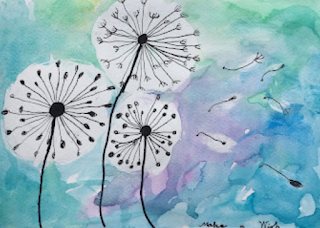


 Student Examples


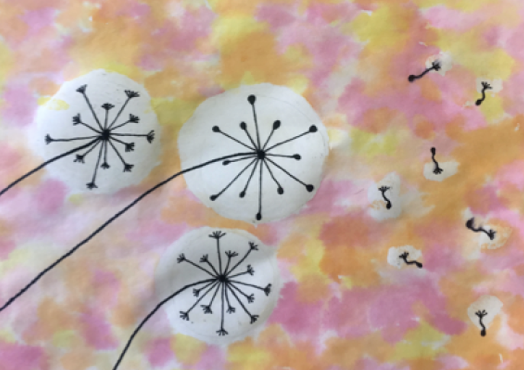


Tuesday, October 31, 2023
COLOR WHEEL ZEBRAS
Color Wheel Zebras

Learning Targets
I can...
- Create an original Color Wheel Zebra using drawing techniques learned in class
- Use color schemes (primary, secondary, analogous), line types (horizontal, vertical, diagonal), and value (lightness, darkness) inspired by French Painter (1964-Present) Norma Bessieres
- Use color wheel techniques (primary, secondary, intermediate, color schemes) and design principles (contrast, repetition, emphasis) based on Contemporary Art
- Define Color Wheel (to represent the colors of the visible spectrum and their relationship to one another)
Lesson One
Day One, Art Start
1. Creation (2023) Norma Bessieres

2. Read How The Zebra Got Stripes by Ron Fontes

3. Discussion Questions "Does art originate from nature or is it a symbolic human invention? Why did the artist choose zebras? How can the relationship between zebra as a living being and the geometric abstraction induced by its features be expressed with a painter's intrinsically artificial means of depicting the living? What is the correlation between inanimate objects and symbols in these compositions? What is your definition of art? How has the zebra inspired artists like Alain Jacquet and Victor Vasarely? How does art reflect geometric and symbolic concepts? How has the artist captured the form of the zebra in this painting? Do stripes originate from man's observation of nature or are they a symbolic invention? Do stripes that appear criss-crosssed, interwoven, accentuated, and colored constitute a boundary between figuration and abstract?"
Lesson Activities
1. Use pencil to draw shape variation (geometric, organic, free form) of the animal parts (ears, tail, eyes) of the zebra paintings
2. Use line types (horizontal vertical diagonal) to add facial features (eyes, nose, mouth) of the zebra paintings
3. Use line types (horizontal, vertical, diagonal) to add details (patterns, stripes, swirls) to the positive space (animal) of the Color Wheel Zebras
Day Two, Art Start
1. Retrieve Color Wheel Zebras for Assigned Tables
2. Resonance (2023) Norma Bessieres

3. Discussion Questions "What are some animals found in nature? Do these animals have special meaning? What is emphasis? What designs do you see? Which colors are found? Which parts are texture and which parts are behind the texture? What animal is this? Which aiming does this close up belong too? What is shown in this picture? Can you guess the animal shown here? What do you see here? What characteristics would you use to describe the look of this animal? Did you show values by having pressure of the pencil by showing highlight and shadows with complementary colors? Did you create a center of interest within the eyes by adding a white reflection? What do you notice about the background? What are three similar characteristics in each picture? Why do you think the artist has created this style? How does this picture make you feel? What would you think the artist is trying to make you feel?"
Lesson Activities
1. Use color combinations (analogous, secondary, primary) to fill in the positive space (foreground) of the zebra paintings
2. Use color combinations (analogous, secondary, primary) to fill in the negative space (background) of the zebra paintings
3. Use line types (horizontal, vertical, diagonal) to fill in the positive space (foreground) of the Color Wheel Zebras
Day Three, Art Start
1. Retrieve Color Wheel Zebras for Assigned Tables
2. Set Up Studio Area (tempera paint, water bucket, paint brushes)
Lesson Activities
1. Add highlights (reflective light, light source, highlights) to the positive space (zebra) of the zebra paintings
2. Add shadows (reflective shadow, cast shadow, shadows) to the negative space (background) of the zebra paintings
3. Use stop motion program (iMotion, FlipaClip, Stop Motion) to add an animation to the Color Wheel Zebras
Artist Examples


 Student Examples


 Posts
Posts

