Monday, September 25, 2023
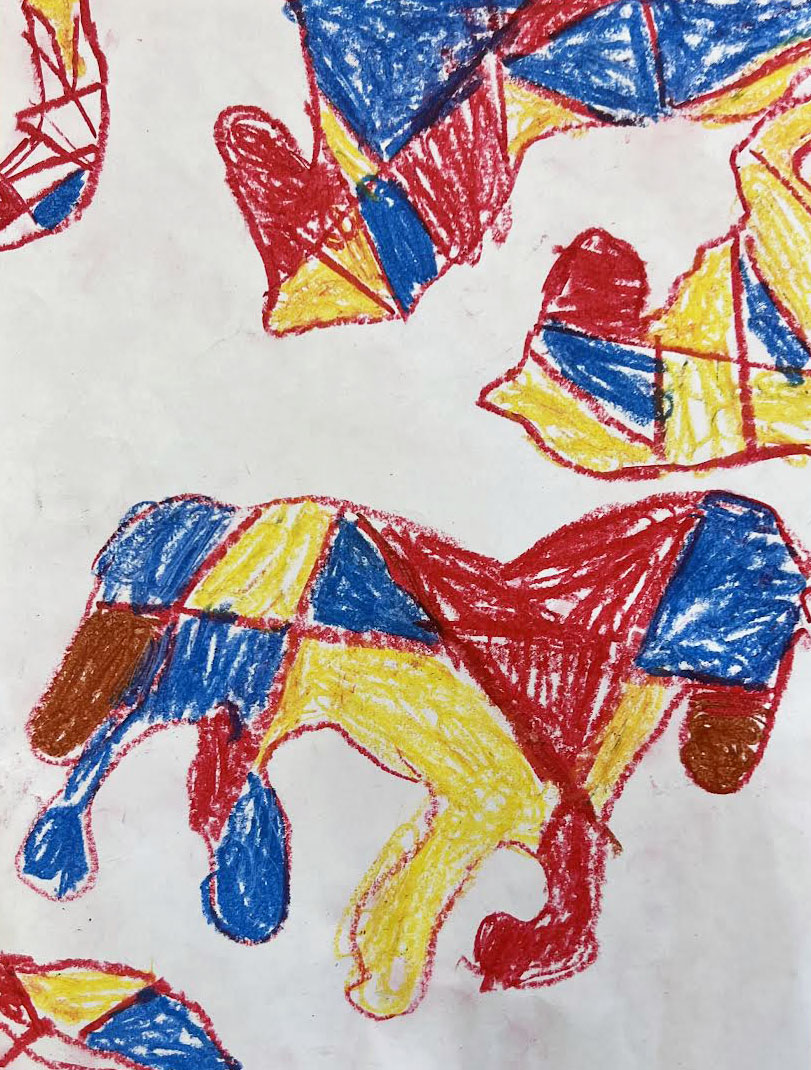
PIET MONDRIAN ANIMALS
Piet Mondrian Animals

Learning Targets
I can...
- Create an original Piet Mondrian Animals using paintings techniques learned in class
- Use line types (horizontal, vertical, diagonal), primary colors (red yellow blue), and shape variation (geometric, organic, free form) inspired by Dutch Artist (1872-Present) Piet Mondrian
- Use art element color (primary colors, red, yellow, blue) and design principles (repetition, composition, contrast) based on Modern Art
- Define Neoplasticism (a style of painting using only vertical lines, horizontal lines, and rectangular shapes in primary colors)
Lesson One
Day One, Art Start
1. Composition No. II (1920) Piet Mondrian

2. Read Piet Mondrian: The Man Who Changed Everything by Waanders Uitgevers Zwolle

3. Discussion Questions "How did Piet Mondrian come to paint this way? How did you choose the placement of colors? What colors do you notice first in the artist's paintings? What she is the largest colored shape? What size is the smallest? What is the most space you have between colored shapes? What is the least? Can you see the shape of a tree in this painting? What makes Piet Mondrian artwork abstract? Is Mondrian thinking about similar things in his artwork? What do you think Piet Modniran is trying to express? How is Piet Mondrian's artwork different from other artists?"
Lesson Activities
1. Choose 12" X 15" Painting Paper
2. Add line types (horizontal vertical diagonal) to the positive space (animal) of the Piet Mondrian Animals
3. Outline line types (horizontal, vertical, diagonal) with neutral colors (black, grey, white) for the positive space (animal) of the Piet Mondrian Animals
Day Two, Art Start
1. Retrieve Piet Mondrian Animals for Assigned Tables
2. Composition A (1923) Piet Mondrian

3. Discussion Questions "Who was Piet Mondrian? What do you notice in this painting Piet Mondrian created? What is Piet Mondrian the founder of? Where was Piet Mondrian born? What shapes did Mondrian mainly use in his paintings? How did Piet Mondrian create straight lines? Who introduced Mondrian to art? How did Piet Mondrian's artwork evolve from 1908 to 1912? What school did Piet Mondrian attend? How did Mondrian's artwork change overtime? What style did Mondrian paint his artwork in? What are movement is Modern Art characterized by? What is the title of this painting?"
Lesson Activities
1. Use primary colors (red yellow blue) to fill in the positive space (animal) of the Piet Mondrian Animals
2. Use primary colors (red yellow blue) to fill in the negative space (background) of the Piet Mondrian Animals
3. Use colored construction paper (blue, red, yellow) to fill in the negative space (background) of the Piet Mondrian Animals
Day Three, Art Start
1. Retrieve Piet Mondrian Animals for Assigned Tables
2. Set Up Studio Area (water bucket, paint brushes, tempera paint)
Lesson Activities
1. Add highlights (reflective light, light source) to fill in the positive space (animal) of the Piet Mondrian Animals
2. Add shadows (reflective shadow, cast shadow) to fill in the negative space (background) of the Piet Mondrian Animals
3. Add details (whiskers, claws, spots, eyelashes) to the positive space (animal) of the Piet Mondrian Animals
Artist Examples
 Student Examples




Thursday, August 29, 2019
PRIMARY STILL LIFE
Primary Still Life

Learning Targets
I can...- Create an original Primary Still Life using observational drawing techniques learning in class
- Use form (two dimensional, three dimensional), shape variation (geometric, organic), and value (light yellow, dark yellow) inspired by Dutch Painter (1872-1944) Piet Mondrian and American Artist (1923-1997) Roy Lichtenstein
- Understand primary colors (red yellow blue) and design principles (composition, variation, balance) relating to Modern Art
- Define Still Life (painting or drawing of an arrangement of objects such as flowers, fruit, or dishes)
Lesson One
Day One, Art Start
1. Glass and Lemon in a Mirror (1974) Roy Lichtenstein

Lesson Activities
1. Choose 12" X 15" Drawing Paper2. Add three dimensional shapes (cylinder, pyramid, sphere) to composition of arranged objects (fruit dishes, fabric)
3. Add an horizon line in the background to separate the folded drapery, objects, and wallpaper
Reminder:
- Initials & Home Teacher on Back of Paper
Day Two, Art Start
1. Retrieve Primary Still Life for Assigned Table2. Still Life with Crystal Bowl (1973) Roy Lichtenstein

Lesson Activities
1. Use primary colors (red yellow blue) to fill in the positive space (fruit bowl) of the still life2. Use primary colors (red yellow blue) to fill in the negative space (wallpaper) of the still life
3. Use shape stamps to add patterns (floral, silk, wood) to the Primary Still Life
Day Three, Art Start
1. Retrieve Primary Still Life for Assigned Table2. Set Up Studio Area (tempera paint, water bucket, paint brushes)
Lesson Activities
1. Add highlights (reflective light, light source) to subject matter (fruit bowl, glassware) of still life2. Add shadows (cast shadow, shadow) to background (wallpaper, table) of still life
3. Outline details (pattern, objects, fruit) in foreground (fruit bowl, glassware) of Primary Still
Life
Artist Examples


Student Examples


 Posts

