Monday, August 26, 2024
GERGELY DUDAS SEARCH DRAWINGS
Gergely Dudas Search Drawings
Learning Targets

I can...
- Create an original Gergely Dudas Search Drawing using collage techniques learned in class
- Use shape variation (geometric, organic, free form), line types (horizontal, vertical, diagonal), and color combinations (analogous, secondary, primary) inspired by Hungarian Artist (2019-Present) Gergely Dudas
- Use drawing techniques (shading, blending, overlapping) and design principles (composition, repetition, movement) based on Seek And Find Cartoons
- Define Repetition (the use of two or more of the same or similar elements such as colors, shapes, or lines)
Lesson One
Day One, Art Start
1. Find BB-8 (2024) Gergely Dudas

2. Read Bear's Spooky Book Of Hidden Things (2018) Gregory Dudas

3. Discussion Questions "Did you ever play "I Spy with my Little Eye" game? What are your favorite games to play at home and in the classroom? What does "I Spy" mean? Where did "I Spy With My Eye" come from? Have you played I Spy games indoors or outdoors? Have you played the I Spy game with friends, family, or adults? How do you play "I Spy with my little eye?" What are the rules of this game? When you play I Spy, do you use yes or no questions to help find the answer? Does I Spy use number recognition or shape identification for young children? Why would visual perception be an important skill for learning to read? What are some of your interests? What do you notice in your surroundings?"
Lesson Activities
1. Use three geometric shapes (rectangle, oval, circle) to create a three dimensional silhouette of a fall animal (fox, moose, squirrel, deer) for the search compositions
2. Add details (eyes, nose, claws) to the three dimensional silhouettes of a fall animal (fox, moose, squirrel ,deer) for the search compositions
3. Outline the positive space (foreground, animals) with neutral colors (black, grey, white) for the Gergely Dudas Search Drawings
Day Two, Art Start
1. Retrieve Gergely Dudas Search Drawing for Assigned Tables
2. Sheep Among Goats (2024) Gregely Dudas

3. Discussion Questions "What do you notice is different with the shapes, colors, and arrangement within this artwork? What is the same and different about each picture? What colors are being used in this artwork? Which area of the artwork is emphasized by the artist? How would you describe this artwork to someone who has never seen it? How does the artist use rotation and translation to create a search composition? Do you think a circle or oval could fill the search composition? Do any spaces cover the space exactly? How can you explain the movement of one tile to another tile? Did everyone use the same number of shapes in their search compositions? Why might the number of shapes vary between students? How many different arrangements did you discover?"
Lesson Activities
1. Add finishing details (eyes, nose, claws) to the positive space (animal, foreground) of the search compositions
2. Use neutral colors (black, grey, white) to outline the positive space (animal, foreground) of the search compositions
3. Add embellishments (salt, glitter, metallic) for the negative space (background, negative space) of the Gergely Dudas Search Drawings
Day Three, Art Start
1. Retrieve Gergely Dudas Search Drawings for Assigned Tables
2. Set Up Studio Area (colored pencils, erasers, markers, sharpeners)
Lesson Activities
1. Add embellishments (salt, glitter, metallic) for the negative space (background, negative space) of search compositions
2. Add neutral colors (black, white, brown, grey) to the three dimensional silhouettes (animal, foreground) of the Gergely Dudas Search Drawings
3. Add value (lightness, darkness, highlights, shadows) to the positive space (animal, foreground) of the Gergely Dudas Search Drawings
Artist Examples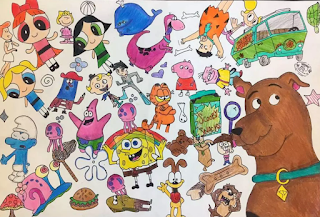


 Student Examples


Tuesday, October 31, 2023
COLOR WHEEL ZEBRAS
Color Wheel Zebras

Learning Targets
I can...
- Create an original Color Wheel Zebra using drawing techniques learned in class
- Use color schemes (primary, secondary, analogous), line types (horizontal, vertical, diagonal), and value (lightness, darkness) inspired by French Painter (1964-Present) Norma Bessieres
- Use color wheel techniques (primary, secondary, intermediate, color schemes) and design principles (contrast, repetition, emphasis) based on Contemporary Art
- Define Color Wheel (to represent the colors of the visible spectrum and their relationship to one another)
Lesson One
Day One, Art Start
1. Creation (2023) Norma Bessieres

2. Read How The Zebra Got Stripes by Ron Fontes

3. Discussion Questions "Does art originate from nature or is it a symbolic human invention? Why did the artist choose zebras? How can the relationship between zebra as a living being and the geometric abstraction induced by its features be expressed with a painter's intrinsically artificial means of depicting the living? What is the correlation between inanimate objects and symbols in these compositions? What is your definition of art? How has the zebra inspired artists like Alain Jacquet and Victor Vasarely? How does art reflect geometric and symbolic concepts? How has the artist captured the form of the zebra in this painting? Do stripes originate from man's observation of nature or are they a symbolic invention? Do stripes that appear criss-crosssed, interwoven, accentuated, and colored constitute a boundary between figuration and abstract?"
Lesson Activities
1. Use pencil to draw shape variation (geometric, organic, free form) of the animal parts (ears, tail, eyes) of the zebra paintings
2. Use line types (horizontal vertical diagonal) to add facial features (eyes, nose, mouth) of the zebra paintings
3. Use line types (horizontal, vertical, diagonal) to add details (patterns, stripes, swirls) to the positive space (animal) of the Color Wheel Zebras
Day Two, Art Start
1. Retrieve Color Wheel Zebras for Assigned Tables
2. Resonance (2023) Norma Bessieres

3. Discussion Questions "What are some animals found in nature? Do these animals have special meaning? What is emphasis? What designs do you see? Which colors are found? Which parts are texture and which parts are behind the texture? What animal is this? Which aiming does this close up belong too? What is shown in this picture? Can you guess the animal shown here? What do you see here? What characteristics would you use to describe the look of this animal? Did you show values by having pressure of the pencil by showing highlight and shadows with complementary colors? Did you create a center of interest within the eyes by adding a white reflection? What do you notice about the background? What are three similar characteristics in each picture? Why do you think the artist has created this style? How does this picture make you feel? What would you think the artist is trying to make you feel?"
Lesson Activities
1. Use color combinations (analogous, secondary, primary) to fill in the positive space (foreground) of the zebra paintings
2. Use color combinations (analogous, secondary, primary) to fill in the negative space (background) of the zebra paintings
3. Use line types (horizontal, vertical, diagonal) to fill in the positive space (foreground) of the Color Wheel Zebras
Day Three, Art Start
1. Retrieve Color Wheel Zebras for Assigned Tables
2. Set Up Studio Area (tempera paint, water bucket, paint brushes)
Lesson Activities
1. Add highlights (reflective light, light source, highlights) to the positive space (zebra) of the zebra paintings
2. Add shadows (reflective shadow, cast shadow, shadows) to the negative space (background) of the zebra paintings
3. Use stop motion program (iMotion, FlipaClip, Stop Motion) to add an animation to the Color Wheel Zebras
Artist Examples


 Student Examples


Wednesday, August 23, 2023
OIL PASTEL DRAGON EYES
Oil Pastel Dragon Eyes

Learning Targets
I can...
- Create an original Oil Pastel Dragon Eye using drawing techniques learned in class
- Use analogous colors (red, purple, blue; yellow, orange, green), line types (horizontal, vertical, diagonal), and shape (two dimensional, three dimensional) inspired by Renaissance Artists
- Use value techniques (shades, tints, shadows, highlights) and design principles (composition, proportion, balance) based on Medieval Art
- Define gradation (a small change from one shade, tone, or color to another)
Lesson One
Day One, Art Start


Lesson Activities
1. Choose 12" X 15" Drawing Paper
2. Add line types (horizontal, vertical, diagonal) to the positive space (dragon) of the Oil Pastel Dragon Eyes
3. Outline line types (horizontal, vertical, diagonal) with analogous colors (red blue purple; green yellow orange) for the positive space (dragon) of the Oil Pastel Dragon Eyes
Day Two, Art Start
1. Retrieve Oil Pastel Dragon Eyes for Assigned Tables
2. Articulated Dragon (1880) Myochin School Japan

3. Discussion Questions "What decision did you make on the dragon's appearance and behavior? What kind of dragon are you making? What type of personality does the dragon have? Is your dragon made up of different creatures? What colors have you chosen for your dragon? Do those colors have symbolic meaning? What kind of background color or pattern does your dragon want to perch? What is the name of your dragon? How are dragons a part of the Lunar New Year celebrations? What does the word culture mean to you? What are some different cultures from around the world? What sorts of traditions and symbols are specific to these different cultures? What sorts of traditions and symbols are found in your own culture? Why might it be important to understand cultures other than your own? What is the relationship between art and culture? Are they connected? If so, how?"
Lesson Activities
1. Use analogous colors (red blue purple; green yellow orange) to fill in the positive space (dragon) of the Oil Pastel Dragon Eyes
2. Use analogous colors (red blue purple; green yellow orange) to fill in the negative space (background) of the Oil Pastel Dragon Eyes
3. Use embellishments (plastic eyes, bubble wrap, brown paper) to fill in the positive space (dragon) of the Oil Pastel Dragon Eyes
Day Three, Art Start
1. Retrieve Oil Pastel Dragon Eyes for Assigned Table
2. Set Up Studio Area (oil pastels, erasers, pencils)
Lesson Activities
1. Add highlights (reflective light, light source) to fill in the positive space (dragon) of the Oil Pastel Dragon Eyes
2. Add shadows (cast shadow, reflective shadow) to fill in the negative space (background) of the Oil Pastel Dragon Eyes
3. Add details (eyelashes, spots, whiskers) to the positive space (dragon) of the Oil Pastel Dragon Eyes
Artist Examples


Student Examples


Monday, December 19, 2022
KOALA COLLAGES
Koala Collages

Learning Targets
I can...
- Create an original Koala Collages using drawing techniques learned in class
- Use shape variation (geometric, organic, free form), space (positive, negative), and texture (implied, actual, visual) inspired by English Artist (2012-Present) Hannah Dale
- Use printmaking techniques (etching, engraving, embossing, stamping) and design principles (composition, proportion, repetition) based on British Art
- Define Texture (the feel or appearance of a surface)
Lesson One
Day One, Art Start
1. Koality Time (2022) Hannah Dale

2. Read The Koala Who Could by Rachel Bright

3. Discussion Question "What does this picture say about koalas? What does the background tell me? What can I inference that the artist might like? What lesson did the main character learn? How can we apply that to our lives as well? Would the koalas have come down on his or her own? What do we know about his character that might help us make this inference? How many things do you want o try, but you fear the risk? How did the artist use printmaking to add texture to the koala? How did the artist divid the koala's face with a horizontal line? How did the artist use dry brush and sponge painting to create texture on the koala? How did the artist add value in this artwork?"
Lesson Activities
1. Choose 8" X 12" Drawing Paper
2. Add line types (contour, outline, perspective) to the positive space (animal) of the koala collages
3. Outline line types (contour, outline, perspective) with neutral colors (black, brown, grey) for the Koala Collages
Day Two, Art Start
1. Retrieve Koala Collages For Assigned Tables
2. Three Of A Kind (2022) Hannah Dale

3. Discussion Questions "How many species of koalas are there? How far can a koala travel in a dat? What do koalas eat? How much food do koalas consume? How long do koalas sleep? What is the biggest threat to a koala? Did the artist paint in long brush strokes? Are the lines curved, straight, or tihin? Does the artist use a variety of shapes? What types of shapes do you see? What are the colors that the artist uses? what do you think the artist is about? What are the similarities in the story behind this artwork? Have you heard these stories before?"
Lesson Activities
1. Use analogous colors (blue purple red) to fill in the positive space (animal) of the koala collages
2. Use analogous colors (blue purple red) to fill in the negative space (background) of the koala collages
3. Use embellishments (plastic eyes, bubble wrap, brown paper) to fill in the positive space (animal) of the Koala Collages
Day Three, Art Start
1. Retrieve Koala Collages for Assigned Table
2. Set Up Studio Area (glue sticks, construction paper, oil pastels)
Lesson Activities
1. Add highlights (reflective light, light source) to fill in the positive space (animal) of the koala collages
2. Add shadows (reflective shadow, cast shadow) to fill in the negative space (background) of the koala collages
3. Add details (eyelashes, fur, claws) to the positive space (animal) of the Koala Collages
Artist Examples

Student Examples


 Posts
Posts

