Tuesday, August 27, 2024
DANDELION PUFFS PAINTINGS
Dandelion Puffs Paintings

Learning Targets
I can...
- Create an original Dandelion Puffs Paintings using drawing techniques learned in class
- Use color combinations (warm colors, cool colors), line types (horizontal vertical diagonal), and shape variation (geometric, organic, free form) inspired by French Artist (1814-1875) Jean-Francois Millet
- Use painting techniques (layering, blending, dry brush, underpainting) and design principles (gradation, composition, proportion) based on Realism
- Define Composition (the way in which different elements of an artwork are combined or arranged together)
Lesson One
Day One, Art Start
1. Dandelions (1867) Jean-Francois Millet

2. Read The Dandelion Seeds Big Dream by Joseph Anthony

3. Discussion Questions "Why are dandelions considered an undesirable weed and not valued in specific environments? How does a close view of a dandelion reference rural and agricultural life? Did you know that Jean Francois Millet brought back the popularity of pastels with his artwork? Did you notice that there is one open flower showing? Where is the path of light and directional cues for taking the viewer throughout the drawing? Can you see the circular design? Can you sense the movement of the seed heads drifting apart? Why are there so many artists that paint dandelions? What do you like about dandelions? Can you think of other ways to use dandelions?"
Lesson Activities
1. Choose 12" X 15" Drawing Paper
2. Use line types (horizontal, vertical, diagonal) to draw positive space (flower, dandelion) of the flower paintings
3. Use color combinations (analogous, warm colors, cool colors) to fill in the positive space (flower) of the Dandelion Puffs Paintings
Day Two, Art Start
1. Retrieve Dandelion Puffs Paintings for Assigned Tables
2. Dandelions (1985) Yayoi Kusama

3. Discussion Questions "Did you know dandelions are edible? Did you know dandelions contact more essential vitamins than spinach? Did you know early European settlers in America used them for food and medicine? How many flowers can you see in a dandelion bloom? Can you guess how the dandelion got the name lion's teeth? Did you learn anything new about dandelions? Why do some people call dandelions weeds? How far do the seeds fly the air is still and when it is windy? Which part of the dandelion reminds you of a lion's tooth? Have you ever blown on a fluff ball of dandelion seeds? Why do you think dandelion seeds are fluffy? Do the seeds with bristles remind you of a helicopter or a parachute?"
Lesson Activities
1. Add shape variation (geometric, organic, free form) to the negative space (background) of the flower paintings
2. Use patterns (stripes, swirls, curls) to add a design to the negative space (background) of the flower paintings
3. Use chalk to blend patterns (swirls, stripes, curls) for the negative space (background) of the Dandelion Puffs Paintings
Day Three, Art Start
1. Retrieve Dandelion Puffs Paintings for Assigned Tables
2. Set Up Studio Area (paint brushes, water buckets, oil pastels, watercolor)
Lesson Activities
1. Blend color combinations (analogous, warm colors, cool colors) for the positive space (flower) of the flower paintings
2. Add highlights (light source, reflective light) to the positive space (flower, dandelion) of the flower paintings
3. Add illusion of depth by add details (glitter, petals, details) to the positive space (flower, dandelion) of the Dandelion Puffs Paintings
Artist Examples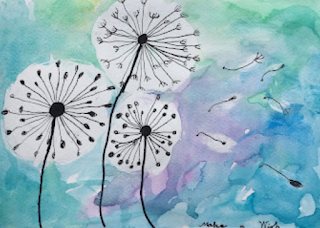


 Student Examples


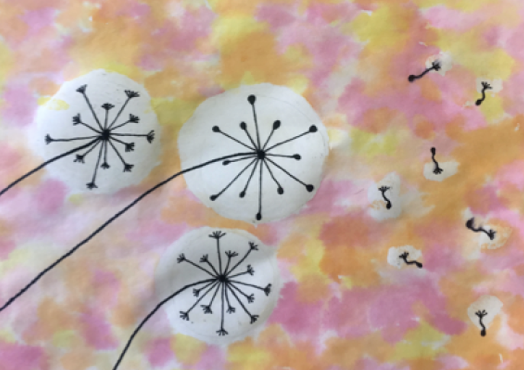


Wednesday, August 31, 2022
SEURAT UMBRELLAS
Seurat Umbrellas

Learning Targets
I can...
- Create an original Seurat Umbrella using drawing techniques learned in class
- Use shape variation (geometric, organic, free form), color combinations (analogous, secondary, primary), and value (lightness, darkness) inspired by Post Impressionist Painter (1859-1891) George Seurat
- Use painting forms (abstract, modernism, expressionism, surrealism) and design principles (repetition, gradation, composition) based on Impressionism
- Define Chromoluminarism (a language that uses colors, lines, shapes, and intensity to show emotions in art)
Lesson One
Day One, Art Start
1. Sunday Afternoon On The Island of La Grande Jatte (1884-1886) Georges Seurat

2. Read "Sunday With Seurat" by Julie Merberg & Suzanne Bober

3. Discussion Questions "What sort of object is this? What do you see (in this painting, sculpture)? What else do you see? How would you describe the composition? How would you describe the motion or activity? How would you describe the expression? How would you describe the clothing? Does this work look natural, representational, or is it stylized? Who do you think this person might be? What do you think this object was used for? Why do you think that? What was going on historically, economically, socially during this period? How does this work of art reflect the period? Can you guess what emotion he was trying to show in this artwork? What new colors are created by this optical mixing? What examples of their works can you find? How do these artist use paintbrushes and colors in unique ways? What other materials could be used to create a pointillist picture? How does this make the drawing realistic?"
Lesson Activities
1. Choose 12 X 15 Painting Paper
2. Use graphite paper to draw the horizon line (diagonal, vertical, horizontal) of the umbrella paintings
3. Use graphite pencil to draw line types (horizontal, vertical, diagonal) for the positive space (umbrella) of the Seurat Umbrellas
Day Two, Art Start
1. Retrieve Seurat Umbrellas for Assigned Tables
2. Women With Umbrella (1884) Georges Seurat

3. Discussion Questions "What types of lines are in this painting? What types of colors are used in this painting? How does your eye move through the artwork? What choices did the artist make to make that happen? How would you describe this artwork to someone who has never seen it? What elements of the painting seem real? What elements seem dreamlike or imaginary? What is normal about this painting? If this painting had sound effects, what would they sound like? What do we know about the artist after viewing this artwork? How do you think the artist feels about the final product? How did the artist use line, shape, and color to contribute to the mood or meaning? What title would you I've this artwork? What would it feel like to be in this artwork? How do you personally relate to or connect with this picture?"
Lesson Activities
1. Use watercolor to fill in the positive space (umbrella) with warm colors (red, orange yellow) of the umbrella paintings
2. Use watercolor to fill in the negative space (background) with cool colors (blue, green, purple) of the umbrella paintings
3. Add details (clouds, wind, stars) to the negative space (background) of the Seurat Umbrellas
Day Three, Art Start
1. Retrieve Seurat Umbrellas for Assigned Tables
2. Set Up Studio Area (paint brushes, water buckets, paper towel)
Lesson Activities
1. Add highlights (light source, reflective light) to the positive space (umbrella) of the umbrella paintings
2. Add shadows (cast shadow, shadow) to the negative space (background) of the umbrella paintings
3. Add embellishments (glitter glue, gem stones, yarn) to the positive space (umbrella) of the Seurat Umbrellas
Artist Examples

Student Examples


Thursday, October 28, 2021
CHRIS UPHUES INSPIRED HEARTS
Chris Uphues Inspired Hearts

Learning Targets
I can...
- Create an original Chris Uphues Inspired Hearts using drawing techniques learned in class
- Use shape variation (geometric, organic), line types (horizontal, vertical, diagonal), and space (positive, negative) inspired by American Artist (1994-Present) Chris Uphues
- Use printmaking techniques (woodcut, etching, engraving) and design principles (balance, composition, gradation) based on Contemporary Art
- Define Symbol (a material object representing or standing for something abstract)
Lesson One
Day One, Art Start
1. Lemon-hearted (2018) Chris Uphues

2. Read Beautiful Days by Chris Uphues

3. Discussion Questions "What is going on in this artwork? What was your first reaction to this artwork? what do we know about the artist after viewing this artwork? What do you think the artist is trying to say in this artwork? What emotions do you notice in the artwork? What emotions do you feel when looking at this artwork? How did the artist use line, shape, and color to contribute to the mood or meaning? How might you feel differently about the world after looking at this artwork?"
Lesson Activities
1. Choose 10" X 10" Black Construction Paper
2. Use template to trace a geometric shape (heart, flower, star) in the center of the Black Construction Paper
3. Use black sharpie marker to outline various lines (horizontal, vertical, diagonal) for the positive space (foreground) of the Chris Uphues Inspired Hearts
Day Two, Art Start
1. Retrieve Chris Uphues Inspired Hearts for Assigned Table
2. 5028 York Boulevard Los Angeles (2018) Chris Uphues

3. Discussion Questions "What pieces were you drawn to the most? Why were you drawn tot these pieces? What are some elements that tie the artist pieces together (bold colors, big shapes, simple patterns, black outlines)? What would you change if you were the artist? What do you feel the artist is trying to accomplish with this piece? What types of media does the artist use? What, if anything, do the pieces remind you of? What about this artwork is something you have seen or experienced before?"
Lesson Activities
1. Use black oil pastel to outline various lines (horizontal, vertical, diagonal) of the positive space (foreground) of the heart designs
2. Use warm colors (red orange yellow) to fill in the positive space (heart) of the Chris Uphues Inspired Hearts
3. Use cool colors (blue green purple) to fill in the negative space (background) of the Chris Uphues Inspired Hearts
Day Three, Art Start
1. Retrieve Chris Uphues Inspired Hearts for Assigned Table
2. Set Up Studio Area (tempera paint, water bucket, paint brushes)
Lesson Activities
1. Add highlights (reflective light, light source) to the positive space (heart) of the Chris Uphues Inspired Hearts
2. Add shadows (cast shadow, shadow) to the negative space (background) of the Chris Uphues Inspired Hearts
3. Add embellishments (found objects, decorations, glitter) to the positive shape (heart) and negative space (background) of the Chris Uphues Inspired Hearts
Artist Examples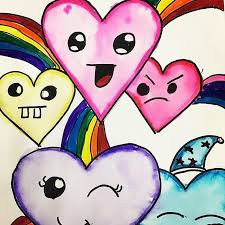

Student Examples


Tuesday, August 10, 2021
FOLK ART RABBITS
Folk Art Rabbits

Learning Targets
I can...
- Create an original Folk Art Rabbits using drawing techniques learned in class
- Use line types (curved, dotted, dashed), shape variation (geometric organic), and space (positive negative) inspired by Neo-Expressionist (1951-Present) Hunt Slonem
- Use collage techniques (cropping, overlapping, layering) and design principles (composition, balance, variation) based on Neo-Expressionism
- Define Composition (placement or arrangement of visual elements in a work of art)
Lesson One
Day One, Art Start
1. Purple Bunnies (2019) Hunt Slonem

2. Read The Velveteen Rabbit by Margery Williams

3. Discussion Questions "What caused Neo-expressionism? What are the characteristics of Neo-expressionism? Was Neo-expressionism just a trend of the art world? What happens when museums do not offer a public perspective that clarifies a movement? What does it mean when museums look for young artists? Should art be used for buying, selling, and commercial systems? Should artists participate in galleries, criticism, and media hype? Should storytelling be involved in the art making process? Do artists need to handle materials carefully for the work to be successful? How do artists deal with rejection?"
Lesson Activities
1. Choose 12" X 15" Drawing Paper
2. Use line types (curved lines, dotted, dashed) to draw positive space (animal) of the bunny collages
3. Use value (lightness, darkness) to fill in the positive space (animal) of the Folk Art Bunnies
Day Two, Art Start
1. Retrieve Folk Art Rabbits for Assigned Table
2. Lucky Charm 5 (2016) Hunt Slonem

3. Discussion Questions "What elements in this painting seem real? What adjectives would you use to describe this artwork? What verbs would you use to describe this artwork? What elements seem dreamlike or imaginary? What is strange about this artwork? What is exciting about this artwork? What do we know about the artist after viewing this artwork? If you could ask the artist a question, what would you ask her? Why do you think this artwork was created? Why do you say that? How do you think the artist feels about the final product? How do you think this artwork was made? Why do you think the artist made this artwork? What do you think the artist is trying to say about this artwork?"
Lesson Activities
1. Add geometric shapes (oval, circle, triangle) to the positive space (animal) of the bunny collages
2. Use pattern (swirls, zig zags, stripes) to add a design to the negative space (background) of the bunny collages
3. Use chalk pastels to smear patterns (swirls, waves, stripes) for the negative space (background) of the Folk Art Rabbits
Day Three, Art Start
1. Retrieve Folk Art Rabbits for Assigned Table
2. Set Up Studio Area (chalk pastels, erasers, sharpeners)
Lesson Activities
1. Blend neutral colors (black white grey) for the positive space (animal) of the bunny collages
2. Add highlights (light source, reflective light) to the positive space (animal) of the bunny collages
3. Add illusion of depth by adding details (rocks grass dirt mud) to the positive space (foreground) of the Folk Art Rabbits
Artist Examples
 Student Examples


 Posts
Posts

