Monday, November 17, 2025
UNICORN COLLAGES
Unicorn Collages Learning Targets

I can...
- Create an original Unicorn Collage using drawing techniques learned in class
- Use color combinations (rainbow order, neon colors, metallic colors), line types (loopy, spiral, scallop, wavy), and shape variation (geometric, organic, free form) inspired by The Unicorn Tapestries
- Use collage techniques (assemblage, photomontage, mixed media, decoupage) and design principles (proportion, contrast, repetition) based on Medieval Art
- Define Imagination (the power to form ideas and images in the mind)
Lesson One
Day One, Art Start
1. Tapestry Fragment Depicting A Unicorn (1500) Victoria and Albert Museum

2. Read Never Let A Unicorn Scribble by Diane Alber

3. Discussion Questions "What do you notice about these creatures? Why might an artist choose to combine parts of many different animals? What might these different animals symbolize? Why might someone have wanted to decorate their doorway with creatures like these? Where might we see animals like these today? What kind of creatures would you choose to decorate your own space? Why would you choose these creatures? How big will your unicorn be? What kind of features (water, tree, fences) does the unicorn need? How will you care for the unicorn everyday? Did you know that some people in medieval times thought unicorns were real animals? What is a magical creature? How are magical creatures different from everyday beings? What specials powers do magical creatures have? What kinds of magical creatures are found in different cultures and in stories from around the world? What makes a magical creature special or unusual?"
Lesson Activities
1. Choose 12" X 15" Drawing Paper
2. Use pencil to draw line types (horizontal, vertical, diagonal) for the positive space (foreground, middle ground, unicorn) of the Unicorn Collages
3. Use pencil to draw line types (horizontal, vertical, diagonal) for the negative space (background) of the Unicorn Collages
Day Two, Art Start
1. Retrieve Unicorn Collages for Assigned Tables
2. The Unicorn In Captivity (1495-1505) South Netherlands

3. Discussion Questions "If you could make a tapestry, what would be in it? Would there be animals in your tapestry? Where would the animals be and what would they be doing? What details would you include? Would you hide little animals, like the frog in Unicorn In Captivity? What colors would you use? What does the unicorn in the story have in common with the one you saw in the picture? Why might some things about this unicorn be different? What special powers does the unicorn in the story have? Was the unicorn in the story friendly or unfriendly? Was the unicorn in this story different than unicorns we read or heard about the other day? If you were a unicorn, what powers would you have? Would you rather have a unicorn or a dragon as a friend? If you were a unicorn, what kinds of things would you do? Would you like to be a unicorn? Why or why not?"
Lesson Activities
1. Use color combinations (analogous, rainbow order, secondary) to fill in the positive space (foreground, middle ground, unicorn) of the Unicorn Collages
2. Use color combinations (analogue, rainbow order, secondary) to fill in the negative space (background) of the Unicorn Collages
3. Use oil pastels to add patterns (dots, stripes, swirls, waves) to the positive space (foreground, middle ground, unicorn) of the Unicorn Collages
Day Three, Art Start
1. Retrieve Unicorn Collages for Assigned Tables
2. Set Up Studio Area (oil pastels, watercolor paint, glue sticks, construction paper)
Lesson Activities
1. Use oil pastels to add patterns (dots, stripes, swirls, waves) to the positive space (foreground, middle ground, unicorn) of the Unicorn Collages
2. Use neutral colors (black, white, brown, grey) for the negative space (background) of the Unicorn Collages
3. Add embellishments (jewels, glitters, fabric) to the positive space (foreground, middle ground, unicorn) of the Unicorn Collages
Artist Examples


 Student Examples


Thursday, August 5, 2021
CLAY WIZARDS
Clay Wizards

I can...
- Create an original Clay Wizard using sculpture techniques learned in class
- Use form (two dimensional, three dimensional), shape (geometric, organic), and texture (rough, smooth) inspired by (1939) The Wizard of Oz
- Use ceramic techniques (hand building coil method slab method) and design principles (movement repetition proportion) based on American Film
- Define Imagination (forming new ideas, images, or concepts that are not present to the senses)
Lesson One
Day One, Art Start
1. The Wizard Vainamoinen (2015) Celestial Images

2. Read Neville the Imagination Wizard by Tanya Latter

3. Discusion Questions "Which wizard was the supporter of King Arthur? In Lord of the Rings, which wizard is the most powerful? What is the name of the good witch in Wizard of Oz? Which little green character is the most powerful wizard in the Star Wars films? Who is the evil wizard and FGrans Vizier of Agrabah in the film Aladdin? Which sorceress is the energy of Merlin and King Arthur? Who is the weird wizard in the Cinematic Universe? Which wizard turns from good to bad in the Lord of the Rings? Which witch curses the princess aurora in sleeping beauty?"
Lesson Activities
1. Add lines for proportion (head body staff) within the silhouette of the wizard sculptures
2. Mold clay into basic shapes (cylinder, cone, pyramid) for the positive space (body) of the wizard sculptures
3. Use modeling tools to draw facial features (eyelashes, eyelids, freckles) within the silhouette of the Clay Wizards
Day Two, Art Start
1. Retrieve Clay Wizard for Assigned Table
2. The Dagda (2018) Kevin Mclaughlin

3. Discussion Questions "How does the wizard look? How do you think the artist drew this wizard? What do you know about wizards? What did you notice that is different about this book? What can you learn from viewing this artwork? Why did the artist use those colors and background for the wizard? What does it mean to be a wizard? What do wizards symbolize? What special features do wizards have?"
Lesson Activities
1. Add facial features (eyelashes, eyelids, beard) within the silhouette of the Clay Wizard
2. Add details (robe, staff, hat) to the positive space (body) of the wizard sculptures
3. Use modeling tools (brush grip paddle) to smooth out the facial features (eyelashes, eyelids, freckles) of the Clay Wizards
Day Three, Art Start
1. Retrieve Clay Wizard for Assigned Table
2. Set Up Studio Area (rubber mat, modeling tools, clay)
Lesson Activities
1. Add tempera paint (red yellow orange) to the positive space (body) of the wizard sculptures
2. Add tempera paint (blue green purple) to the negative space (background) of the wizard sculptures
3. Apply Gloss finish to the facial proportions, facial features, and accessories of the Clay Wizards
Artist Examples

Student Examples


Tuesday, December 8, 2020
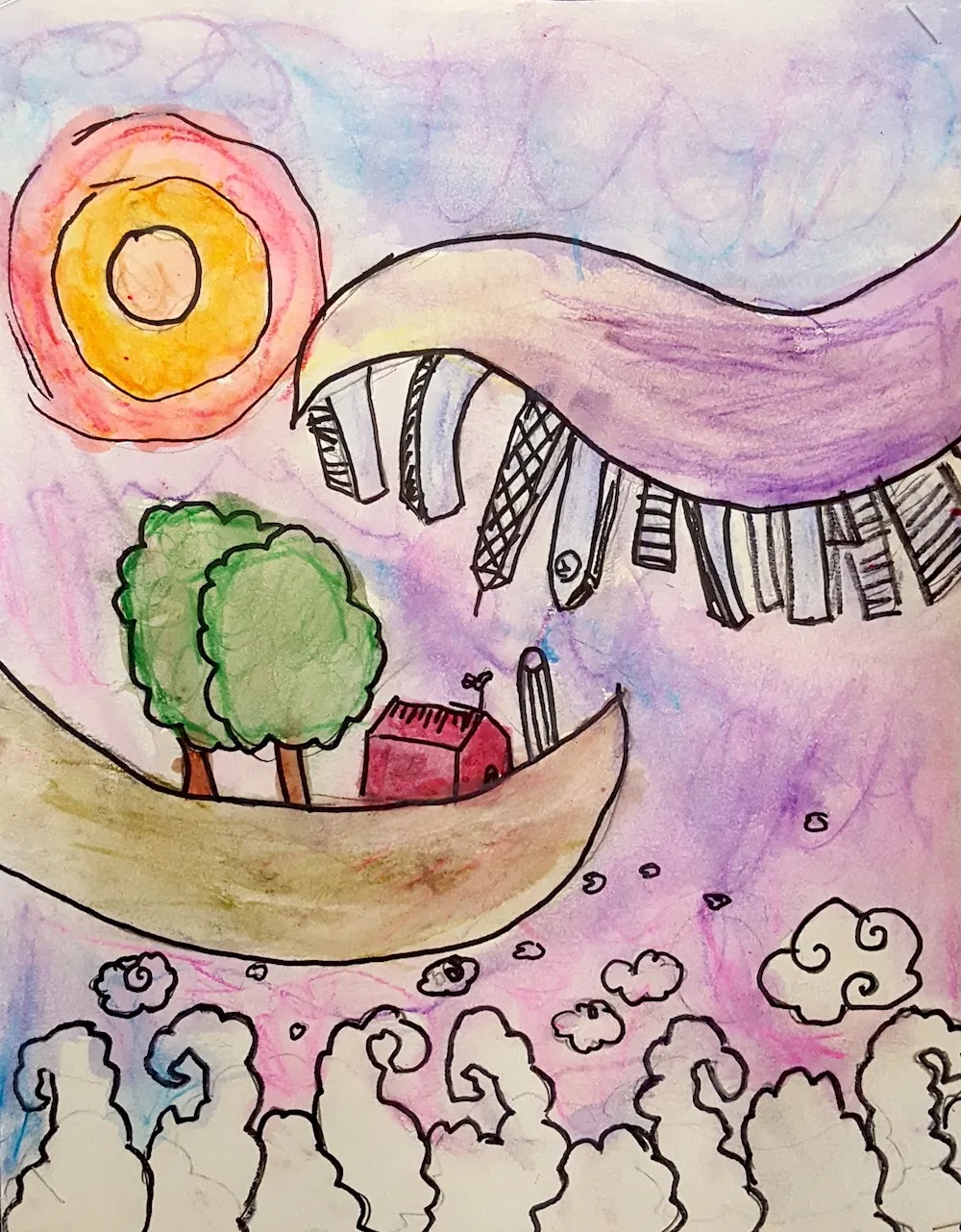
WHIMSICAL LANDSCAPES
Whimsical Landscapes

Learning Targets
I can...
- Create an original Whimsical Landscapes using drawing techniques learned in class
- Use color combinations (complementary, secondary, analogous), shape variation (geometric organic free form) and space (positive negative) inspired by American Artist (1981-Present) Justin Vining
- Use art element: line (curved angled wavy) and design principles (composition proportion balanced) based on Contemporary Art
- Define Whimsical (a vibrant, playful, and childlike style of art)
Lesson One
Day One, Art Start
1. Catching Stars On Park Avenue (2014) Justin Vining

2. Read Come Look With Me: Exploring Landscape Art With Children by Gladys S. Blizzard

3. Discussion Questions "How long does it take the artist to complete a painting? Why did he decide to become an artist? Why does the artist make his landscapes abstract? What is your favorite painting that at the artist has made? What do you think of his artwork? How is the artist influenced by art history and his surroundings? Have you seen his artwork before? Has Vining stepped away from his past or has he embraced it? How would you define or explain the work of Vining? Is he predictable? Is he still pushing himself? How? What is the definition of Abstract Art? What other famous artists would you compare Vining to? How has Vining's experience as an art educator and lawyer influenced his work? Are these experiences completely opposite? Is that good? As an artist, how important is it to draw inspiration from your surroundings? How might we become distracted by engaging in the world around us? How important is it to keep a sketchbook?"
Lesson Activities
1. Use a ruler, compass, or straight edge to draw the scenery of the landscape drawings
2. Add details (buildings, moon, farm) within the negative space (scenery) of the landscape paintings
3. Use colored sharpies to outline the negative space (background) of the Whimsical Landscapes
Day Two, Art Start
1. Retrieve Whimsical Landscapes for Assigned Table
2. The Road Less Traveled (2014) Justin Vining

3. Discussion Questions "What can you see? What do you think the meaning behind this image is? How does this image make you feel? What do you like about the image? What are some art elements and principles you can see? How does Vining use brushes or tools to show all the visual elements in his paintings? How would you compose your section? How will your section fit into the big picture? How is this painting inspiring your own work? What is going on in this picture? Who is Justin Vining and how did his artwork set him apart? How has Vining created this painting? What mediums and processes has he used? What art elements and principles has Vining used in his painting? Where can you see them? What inspiration comes to mind from this painting?"
Lesson Activities
1. Add patterns (swirls stripes stars) to positive space (foreground) and negative space (background) of scenery of landscape paintings
2. Use color combinations (analogous complementary secondary) to fill in the negative space (background) of the landscape paintings
3. Use color combinations (analogous complementary secondary) to fill in the positive space (foreground) of the Whimsical Landscapes
Day Three, Art Start
1. Retrieve Whimsical Landscapes for Assigned Tables
2. Set Up Studio Area (washable markers, sharpie markers, colored pencils)
Lesson Activities
1. Add highlights (reflective light, light source) within the positive space (foreground) of the scenery within the landscape paintings
2. Add shadows (cast shadows, shadow) within the negative space (background) of the scenery within the landscape paintings
3. Add details (moon, house, farm) within the negative space (background) within the scenery of the Whimsical Landscapes
Artist Examples


 Student Examples




 Posts

