Saturday, October 7, 2023
VERMEER INSTRUMENT COMPOSITIONS
Vermeer Instrument Compositions

Learning Targets
I can...
- Create an original Vermeer Instrument Compositions using drawing techniques learned in class
- Use neutral colors (black, white, grey, brown), line types (horizontal, vertical, diagonal), and value (lightness, darkness) inspired by Dutch Painter (1632-1975) Johannes Vermeer
- Use printmaking techniques (woodcut, etching, engraving, lithography) and design principles (emphasis, repetition, rhythm) based on Dutch Golden Age
- Define Camera Obscura (a darkened box with a convex lens for protecting the image of an object onto a screen inside)
Lesson One
Day One, Art Start
1. The Guitar Player (1670-1673) Johannes Vermeer

2. Read Secret Knowledge: Rediscovering The Lost Techniques Of The Old Masters by David Hockney

3. Discussion Questions "What type of mood does this scene create for you? What features do you see in the foreground of this painting? Can you find small dots of paint on the brick walls, trees, and boats? Why did the artist paint these white dots in the scene? How would you describe the texture of the musical instrument? How would you draw this texture using only lines? Which feature in the room reflects light the most brightly? Where can we see shadows in the room? What do you notice about the dresses? Can you find any other similarities in these three paintings? Can you find any differences in these paintings? Which direction is the light shining in this painting? How did the artist create the illusion of light reflecting on the pearl? What type of feeling does each color create for the viewer? Can you find objects in the picture that are typical props in Vermeer's paintings? What makes this painting different from the other interior scenes of this artist? How does the artist show distance?"
Lesson Activities
1. Choose 12" X 15" Printmaking Paper
2. Use pencil to draw simple shapes (circle, triangle, rectangle) and complex shapes (ellipse, parallelogram, hexagon) of the instruments for the instrument prints
3. Use wooden stylus to outline line variation (thick, thin, contour) of the positive space (instrument) of the Vermeer Instrument Compositions
Day Two, Art Start
1. Retrieve Vermeer Instrument Compositions for Assigned Tables
2. The Concert (1664) Johannes Vermeer

3. Discussion Questions "What was the first artwork the artist ever made? Do you think it is important to be a trained artist? What type of printmaking techniques do you think the artist preferred? What project did the artist work on? What do you think drove the artist to make prints? Who was an important mentor in this artists life? What materials did the artist favor? Why was the artist drawn to this subject matter? What does this artwork represent? What connection do artists have to their artwork? What materials did the artist favor? What do you think art means to this artist? Does this artwork represent something to the artist? What is inspirational about this artwork?"
Lesson Activities
1. Use engraving tools to outline line variation (thick thin contour outline) of the positive space (instrument) for the instrument prints
2. Use neutral colors (black, grey, brown, white) for the negative space (background) for the instrument prints
3. Use neutral colors (black, grey, brown, white) to fill in the positive space (foreground) of the Vermeer Instrument Compositions
Day Three, Art Start
1. Retrieve Vermeer Instrument Compositions for Assigned Tables
2. Set Up Studio Area (brayer, printmaking plates, gel plates, speedball ink)
Lesson Activities
1. Use printmaking paper to print one monoprint of every neutral color (black, brown, grey, white) of the instrument prints
2. Add highlights (reflective light, light source) to the positive space (foreground) of the Vermeer Instrument Compositions
3. Add shadows (cast shadow, reflective shadow) to the negative space (background) of the Vermeer Instrument Compositions
Artist Examples


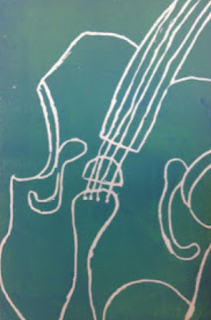 Student Examples


Friday, September 22, 2023
VAN GOGH LEAF PRINTS
Van Gogh Leaf Prints

Learning Targets
I can...
- Create an original Van Gogh Leaf Prints using painting techniques learned in class
- Use shape variation (geometric, organic, free form), line types (horizontal, vertical, diagonal), and texture (visual, actual, implied) inspired by Dutch Painter (1853-1890) Vincent Van Gogh
- Use printmaking techniques (woodcut, etching, engraving, lithography) and design principles (repetition, variation, movement) based on Post Impressionism
- Define Stencil (a printing process by which areas are blocked out to keep ink from non-image areas)
Lesson One
Day One, Art Start
1. Autumn Landscape (1885) Vincent Van Gogh

2. Read Vincent And The Colors Of The Wind by Chiara Lossani

3. Discussion Questions "How does nature inspire artwork? Why did Van Gogh become an artist? How many paintings did Vincent Van Gogh sell during his lifetime? Was Vincent Van Gogh left-handed or right-handed? What type of paint did Vincent Van Gogh use? Why did Vincent Van Gogh want to live in Paris? Why is yellow so prominent in Vincent Van Gogh's paintings? How old was Vincent Van Gogh when he started painting? What style did Vincent Van Gogh paint in? How many paintings did Van Gogh sell in his lifetime? What is Post Impressionism? What are Vincent Van Gogh's most influential artworks? Why should artists study Van Gogh's artwork?"
Lesson Activities
1. Use leaf templates (maple, clove, chestnut, hickory) to outline basic shapes (geometric, organic, free form) for leaf prints
2. Use line types (horizontal, vertical, diagonal) to fill in the positive space (foreground) of the leaf prints
3. Use color combinations (analogous, complementary, secondary) to fill in the positive space (foreground) of the Van Gogh Leaf Prints
Day Two, Art Start
1. Retrieve Van Gogh Leaf Prints for Assigned Table
2. Falling Leaves (Les Alyscamps) (1888) Vincent Van Gogh

3. Discussion Questions "What do you enjoy most about this painting? What do you like least about this painting? How would you do things differently? What other subjects could be painted in the post impressionism style? How did Vincent van Gogh use texture in his paintings? If you could ask Vincent Van Gogh one question, what would it have been? What is Vincent Van Gogh famous for? How does understanding the artist change our understanding of his paintings? What made Vincent Van Gogh unique? What can we learn from Vincent van Gogh? How did Vincent Van Gogh paint? Why did Vincent van Gogh begin painting? Why is Vincent Van Gogh important to art history? Why is Vincent Van Gogh considered one of the best painters the world has ever seen? What are the stylistic differences between Van Gogh's work? Which year was best for Van Gogh, in terms of his artwork? How long did it take Vincent van Gogh to complete a painting?"
Lesson Activities
1. Use color combinations (analogous, complementary, secondary) to fill in the positive space (leaf) of the leaf prints
2. Use color combinations (analogous, complementary, secondary) to fill in the negative space (background) of the leaf prints
3. Use line types (horizontal, vertical, diagonal) to add patterns (dots, swirls, stripes) to the positive space (leaf) of the Van Gogh Leaf Prints
Day Three, Art Start
1. Retrieve Van Gogh Leaf Prints for Assigned Table
2. Set Up Studio Area (foam plates, speed ball ink, brayers, rollers)
Lesson Activities
1. Use line types (horizontal, vertical, diagonal) to add patterns (dots, swirls, stripes) to the negative space (background) of the leaf prints
2. Use color combinations (analogous, complementary, secondary) to fill in the negative space (background) with line types (horizontal, vertical, diagonal) of the leaf prints
3. Use color mixing techniques (blending, overlapping, contrasting) to fill in the positive space (leaf) of the Van Gogh Leaf Prints
Artist Examples


 Student Examples


Friday, August 25, 2023
MONET POND PRINTS
Monet Pond Prints
 Learning Targets

I can...
- Create an original Monet Pond Prints using collage techniques learned in class
- Use color schemes (cool colors, warm colors, neutral colors), shape variation (geometric, organic, free form), and texture (actual, implied, visual) inspired by French Painter (1840-1926) Claude Monet
- Use printmaking techniques (collagraph, monotype, etching, engraving) and design principles (repetition, balance, movement) based on Impressionism
- Define Scene (the place where a real or imaginary action, event, or artwork occurs)
Lesson One
Day One, Art Start
1.Water Lily Pond X (1919) Claude Monet

2. Read Ella In The Garden Of Giverny: A Picture Book About Claude Monet by Daniel Fehr

3. Discussion Questions "Who can tel me how Monet captured light in his painting? How will you go about reproducing this effect? What colors dominate the picture? How does the picture make you feel? How would you describe this picture? What is it a picture of? What is the season in the painting? How do you know? What wildlife would you expect to see if you visited this pond? What sounds would the artist hear? What would the artist smell? What does the artist see in this artwork? Which lily pad would you choose to settle on for a while? Where was Monet when he painted this? What colors did he use? How does Monet give the feeling of distance? How does Monet show perspective? Are there any places where there is no paint? Did Monet paint Koi Fish?"
Lesson Activities
1. Choose 12" X 12" Cardboard Circle
2. Use pencil to draw a decorative border (lines, stripes, squares) around the negative space (background) of the pond prints
3. Add scenery (water, ripples, petals, wave) to the negative space (background) of the Monet Pond Prints
Day Two, Art Start
1. Retrieve Monet Pond Prints for Assigned Tables
2. Color Plate Of Water Lily Pond (1867) Claude Monet

3. Discussion Questions "Who decides what goes in a museum? Who decides what is good art? How are these two painting styles different? Which paintings have the biggest range in value? What do you see in the shadow colors in the impressionist paintings? Why do you think the impressionist chose to paint that way? How do you like to paint? Have you ever wanted to capture a moment? How do artists create artwork that shows not just how something looks but how something makes them feel? Can you see how Monet has tried to capture light and reflection on the surface of the water by dabs of white paint? Do you think it is strange that he painted such a calm and beautiful picture when there was chaos all around him? Who was Claude Monet?"
Lesson Activities
1. Add flowers (roses, carnations, tulips, lilies, flowers) to the positive space (middle ground) of the pond prints
2. Add shadows (reflective shadow, cast shadow) to the negative space (background) of the pond prints
3. Use black sharpie marker to outline the positive space (foreground) and negative space (background) of the Monet Pond Prints
Day Three, Art Start
1. Retrieve Monet Pond Prints for Assigned Tables
2. Set Up Studio Area (bubble wrap, speed ball ink, brayers, paper)
Lesson Activities
1. Use cool colors (red, orange yellow) to fill in the positive space (foreground) of the pond prints
2. Use cool colors (blue green purple) to fill in the negative space (background) of the pond prints
3. Add highlights (reflective light, light source) and shadows (cast shadow, reflective shadow) with metallic colors (gold, silver, bronze) for the Monet Pond Prints
Artist Examples.JPG)


 Student Examples


.JPG)


Thursday, November 17, 2022
PRINTED FENCE WITH FLOWERS
Printed Fence With Flowers

Learning Targets
I can...
- Create an original Printed Fence With Flowers using drawing techniques learned in class
- Use line types (horizontal, vertical, diagonal), shape variation (geometric, organic, free form), and space (positive, negative) inspired by French Painter (1840-1926) Claude Monet
- Use printmaking techniques (etching, engraving, woodcut, lithography) and design principles (contrast, balance, proportion) based on Impressionism
- Define Monoprint (a form of printmaking where the image can only be made once)
Lesson One
Day One, Art Start
1. The Garden Gate At Vetheuil (1881) Claude Monet

2. Read Extraordinary Garden by Sam Boughton

3. Discussion Questions "How can sharing your gifts with others make things extraordinary? How did Joe feel before and after he started his garden? How do you think Hoe's neighbors felt the njoe shared his garden with them? What do you have that you could share that might bring joy to thatchers? What does Joe create with his imagination? What was the thing that helped Joe bring his idea to life? How long do you think it took for his idea to grow? How long do you think it took for his seed to grow? Who does he share his plants with? Can you think of other words to describe something as ordinary? Are there ordinary colors that were used?"
Lesson Activities
1. Choose 12" X 15" Watercolor Paper
2. Use line types (horizontal, vertical, diagonal) to fill in the positive space (foreground) of the flower garden designs
3. Add scenery (blue sky, wooden fence, insects) to the positive space (foreground) of the Printed Fence With Flowers
Day Two, Art Start
1. Retrieve Printed Fence With Flowers for Assigned Table
2. The Pond With Ducks In Autumn (1873) Claude Monet

3. Discussion Questions "What do you think extraordinary means? How can you take ordinary activities and make them extraordinary? What is it? How does it work? Does it have extraordinary colors? Can you use it, or is it just a cool, silly thing to look at? Where would you place the seeds in your house? Would you place them under the stairs, behind the sofa, or inside a sock? Where is the silliest place you can think of to find a seed? Is there a real seed somewhere in your house? Could you plant the seed? What will grow in your garden? What colors will be there? Will there be water in your garden, a waterfall, or a river?" What amazing animals might be in your garden? Who will you share this space with?"
Lesson Activities
1. Add flowers (roses, carnations, tulips, irises, sunflowers) to the positive space (foreground) of the flower garden designs
2. Add details (clouds, sun, birds) to the negative space (background) of the flower garden designs
3. Use black sharpie marker to outline the foreground, middle ground, and background of the Printed Fence With Flowers
Day Three, Art Start
1. Retrieve Printed Fence With Flowers for Assigned Tables
2. Set Up Studio Area (watercolor, buckets, colored pencils)
Lesson Activities
1. Use color combinations (analogous, secondary, complementary) to fill in the positive space (foreground) of the flower garden designs
2. Use color combinations (analogous, secondary, complementary) to fill in the negative space (background) of the flower garden designs
3. Add highlights (reflective light, light source) and shadows (reflective shadow, cast shadow) to the positive space (foreground) of the Printed Fence With Flowers
Artist Examples 


 Student Examples


Thursday, September 22, 2022
IRANIAN TEAPOTS
Iranian Teapots

Learning Targets
I can...
- Create an original Iranian Teapot using collage techniques learned in class
- Use line types (horizontal, vertical, diagonal), shape variation (geometric, organic, free form), and texture (metal, fabric, paper) inspired by the Persian Empire
- Use printmaking techniques (embossing, stamping, relief) and design principles (repetition, emphasis, composition) based on 18th Century Art
- Define Embossed (a raised pattern on the surface of metal, leather, textiles, paper, or other substances)
Lesson One
Day One, Art Start
1. Vintage Middle East Persian Copper Hand Engraved Water Pitcher Ewer Teapot

2. Read Teatime Around The World by Denyse Waissbluth & Chelsea O'Bryne

3. Discussion Questions "Why is color important in art? How does color help create a mood in a work of art? Who do you think this artwork was created for? Why do you say that? How do you think this artwork was made? How can you connect this artwork to your own life? Was this intended to be a work of art or not? Why do you think that? How does that impact your understanding of the artwork? What are the values and beliefs of the culture in which this artwork was made?"
Lesson Activities
1. Choose 12" X 15" Drawing Paper
2. Use pencil to draw the basic shapes (oval, cylinder, circle) of one of the three sized (small, medium, large) teapot drawings
3. Use a pencil to draw the basic shapes (oval, cylinder, circle) of parts (handles, lid, spout) of the Iranian Teapots
Day Two, Art Start
1. Retrieve Iranian Teapot for Assigned Table
2. Vintage Copper Turkish Teapot Tea Kettle Pot for Stove Top Decorative White Fancy Hammered Persian Moroccan Glasses

3. Discussion Questions "What does this artwork teach us about the past? What was happening in history when this artwork was made? How does that change your understanding of the artwork? How might your interpretation of this artwork be different from someone in another culture? What is beautiful about this artwork? Who do you know that would really like this artwork? Why would they like it? How might you feel differently about the world after looking at this artwork? How do you personally relate to or connect with this artwork? What symbols do you notice in this artwork?"
Lesson Activities
1. Use metallic colors (copper, gold, silver) to outline the positive space (teapot) and details (spout, handle, lid) of the teapot drawings
2. Fill in the positive space (teapots) with neutral colors (black, white, grey) for the teapot drawings
3. Fill in the negative space (background) with complementary colors (red, green; blue, orange; yellow, purple) for the Iranian Teapots
Day Three, Art Start
1. Retrieve Iranian Teapot for Assigned Table
2. Set Up Studio Area (glue sticks, cotton balls, scissors)
Lesson Activities
1. Use permanent marker to fill in the positive space (teapots) with patterns (stripes, zig zags, polka dots0 of the teapot drawings
2. Use permanent marker to fill in the negative space (background) with patterns (stripes, zig zags, polka dots) of the teapot drawings
3. Add highlights (reflective light, light source) and shadows (cast shadow, reflective shadow) for the Iranian Teapots
Artist Examples


 Student Examples


 Posts
Posts

