Tuesday, May 19, 2026
DIAMOND MURAL
Diamond Mural Learning Targets

I can...
- Create an original Diamond Mural using drawing techniques learned in class
- Use shape variation (geometric, organic, free form), color combinations (neutral, warm/cool colors, analogous colors), and space (positive, negative) inspired by American Artist (1989-Present) Maya Nayuk
- Use mathematical concepts (measurements, patterns, functions, tessellations) and design principles (repetition, composition, proportion) based on American Art
- Define Cross Stitch Pattern (a grid-based guide that tells an artist where to place x-shaped stitches on fabric to create a pattern)
Lesson One
Day One, Art Start
1. Kilim 1 (2024) Maya Hayuk

2. Read Mathterpieces: The Art Of Problem Problem Solving by Greg Paprocki

3. Discussion Questions "Why would a human invent shapes, patterns, or tessellations? What if buildings were only made from one shape (triangles, circles, ovals, swaures)? How do artists use mathematics (geometric, tessellations, symmetry) to create artwork? How do design principles (repetition, balance, harmony) help to create a mural? How does a mural represent a school community and why would a school community create a mural? Why would an artist simplify an image into patterns, shapes, or pixels? How can your individual contributions strengthen a community artwork? What do you find difficult about working inside a grid or pattern system? How do these geometric shapes (circles, triangles, squares, rectangles) create a bigger picture? Did you know the artist used mandalas, Rorschach tests, and pysanka as visual inspiration for her artwork? What happens when you look at artwork up close compared to far away? Is Maya Hayuk's artwork more mathematical or emotional? Why do contemporary muralists often use geometric abstraction?"
Lesson Activities
1. Choose 5 2" X 2" construction paper diamonds
2. Use a protractor, straight edge, and compass to draw lines to help divide the sections of each construction paper diamond
3. Write name/positive message on each 2" X 2" construction paper diamond before adding the diamonds to the Diamond Mural
Day Two, Art Start
1. Retrieve Diamond Mural for Assigned Tables
2. Hammer Projects: Maya Hayuk (2024) Maya Mayuk

3. Discussion Questions "What are some similarities and differences between these examples of previous murals? How does an artist handle revisions to the design of a mural? How do artists create digital mockups or sketches to visualize the mural on the wall? What type of mural does the artist specialize in: realism, abstract, or illustrative? What is your experience with public art? Do you think this method would be helpful for drawing other things? How do artists make their artwork today? Is there something that could be improved in this artwork? How does someone become an artist? When did the artist start making artwork? What happens when two geometric shapes (triangles, squares, ovals, diamonds) overlap? Does the geometric shapes (triangles, squares, ovals, diamonds) create a new color?"
Lesson Activities
Day Three, Art Start
Lesson Activities
Artist Examples


 Student Examples


Wednesday, August 21, 2024
HENS WITH CHICKS COLLAGES
Hens With Chicks Collages

Learning Targets
I can...
- Create an original Hens With Chicks Collages using drawing techniques learned in class
- Use shape variation (geometric organic free form), line types (horizontal vertical diagonal), and texture (actual, visual, implied) inspired by Chicks and Chickens by Gail Gibbons
- Use collage techniques (layering, cutting, tearing) and design principles (balance, composition, emphasis) based on Illustration
- Define Texture (the perceived surface quality of a work of art)
Lesson One
Day One Art Start
1. Rooster, Hen, and Chicken with Spiderwort (1830-1833) Katsushika Hokusai

2. Read Chicks and Chickens by Gail Gibbons

3. Discussion Questions "What is the symbolic meaning behind a chicken? How does a chicken represent owning land and owning a home? What similarities do you notice from the beginning of the book to the end of the book? What differences do you notice? What would you do if you woke up one night to find the shadow of a giant chicken in your bedroom door? Is this mischievous giant chicken a friend or a foe? What words can you use to describe the hens or chickens? What are baby hens called? What noises do chickens make?"
Lesson Activities
1. Choose 12 X 15 Painting Paper
2. Draw foreground (hen), middle ground (chicks), and background (nests) of the chicken collages
3. Use painting techniques (blending, smudging, layering) to add layers to the subject matter (chickens) of the Hens With Chicks Collages
Day Two, Art Start
1. Retrieve Hens With Chicks Collages for Assigned Tables
2. Flock Of Chickens (1835) Katsushika Hokusai

3. Discussion Questions "What do you know about chickens? What kinds of sounds do chickens make? Where do chickens live? How are baby chickens born? How long does it take for an egg to thatch? Would you like to watch a baby chick being hatched? Are there similarities and differences between these chickens? What feather color, egg color, and feather texture can you identify? Can you determine if the picture represents a rooster, hen, or chick? Which breed of chicken would you choose? What characteristics do these chickens have that are similar or different from one another?"
Lesson Activities
1. Add thin layers of paint to the foreground (hen), middle ground (chicks), and background (wallpaper) of the chicken collages
2. Use painting techniques (blending, smudging, layering) to add details (beaks, eyes, eyelashes) to the chicken collages
3. Use painting techniques (blending, smudging, layering) to add texture (implied, actual, visual) of the Hens With Chicks Collages
Day Three, Art Start
1. Retrieve Hens With Chicks Collages for Assigned Table
2. Set Up Studio Area (glue sticks, scissors, collage materials)
Lesson Activities
1. Use cool colors (blue green purple) to fill in the negative space (background) of the chicken collages
2. Use warm colors (red orange yellow) to fill in the positive space (foreground) of the chicken collages
3. Use tint (white) and shade (black) to add the illusion of depth within the Hens With Chicks Collages
Artist Examples
 Student Examples


Thursday, September 14, 2023
AUTUMN HARVEST PATTERNS
Autumn Harvest Patterns

Learning Targets
I can...
- Create an original Autumn Harvest Pattern using drawing techniques learned in class
- Use line types (horizontal, vertical, diagonal), shape variation (geometric, organic, free form), and space (positive, negative) inspired by American Artist (1947-Present) Janice Schupak Frishopf
- Use observational drawing techniques (perspective, proportion, measurements) and design principles (contrast, composition, variation) based on Contemporary Art
- Define Shape (a closed space made when a line connects to itself)
Lesson One
Day One, Art Start
1. Winter Squash (2023) Janice Schupak Frishopf

2. Read Legally Blind Belmont Artist Celebrates 10 Years Of Creating Dancing Colors by Joanna Tzouveils

3. Discussion Questions "Why is art important? What role does art play in our society? What value is placed upon artist and their art? Why? What makes something a work of art? Is art defined by boundaries? If so, what are they and how have they changed over the course of history? What is the role of the artist? How has this role changed over time? Who decides what a work of art means- the artist, the critic, the viewer? How do history and the passage of time affect the meaning of an artwork? What are the most important skills an artist can have? What materials and tools do artists use to create art today? Have the tools changed overtime? Where do artists find inspiration? What is the difference between working alone and collaborating on an artwork with fabricators, audiences, or others? What are the subjects, issues, and themes important to artists working today? What role does beauty play in contemporary art? Does a work of art need to be beautiful? Why or why not? Who decides what is beautiful?"
Lesson Activities
1. Use geometric shapes (oval circle rectangle) to draw an assorted vegetables (beans, corn, squash) for the harvest drawings
2. Use geometric shapes (oval circle rectangle) to draw details (stem, leaves, table) for the harvest drawings
3. Use line types (horizontal, vertical, diagonal) to draw the positive space (beans, corn, squash) and details (stem, leaves, table) of the Autumn Harvest Patterns
Day Two, Art Start
1. Retrieve Autumn Harvest Patterns for Assigned Tables
2. Autumn Carnival (2023) Janice Schupak Frishpof

3. Discussion Questions "Why is contemporary art important? Which area of the artwork is emphasized by the artist? Which area of the artwork is most important? How did the artist use proportion? How did the artist use line, shape, and color to contribute to the mood or meaning? What symbols do you notice in the artwork? How can you connect this artwork to your own life? What does this artwork remind you of? How might you feel differently about the world after looking at this artwork? What do you want to remember about this artwork? Who do you know that would really like this artwork? Why would they like it? What is beautiful about this artwork? What does this artwork teach us about the past?"
Lesson Activities
1. Use line types (horizontal, vertical, diagonal) to add details (stems, leaves, tables) to the positive space (beans, corn, squash) of the harvest drawings
2. Use oil pastels to fill in the positive space (beans, corn, squash) with neutral colors (black white grey) for the harvest drawings
3. Use oil pastels to fill in the negative space (background) with neutral colors (black white grey) for the Autumn Harvest Patterns
Day Three, Art Start
1. Retrieve Autumn Harvest Patterns for Assigned Tables
2. Set Up Studio Area (construction paper, oil pastels, charcoal)
Lesson Activities
1. Add vegetable parts (brown stem, green leaves, shell) with neutral colors (black white grey) for harvest drawings
2. Use texture techniques (erase, cloth, sponge) to add details (stem, leaves, table) to the harvest drawings
3. Add highlights (reflective light, light source) and shadows (cast shadow, shadow) to the negative space (background) of the Autumn Harvest Patterns
Artist Examples


 Student Examples


Wednesday, August 11, 2021
ABSTRACT MOOSE
Abstract Moose

Learning Targets
I can...
- Create an original Abstract Moose using drawing techniques learned in class
- Use shape variation (geometric organic), line types (horizontal vertical diagonal) and space (positive negative) inspired by Australian Artist (1992-Present) Dawn Gerety
- Use repetitive patterns (dots, swirls, stripes) and design principles (contrast, gradation, movement) based on Contemporary Art
- Define Pattern (a repeated decorative design)
Lesson One
Day One, Art Start
1. River Moose (2021) Dawn Gerety

2. Read Morris the Moose by B. Wiseman

3. Discussion Questions "What do you know about moose? What do you think when you hear about moose? What is the reason that Morris gives for the cow being a moose? What reasoning did Morris use to conclude that the cow is a moose? What is wrong with Morris's reasoning? Do you agree with Morris, that he knows that the cow is a moose? Is there more knowledge than having reasons for a brief? When was there time you had a reason for knowing something? As a result of what you have now said, do you think that everything you know you know for a reason? How does the cow do this? How does Morris respond? Has anything like this ever happened to you?"
Lesson Activities
1. Use three geometric shape (rectangle, oval, circle) to create a three-dimensional silhouette of a abstract moose for the winter landscapes
2. Add details (eyes, horns, ears) to the three dimensional silhouette of the abstract moose for the winter landscapes
3. Outline positive space (moose) with neutral colors (black brown grey) for the Abstract Moose
Day Two, Art Start
1. Retrieve Abstract Moose for Assigned Table
2. Aurora Bou (2021) Dawn Gerety

3. Discussion Questions "Why do you think people keep saying they know something even though they do not? Does yelling make Morris right? Why does he yell? What do you think he should have done to convince the deer that he was wrong and that Morris was not a deer? Why does seeing their own reflections convince the animals that they were wrong? What does the saying "seeing is believing" mean? Do you agree with it? Why is Morris not convinced when the other animals tell him that he is wrong? Can you think of other situations in which people have persisted in their mistakes despite having evidence that they were wrong? Can you think of situations in which new evidence has made people change what they think?"
Lesson Activities
1. Add finished details (eyes nose ears) to the positive space (moose) of the winter landscapes
2. Finish outlining positive space (moose) with neutral colors (brown black grey) for the winter landscapes
3. Add embellishments (salt, glitter, metallic) for the negative space (background) of the Abstract Moose
Day Three, Art Start
1. Retrieve Abstract Moose for Assigned Table
2. Set Up Studio Area (water bucket, paintbrush, watercolor)
Lesson Activities
1. Finish adding embellishments (salt, glitter, metallic) for the negative space (background) of the Abstract Moose
2. Add neutral colors (brown black grey) to the three dimensional silhouette (moose) of the Abstract Moose
3. Add value (highlights, shadows) to the positive space (animal) of the Abstract Moose
Artist Examples


 Student Examples


Sunday, August 1, 2021
ERIC CARLE INSPIRED CATERPILLARS
Eric Carle Inspired Caterpillars
Learning Targets
I can...
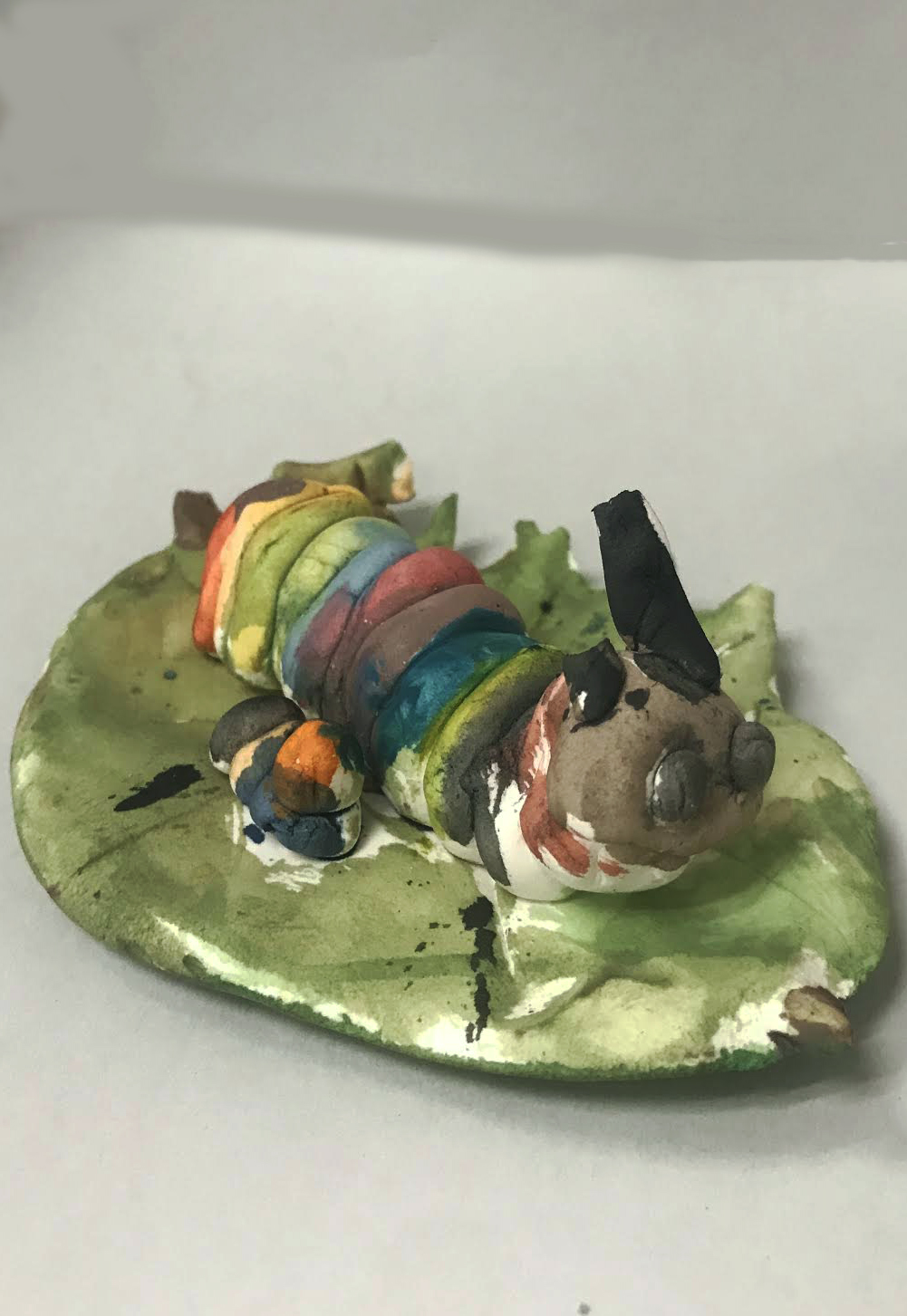
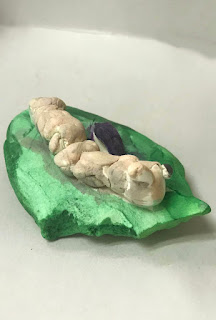
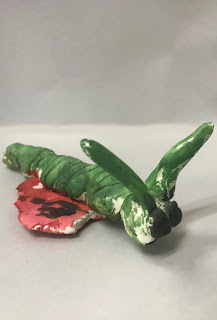
- Create an original Eric Carle Inspired Caterpillar using sculpture techniques learned in class
- Use analogous colors (orange yellow green), form (cylinder, cone, sphere), and texture (rough, smooth) inspired by American Author (1929-2021) Eric Carle
- Use ceramic techniques (slip and score, hand building, pinch pot) and design principles (balance, proportion, repetition) based on Illustration
- Define Pattern (a design in which lines, shapes, forms, or colors are repeated)
Lesson One
Day One, Art Start
1. Caterpillar Lollipop (1985) Eric Carle

2. Read The Very Hungry Caterpillar by Eric Carle

3. Discussion Questions "Does he look happy? How do you think the artist made this caterpillar? Why do you think the caterpillar is so hungry? What do you notice that is different about this book? What do you know about caterpillars? How many things does he eat on Saturday? How many things is did he eat on Friday? Do pets change? How do trees change? Do people change? How have you changed? What foods would you eat if you were a caterpillar? Where would you fly if you were a butterfly?"
Lesson Activities
1. Use modeling techniques (hand building forming shapes) to make three dimensional spheres for clay caterpillars
2. Use assemblage techniques (attaching slip and score smoothing) to connect the three main body parts (head thorax abdomen) of the clay caterpillars
3. Use addictive techniques (eye balls long legs antennas) to add additional parts to Eric Carle Inspired Caterpillars
Day Two, Art Start
1. Retrieve Eric Carle Inspired Caterpillars for Assigned Table
2. The Rainbow Caterpillar (1985) Eric Carle

3. Discussion Questions "Why are insects colorful? Which insects are bigger, the male or the female? What are some differences between insects? Why are insects symmetrical? What is the most important part of a sculpture? Why times of shapes can you use to break up your sculpture? Where do you think butterflies come from? Have you ever saw a caterpillar or touched a caterpillar? If you have touched one, how did it feel? What color caterpillars have you seen? Why do you think the caterpillar had a stomach ache? Do you think you would have a stomach ache if you ate that much food? What do you do when you have a stomachache? What made the caterpillar feel all better?"
Lesson Activities
1. Use assemblage techniques (attaching slip and score smoothing) to connect the details (eyeballs long legs wings) of the clay caterpillars
2. Add embellishments (beds wire buttons) to decorate the outside (bug) of the clay caterpillars
3. Add imprints (texture plates stamps carving) to the positive space (bug) of the Eric Carle Inspired Caterpillars
Day Three, Art Start
1. Retrieve Eric Carle Inspired Caterpillar for Assigned Table
2. Set Up Studio Area (paint brushes, modeling tools, air dry clay)
Lesson Activities
1. Use analogous colors (green yellow orang) to fill in the positive space (bug) of the Clay Caterpillars
2. Use analogous colors (blue purple red) to fill in the negative space (background) of the clay caterpillars
3. Use metallic colors (gold silver bronze) to outline the line types (horizontal, vertical, diagonal) of the positive space (bug) of the Eric Carle Inspired Caterpillars
Artist Examples

Student Examples



 Posts
Posts

