Wednesday, August 28, 2024
VIKING LONGSHIP PAINTINGS
Viking Longship Paintings

Learning Targets
I can...
- Create an original Viking Longship Paintings using drawing techniques learned in class
- Use color combinations (analogous, warm colors, cool colors), line types (horizontal, vertical, diagonal), and value (lightness, darkness, highlights, shadows) inspired by Scandinavian Longships
- Use painting techniques (underpainting, blending, overlapping) and design principles (composition, proportion, gradation) based on Nordic Art
- Define Hull (the frame or body of the ship exclusive of masts, engines, or superstructures)
Lesson One
Day One, Art Start
1. Oseberg (820 CE) Museum Of The Viking Age

2. Read Picture Of The Past: Life On A Viking Ship by Jane Shuter

3. Discussion Questions "What are Viking longships also known as? What two things were used to power a Viking longship? What were the long Viking stories children learned and listened to called? What was the Viking heaven or afterlife called? Which Viking God rode an eight-legged horse? When did sailing boats or long boars first appear in Scandinavia? What was the navy the Vikings had called? What are the two most famous Viking ships, found in mounds of Norway? How were the sails marked to show that it was a King's ship? Where did the Vikings sleep when traveling at sea? How did the Vikings transport the ships over land? How were the Vikings longships made waterproof? What was the purpose of shields on the side of the ship? How long would a voyage have taken ideal weather?"
Lesson Activities
1. Choose 12" X 15" Painting Paper
2. Use pencils to draw simple shapes (circle, triangle, rectangle) and complex shapes (ellipse, parallelogram, hexagon) of ships for ship paintings
3. Use wooden stylus to outline line variation (thick, thin, contour) of the positive space (ship) of the Viking Longship Paintings
Day Two, Art Start
1. Retrieve Viking Longship Paintings for Assigned Tables
2. Gokstad (890 CE) Museum Of The Viking Age

3. Discussion Questions "What can you tell me about this picture? How do you think the artist came up with the idea for this artwork? What title would you give this picture? How do you think the artist was feeling when he made this artwork? How does your eye move throughout this artwork? What choices did the artist make to make this happen? What does this photograph say about the world we live in? How might your interpretation of this artwork be different from someone in another culture? If you could ask this artwork a question, what would you ask? Do you think it is important to be a trained artist? What projects did this artist work on? Why was the artist drawn to this subject matter?"
Lesson Activities
1. Use permanent markers to outline line variation (thick, thin, contour, outline) of the positive space (ship) for the ship paintings
2. Use neutral colors (black grey brown white) to fill in the negative space (background) of the ship paintings
3. Use neutral colors (black, grey, brown, white) to fill in the positive space (foreground, ship) of the Viking Longship Paintings
Day Three, Art Start
1. Retrieve Viking Longship Paintings for Assigned Tables
2. Set Up Studio Area (paint brushes, tempera paint, watercolor, water buckets)
Lesson Activities
1. Use printmaking paper to print one monoprint of every neutral colors (black, brown, grey, white) of the ship paintings
2. Add highlights (reflective light, light source) to the positive space (longship, foreground) of the ship paintings
3. Add shadows (cast shadow, reflective shadow) to the negative space (background) of the Viking Longship Paintings
Artist Examples
 Student Examples


Tuesday, August 27, 2024
DANDELION PUFFS PAINTINGS
Dandelion Puffs Paintings

Learning Targets
I can...
- Create an original Dandelion Puffs Paintings using drawing techniques learned in class
- Use color combinations (warm colors, cool colors), line types (horizontal vertical diagonal), and shape variation (geometric, organic, free form) inspired by French Artist (1814-1875) Jean-Francois Millet
- Use painting techniques (layering, blending, dry brush, underpainting) and design principles (gradation, composition, proportion) based on Realism
- Define Composition (the way in which different elements of an artwork are combined or arranged together)
Lesson One
Day One, Art Start
1. Dandelions (1867) Jean-Francois Millet

2. Read The Dandelion Seeds Big Dream by Joseph Anthony

3. Discussion Questions "Why are dandelions considered an undesirable weed and not valued in specific environments? How does a close view of a dandelion reference rural and agricultural life? Did you know that Jean Francois Millet brought back the popularity of pastels with his artwork? Did you notice that there is one open flower showing? Where is the path of light and directional cues for taking the viewer throughout the drawing? Can you see the circular design? Can you sense the movement of the seed heads drifting apart? Why are there so many artists that paint dandelions? What do you like about dandelions? Can you think of other ways to use dandelions?"
Lesson Activities
1. Choose 12" X 15" Drawing Paper
2. Use line types (horizontal, vertical, diagonal) to draw positive space (flower, dandelion) of the flower paintings
3. Use color combinations (analogous, warm colors, cool colors) to fill in the positive space (flower) of the Dandelion Puffs Paintings
Day Two, Art Start
1. Retrieve Dandelion Puffs Paintings for Assigned Tables
2. Dandelions (1985) Yayoi Kusama

3. Discussion Questions "Did you know dandelions are edible? Did you know dandelions contact more essential vitamins than spinach? Did you know early European settlers in America used them for food and medicine? How many flowers can you see in a dandelion bloom? Can you guess how the dandelion got the name lion's teeth? Did you learn anything new about dandelions? Why do some people call dandelions weeds? How far do the seeds fly the air is still and when it is windy? Which part of the dandelion reminds you of a lion's tooth? Have you ever blown on a fluff ball of dandelion seeds? Why do you think dandelion seeds are fluffy? Do the seeds with bristles remind you of a helicopter or a parachute?"
Lesson Activities
1. Add shape variation (geometric, organic, free form) to the negative space (background) of the flower paintings
2. Use patterns (stripes, swirls, curls) to add a design to the negative space (background) of the flower paintings
3. Use chalk to blend patterns (swirls, stripes, curls) for the negative space (background) of the Dandelion Puffs Paintings
Day Three, Art Start
1. Retrieve Dandelion Puffs Paintings for Assigned Tables
2. Set Up Studio Area (paint brushes, water buckets, oil pastels, watercolor)
Lesson Activities
1. Blend color combinations (analogous, warm colors, cool colors) for the positive space (flower) of the flower paintings
2. Add highlights (light source, reflective light) to the positive space (flower, dandelion) of the flower paintings
3. Add illusion of depth by add details (glitter, petals, details) to the positive space (flower, dandelion) of the Dandelion Puffs Paintings
Artist Examples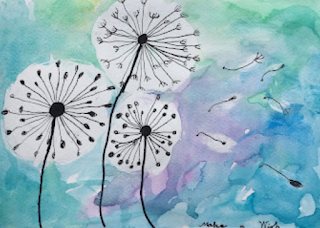


 Student Examples


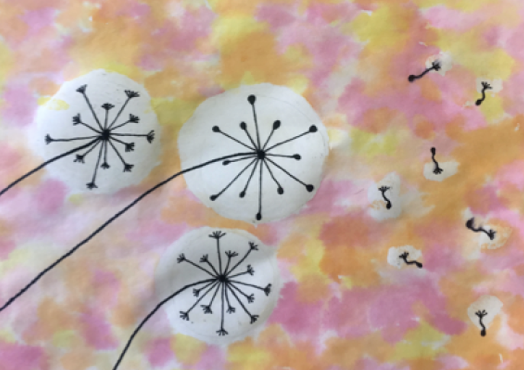


Thursday, October 26, 2023
DUMP TRUCK PAINTINGS
Dump Truck Paintings

Learning Targets
I can...
- Create an original Dump Truck Painting using drawing techniques learned in class
- Use shape variation (geometric, organic, free form), line types (horizontal, vertical, diagonal), and texture (visual, actual, implied) inspired by American Artist (2009-Present) Desiree Bender
- Use painting techniques (overlapping, layering, cropping) and design principles (composition, movement, repetition) based on American Art
- Define Texture (the feel or appearance of a surface)
Lesson One
Day One, Art Start
1. Mean Green (2009) Desiree Bender

2. Read Design In Motion: The Recycling Truck Project by Google Arts & Culture

3. Discussion Questions "What do you think of the saying "one person's trash another's treasure"? How would you describe your dream job? In what ways, could a vehicle be considered a work of art? What is the most artistic vehicle you have ever seen? Why should drivers begin decorating dump trucks? Why would someone spend so much money to decorate a truck? What impacts the way the while's are decorated? What purpose does this kind of public folk art serve? What feelings do the decorative design on these vehicles invoke? Why do you think so? Based on the images you see, what material do you are used to decorate the vehicle? Do you know anything about truck art? How man people are employed in workshops for truck art?"
Lesson Activities
1. Choose 12" X 15" Drawing Paper
2. Use geometric shapes (triangles, circles, rectangles) to draw exterior (outside) of the dump truck paintings
3. Use geometric shapes (triangles, circles, rectangles) to draw the main parts (wheels, cab, headlights) of the Dump Truck Paintings
Day Two, Art Start
1. Retrieve Dump Truck Paintings for Assigned Tables
2. Patterned Flight (2009) Desiree Bender

3. Discussion Questions "What type of transportation machines can you name? How are dump truck vehicles designed? What is the primary purpose of a dump truck? How do the different regions impact the way the vehicles are decorated? Based on the images you see, what kinds of materials do you think are used to decorate the vehicle? What value does this artwork have in society? What is the most important thing about dump trucks? What does the text teach us about the artist? What does the text teach us about the dump trucks? What are the important parts of a dump truck?"
Lesson Activities
1. Use line types (horizontal, vertical, diagonal) to outline the neutral colors (black, grey, white) of the dump truck paintings
2. Add decorative patterns (dots, swirls, stripes) to the positive space (dump truck) of the dump truck paintings
3. Add line types (horizontal, vertical, diagonal) to the negative space (background) of the dump truck paintings
Day Three, Art Start
1. Retrieve Dump Truck Paintings for Assigned Tables
2. Set Up Studio Area (tempera paint, paint brushes, water buckets)
Lesson Activities
1. Use warm colors (red orange yellow) to fill in the positive space (dump truck) of the dump truck paintings
2. Use cool colors (green blue purple) to fill in the negative space (background) of the dump truck paintings
3. Add highlights (reflective light, light source, lightness) to the positive space (foreground) of the Dump Truck Paintings
Artist Examples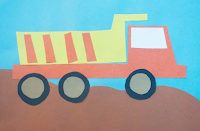


 Student Examples


Saturday, September 23, 2023
FIREFLY JAR PAINTINGS
Firefly Jar Paintings

Learning Targets
I can...
- Create an original Firefly Jar Paintings using drawing techniques learned in class
- Use color combinations (metallic, glow in the dark, secondary), shape variation (geometric, organic, freeform), and space (positive, negative) inspired by Edo, Meiji, And Tashio Period
- Use painting techniques (underpainting, dry brush, blending, layering) and design principles (composition, proportion, repetition) based on Asian Art
- Define Luminosity (the illusion of light from within the painting)
Lesson One
Day One, Art Start
1. Searching For Fireflies (1768) Suzuki Harunobu

2. Read The Very Lonely Firefly by Eric Carle

3. Discussion Questions "When do fireflies come out? What do we see in the summer night? What happens when you try to catch a firefly? Why do fireflies light up? What do fireflies eat? Do you call them fireflies or lightning bugs? Why do fireflies only appear on hot summer nights? Why do some people call the insects fireflies bugs or lightning bugs? How many fireflies did you find? When did they start to show up before or after dusk? Were the fireflies flying or sitting on something? Which area of the artwork is emphasized by the artist? What is the story being told, if any? How might you feel differently about the world after looking at this artwork? What dose this artwork say about the culture in which it was produced? What does this artwork tell us about the past?"
Lesson Activities
1. Use drawing techniques (layering overlapping cropping) to make a composition for the fireflies paintings
2. Use drawing techniques (layering overlapping cropping to add parts (wings, legs, lightbulb) to the positive space (fireflies) of the fireflies paintings
3. Add design details (eyes, patterns, wings) to the positive space (fireflies) of the Firefly Jar Paintings
Day Two, Art Start
1. Retrieve Firefly Jar Paintings for Assigned Tables
2. Woman And Child Catching Fireflies (1793) Eishosai Choki

3. Discussion Questions "What was happening in history when this artwork was made? How does this change your understanding of the artwork? What are the values and beliefs of the culture in which this artwork was made? How might your interpretation of this artwork be different from someone in another culture? If you could ask this artwork a question, what would you ask it? What does this artwork teach us about the future? How can you connect this artwork to your own life? How does this title contribute to your understanding of the meaning? How did the artist use line, shape, and color to contribute to the mood or meaning of the artwork? What do you think happened before this scene? What do you think happened next? What do you think the artist is trying to say in this artwork? What is the meaning or message? How does your eye move through the artwork? What choices did the artist make to make that happen?"
Lesson Activities
1. Use value (highlights, reflective light, cast shadow) to add contrast to the positive space (foreground) of the fireflies paintings
2. Use value (cast shadow, shadow, highlights) to add contrast to the negative space (background) of the fireflies paintings
3. Use texture (actual, visual, implied) to add details (wings, legs, lightbulb) to the positive space (fireflies) of the Firefly Jar Paintings
Day Three, Art Start
1. Retrieve Firefly Jar Paintings for Assigned Tables
2. Set Up Studio Area (tempera paint, paint brushes, water buckets)
Lesson Activities
1. Use color combinations (glow in the dark, metallic, secondary) to fill in the positive space (fireflies) of the fireflies paintings
2. Use color combinations (glow in the dark, metallic, secondary) to fill in the negative space (background) of the fireflies paintings
3. Use metallic colors (gold, silver, bronze) to outline the line types (horizontal, vertical, diagonal) of the positive space (fireflies) of the Firefly Jar Paintings
Artist Examples


 Student Examples


 Posts
Posts

