Tuesday, August 27, 2024
DANDELION PUFFS PAINTINGS
Dandelion Puffs Paintings

Learning Targets
I can...
- Create an original Dandelion Puffs Paintings using drawing techniques learned in class
- Use color combinations (warm colors, cool colors), line types (horizontal vertical diagonal), and shape variation (geometric, organic, free form) inspired by French Artist (1814-1875) Jean-Francois Millet
- Use painting techniques (layering, blending, dry brush, underpainting) and design principles (gradation, composition, proportion) based on Realism
- Define Composition (the way in which different elements of an artwork are combined or arranged together)
Lesson One
Day One, Art Start
1. Dandelions (1867) Jean-Francois Millet

2. Read The Dandelion Seeds Big Dream by Joseph Anthony

3. Discussion Questions "Why are dandelions considered an undesirable weed and not valued in specific environments? How does a close view of a dandelion reference rural and agricultural life? Did you know that Jean Francois Millet brought back the popularity of pastels with his artwork? Did you notice that there is one open flower showing? Where is the path of light and directional cues for taking the viewer throughout the drawing? Can you see the circular design? Can you sense the movement of the seed heads drifting apart? Why are there so many artists that paint dandelions? What do you like about dandelions? Can you think of other ways to use dandelions?"
Lesson Activities
1. Choose 12" X 15" Drawing Paper
2. Use line types (horizontal, vertical, diagonal) to draw positive space (flower, dandelion) of the flower paintings
3. Use color combinations (analogous, warm colors, cool colors) to fill in the positive space (flower) of the Dandelion Puffs Paintings
Day Two, Art Start
1. Retrieve Dandelion Puffs Paintings for Assigned Tables
2. Dandelions (1985) Yayoi Kusama

3. Discussion Questions "Did you know dandelions are edible? Did you know dandelions contact more essential vitamins than spinach? Did you know early European settlers in America used them for food and medicine? How many flowers can you see in a dandelion bloom? Can you guess how the dandelion got the name lion's teeth? Did you learn anything new about dandelions? Why do some people call dandelions weeds? How far do the seeds fly the air is still and when it is windy? Which part of the dandelion reminds you of a lion's tooth? Have you ever blown on a fluff ball of dandelion seeds? Why do you think dandelion seeds are fluffy? Do the seeds with bristles remind you of a helicopter or a parachute?"
Lesson Activities
1. Add shape variation (geometric, organic, free form) to the negative space (background) of the flower paintings
2. Use patterns (stripes, swirls, curls) to add a design to the negative space (background) of the flower paintings
3. Use chalk to blend patterns (swirls, stripes, curls) for the negative space (background) of the Dandelion Puffs Paintings
Day Three, Art Start
1. Retrieve Dandelion Puffs Paintings for Assigned Tables
2. Set Up Studio Area (paint brushes, water buckets, oil pastels, watercolor)
Lesson Activities
1. Blend color combinations (analogous, warm colors, cool colors) for the positive space (flower) of the flower paintings
2. Add highlights (light source, reflective light) to the positive space (flower, dandelion) of the flower paintings
3. Add illusion of depth by add details (glitter, petals, details) to the positive space (flower, dandelion) of the Dandelion Puffs Paintings
Artist Examples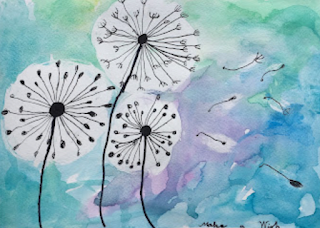


 Student Examples


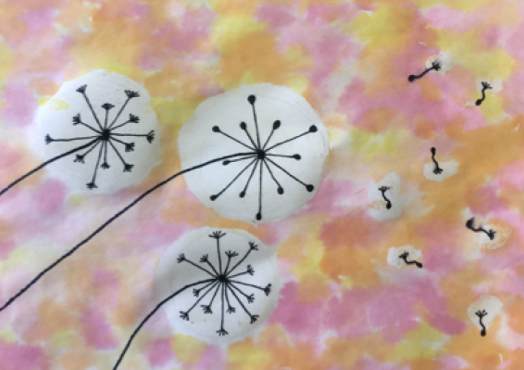


Wednesday, November 29, 2023
MARGARET PRESTON INSPIRED FLOWERS
Margaret Preston Inspired Flowers

Learning Targets
I can...
- Create an original Margaret Preston Inspired Flowers using drawing techniques learned in class
- Use line types (horizontal, vertical, diagonal), shape variation (geometric, organic, free form), and value (lightness, darkness, highlights, shadows) inspired by Australian Painter (1875-1963) Margaret Preston
- Use drawing styles (gesture, line, perspective, photorealism, scientific, silhouette) and design principles (proportion, movement, emphasis) based on National Art
- Define Aboriginal (the spiritual and symbolic carvings, paintings, or depictions of nature created by indigenous people)
Lesson One
Day One, Art Start
1. Sturt's Desert Pea (1930) Margaret Preston

2. Read Margaret Preston: The Art Of Constant Rearrangement by Elizabeth Butel

3. Discussion Questions "What role did Margaret Preston play in modern art? Do you think Margaret Preston's idea for a national identity- which led to the adoption of Aboriginal-styled designs and motifs- was progressive or misguided? Do you think countries have a national visual identity? Why should artists look at Preston's work now and have conversations about their own artwork? If you were sitting with Margaret Preston, what would you like to ask her? What qualities do you notice in her artwork? How has she used color, line, and shape within the artwork? What do you notice that is different about the composition? What can you see in the foreground, middle ground, and background? Which colors are predominant, and where are they used?"
Lesson Activities
1. Choose 12" X 15" Drawing Paper
2. Use line types (horizontal, vertical, diagonal) to fill in the positive space (foreground) of the flower drawings
3. Use color combinations (analogous, complementary, secondary) to fill in the positive space (foreground) of the Margaret Preston Inspired Flowers
Day Two, Art Start
1. Retrieve Margaret Preston Inspired Flowers for Assigned Tables
2. Sturt's Pea (1944) Margaret Preston

3. Discussion Questions "How does her use of color draw your eyes to the floral arrangements? Do you think Margaret Preston has used color in a realistic way, or do you think she has exaggerated or enhanced the colors of the flowers? Why do you think she chose to use such bold lines and borders? How does this affect the way we view the subject matter? Why do you think she chose to create this area of pattern? How does it enhance the artwork? What can we learn about Margaret Preston's feelings about Australian flora by looking at her artwork? What might these characteristics and properties symbolize? What species of flora did you choose? What did you find out about it during your research? What symbolic characteristics did you assign to your chosen plant and why? Which part of the process did you find the most challenging, and which was the most rewarding? Why?"
Lesson Activities
1. Add shape variation (geometric, organic, free form) to the negative space (background) of the flower drawings
2. Use patterns (swirls, zigzags, stripes) to add designs to the negative space (background) of the flower drawings
3. Use chalk to blend patterns (swirls, zig zags, stripes) for the negative space (background) of the Margaret Preston Inspired Flowers
Day Three, Art Start
1. Retrieve Margaret Preston Inspired Flowers for Assigned Tables
2. Set Up Studio Area (oil pastels, chalk, erasers, pencils, charcoal)
Lesson Activities
1. Use color combinations (analogous, complementary, secondary) to fill in the positive space (flower) of the flower drawings
2. Add highlights (light source, reflective light) to the positive space (flower) of the flower drawings
3. Add illusion of depth by adding details (petals, vase, leaves, glitter) to the positive space (flower) of the Margaret Preston Inspired Flowers
Artist Examples


 Student Examples


Sunday, September 3, 2023
ANDY WARHOL FLOWER COLLAGES
Andy Warhol Flower Collages

Learning Targets
I can...
- Create and original Andy Warhol Flower Collage using drawing techniques learned in class
- Use color combinations (analogous, complementary, secondary), shape variation (geometric, organic, free form), and space (positive, negative) inspired by American Artist (1928-1987) Andy Warhol
- Use printing process (lighting, cropping, editing, contrasting) and design principles (repetition, alignment, composition) based on Pop Art
- Define Silkscreen (a stencil cut out of thin paper or material to be printed by rubbing, rolling, or spraying ink on the surface)
Lesson One
Day One, Art Start
1. Flowers (1993) Andy Warhol

2. Read Andy Warhol's Colors by Susan Goldman Rubin

3. Discussion Questions "How did Warhol use photography, collage, drawing, and silk-screening in this print? What color combinations does Warhol use? Are the colors realistic? Are they appealing? Why or why not? How are the flowers arranged? How does Andy Warhol use shadows in the composition? What three colors did the artist use to create a triad print? What four colors were used to make a tetrad print? How did Warhol use lighting, cropping, editing, and contrasting to manipulate his source images for photographic silkscreen printing? Why did Warhol do this? What aesthetic was he trying to achieve? How is image transferred onto a silkscreen? What does it mean to expose an image onto a silkscreen? What were the advantages of underpainting as opposed to making a multilayer print with multiple silkscreens? What did Warhol mean by this? What are the advantages and disadvantages of painting like machines?"
Lesson Activities
1. Choose 12" X 15" Drawing Paper
2. Use line types (horizontal, vertical, diagonal) to draw positive space (flower) of the flower collages
3. Use color combinations (analogous, secondary, complementary) to fill in the positive space (flower) of the Andy Warhol Flower Collages
Day Two, Art Start
1. Retrieve Andy Warhol Flower Collages for Assigned Tables
2. Flowers (1968) Andy Warhol

3. Discussion Questions "How did Andy Warhol create a unique art style? What are other everyday materials that we can use to create art? What are more ways color, texture, and balance can be used to create vivid, engaging art? Is one series more colorful than the other? How did Warhol create the background differently in each series? What did he change in each flower print? Do these flowers perfectly reflect each other on both sides? What artist do you think created the flower artwork? How can you tell it is an Andy Warhol piece? Are there any other everyday materials that could be used to create different textures for printmaking?"
Lesson Activities
1. Add shape variation (geometric, organic, free form) to the negative space (background) of the flower collages
2. Use patterns (swirls, stripes, dots) to add a design to the negative space (background) of the flower collages
3. Use green chalk to fill in the negative space (leaves, grass, weeds, background) of the Andy Warhol Flower Collages
Day Three, Art Start
1. Retrieve Andy Warhol Flower Collages for Assigned Tables
2. Set Up Studio Area (chalk pastels, speed ball ink, brayers, black construction paper)
Lesson Activities
1. Blend color combinations (analogous, complementary, secondary) for the positive space (flower) of the flower collages
2. Add highlights (light source, reflective light) to the positive space (flower) of the flower collages
3. Add illusion of depth by adding details (petals, glitter, sprinkles) to the positive space (flower) of the Andy Warhol Flower Collages
Artist Examples


 Student Examples


Friday, September 1, 2023
TULIP PAINTINGS
Tulip Paintings

Learning Targets
I can...
- Create an original Tulip Paintings using drawing techniques learned in class
- Use line types (horizontal, vertical, diagonal), shape variation (geometric, organic, free form), and value (lightness, darkness, tints, shades) inspired by American Artist (1967-Present) Jane Jones
- Use observational techniques (vantage point, scale, perspective) and design principles (composition, movement, repetition) based on Realism
- Define Still Life (a work of art depicting mostly inanimate subject matter)
Lesson One
Day One, Art Start
1. Garden Of Joy (2016) Jane Jones

2. Read Holland Museum Getting Ready For Tulip Time With New Exhibition by Corinne Moore

3. Discussion Questions "The Tulip Time Festival is the biggest Tulip Festival in the United States. The Tulip Festival is in Holland, Michigan. The festival start in 1929. The Tulip Festival takes place in the month of May. Tulips are colorful flowers that bloom in the spring. Many people from the Netherlands lie in Holland, Michigan. The tulip flower is a special flower to the people in the Netherlands. Many tulips grow in the Netherlands. In 1976, President Gerald Ford visited the Tulip Festival. Every year the festival has music, dancing, and fireworks. Readers Digest named the festival the best small town festival in the United States. What country is the Tulip Time festival in? What state is the Tulip Time Festival in? When did the festival start? What month does the festival take place in? What country is the tulip festival special too? What president visited the Tulip Time Festival?"
Lesson Activities
1. Choose 12" X 15" Painting Paper
2. Use line types (horizontal, vertical, diagonal) to draw positive space (tulip) of the flower paintings
3. Use color combinations (analogous, complementary, secondary) to fill in the positive space (tulip) of the Tulip Paintings
Day Two, Art Start
1. Retrieve Tulip Paintings for Assigned Tables
2. Garden Party (2013) Jane Jones

3. Discussion Questions "What does a tulip look like? What can you tell about the stem and the leaves? What do the petals look like? How many kinds of flowers can you find in this painting? Do you think they all bloom at the same time, the way you see them? Can you find all three tulips in the painting? What type of flower would you be? How many flowers can you identify? Do you know the name of all these flowers? How many different colors can you find on this flower? Are some of the flowers more colorful than others? How would you describe the shape of the petals? Are the petals the same on each flower? Where did you find each flower? How would you describe it? How would you describe its stem, petals, or leaves? Is the flower part of something else or is it growing by itself? Are there more flower like this one nearby?"
Lesson Activities
1. Add shape variation (geometric, organic, free form) to the negative space (background) of the flower paintings
2. Use patterns (swirls, stripes, dots) to add a design to the negative space (background) of the flower paintings
3. Use color combinations (analogous, complementary, secondary) to blend patterns (swirls, stripes, dots) for the negative space (background) of the Tulip Paintings
Day Three, Art Start
1. Retrieve Tulip Paintings for Assigned Tables
2. Set Up Studio Area (paintbrushes, water bucket, tempera paint)
Lesson Activities
1. Blend color combinations (analogous, complementary, secondary) for the positive space (tulip) of the tulip paintings
2. Add highlights (reflective light, light source) to the positive space (tulip) of the tulip paintings
3. Add illusion of depth by adding details (petals, glitter, sprinkles) to the positive space (foreground) of the Tulip Paintings
Artist Examples


 Student Examples


 Posts

