Friday, September 9, 2022
MIROCO MACHIKO INSPIRED ILLUSTRATIONS
Miroco Machiko Inspired Illustrations

Learning Targets
I can...
- Create an original Miroco Machine Inspired Illustration using drawing techniques learned in class
- Use metallic colors (bronze, gold, silver), shape variation (geometric, organic, free form), and space (positive, negative) inspired by Japanese Illustrator (1981-Present) Miroco Machiko
- Use watercolor techniques (layering, underpainting, wash) and design principles (composition, balance, variation) based on Contemporary Art
- Define Emphasis (to create a center of interest in an artwork through color contrast and direction lines)
Lesson One
Day One, Art Start
1. Vegetables (2019) Miroco Machiko

2. Read Vegetables by Sara Anderson

3. Discussion Questions "What did we learn throughout this project? Do artists like to use paint? What kind of paint? What was the world like when the artist made this artwork? How have you used formal elements such as line, tone, color, and shape? What materials did you use and why? Did they work successfully? What meaning, theme, or message did you want to convey? Were you successful? Are you happy with your final piece? Are any elements or qualities you like in particular? Does your final work they way you thought it would initially? How effective is it? Is there anything you would change?"
Lesson Activities
1. Choose 12" X 15" Painting Paper
2. Add three objects (tomatoes, carrots, cucumber, mangos, strawberries) to the positive space (fruits, vegetables) of the watercolor illustrations
3. Add patterns (stripes, swirls, diagonal lines) to the negative space (background) of the watercolor illustrations
Day Two, Art Start
1. Retrieve Miroco Machiko Inspired Illustrations for Assigned Tables
2. Plants (2019) Miroco Machiko

3. Discussion Questions "How does the artist use design, patterns, and color to inspire others? Do these look like real plants or flowers you have seen before? How does the artist use bold and bright colors? What are the names of these fruits and vegetables? Do these vegetables look three dimensional or two dimensional? What childlike imagery does the artist include with her work? Why would an artist want to draw plants as a still life? How would you describe the artists style? What are your favorite fruits and vegetables?"
Lesson Activities
1. Use warm/cool colors (red, orange, yellow, green) to fill in the positive space (fruit, vegetables) of the watercolor illustrations
2. Use neutral colors (black, brown, grey) to fill in the negative space (background) of the watercolor illustrations
3. Use felt tip pens to add line types (contour line, crosshatching outline) to the positive space (fruit, vegetables) of the Miroco Machiko Inspired Illustrations
Day Three, Art Start
1. Retrieve Miroco Machiko Inspired Illustrations for Assigned Tables
2. Set Up Studio Area (watercolor, paintbrushes, water bucket)
Lesson Activities
1. Add tints (adding white, reflective light, light source) to the subject matter (fruit, vegetables) of the watercolor illustrations
2. Add shades (adding black, cast shadow, shadow) to the negative space (background) of the watercolor illustrations
3. Use drawing tools (vine charcoal, kneaded eraser, spray fixative) to add details (fruits, vegetable) to the Miroco Machiko Inspired Illustrations
Artist Examples
 Student Examples


Tuesday, August 30, 2022
SURREALIST APPLES
Surrealist Apples

Learning Targets
I can...
- Create an original Surrealist Apples using drawing techniques learned in class
- Use line types (horizontal, vertical, diagonal), shape variation (geometric, organic, free form), and texture (clouds, sand, treetops) inspired by Surrealist Artist (1898-1967) Rene Magritte
- Use collage techniques (overlapping, layering mixed media) and design principles (movement, proportion, composition) based on Surrealism
- Define Art Movement (a group of artists agree on a certain style of art with a specific common philosophy or goal)
Lesson One,
Day One, Art Start
1. The Listening Room (1952) Rene Magritte
.jpg!Large.jpg)
2. Read Magritte's Apple by Klaas Verplancke

3. Discussion Questions "How would you describe this scene? What are some of the items you see and what do you think they mean? Is this a realistic painting? Which images are realistic? What makes it look surreal (dreamlike imagery)? Where do you see examples of texture? Where do you see examples of replacement and juxtaposition? Why do you think the artist gave this artwork a title? How does this painting make you feel? Do you like it? Why or why not? Where were these objets placed in his artwork?"
Lesson Activities
1. Choose 12" X 15" Drawing Paper
2. Use graphite pencil to outline three dimensional shapes (apples) onto positive space (apple) for fruit collages
3. Use graphite pencil to add texture (clouds, treetops, sand) to the negative space (background) of the Surrealist Apples
Day Two, Art Start
1. Retrieve Surrealist Apples for Assigned Table
2. The Hesitation Waltz (1950) Rene Magritte

3. Discussion Questions "Do you know what I mean when I say a "movement" in art? What do you know about Surrealism, or the Surrealism movement? What room do you think this is? What makes you think this? What do you think is the focal point of this painting? What is in the background? What is out of place? What kind of lines are used in the picture? Are the lines straight or curved? Do you see different textures? What are they? Is the painting full or empty? What takes most of the space? Do the objects in the painting seem to be moving or still? Is the image serious or lighthearted? Why do you think the Artis was thinking when he painted this? How do you feel when you look at this painting? Why? Do you like this painting? Why or why not? Does everything in this picture make sense?"
Lesson Activities
1. Use analogous colors (red, blue, purple) to fill in the positive space (apple) of the fruit collages
2. Use analogous colors (red, blue purple) to fill in the negative space (background) of the fruit collages
3. Use neutral colors (brown, grey, black) to add contrast to the positive space (apples) of the Surrealist Apples
Day Three, Art Start
1. Retrieve Surrealist Apples for Assigned Table
2. Set Up Studio Area (paint brushes, water buckets, oil pastels)
Lesson Activities
1. Use neutral colors (black, grey, white) to add highlights (reflective light, light source) to the positive space (fruit) of the fruit collages
2. Use neutral colors (black, grey, white) to add shadows (reflective shadow, cast shadow) to the negative space (background) of the fruit collages
3. Fill in the positive space (fruit) and negative space (background) to remove any white space from the Surrealist Apples
Artist Examples
 Student Examples


Monday, January 4, 2021
WATERCOLOR WATERMELON
Watercolor Watermelon

Learning Targets
I can...
- Create an original Watercolor Watermelon using painting techniques learned in class
- Use color theory (warm colors, cool colors), line types (horizontal vertical diagonal), and space (positive negative) inspired by Mexican Painter (1907-1954) Frida Kahlo
- Use drawing techniques (overlapping cropping layering) and design principles (composition repetition variation) based on Surrealism
- Define Style (artist portrays subject matter and expressed visual elements through a work of art)
Lesson One
Day One, Art Start
1. Viva La Vida, Watermelons (1954) Frida Kahlo

2. Read Viva La Vide! Long Live Life! by Carmen T. Bernier-Grand

3. Discussion Questions "What was Frida Kahlo's full birth name? Why did Frida Kahlo change her date of birth of her birth certificate? Why was Kahlo pretending to be three years younger? What was Frida Kahlo's nationality? Who or what is depicted in most of Frida's paintings? In what year did she join the Mexican Communist Party and fall in love with Diego Rivera? What was the first solo exhibition of Frida Kahlo's work held? Frida began her career as an artist after what? What was Frida and Diego's marriage often called? Who was Frida Kahlo? What are some of Frida Kahlo's most famous paintings? Do you have a favorite artist? What will you include in your artwork that represents what matters to you?"
Lesson Activities
1. Choose 12" X 15" Drawing Paper
2. Add three dimensional shapes (cylinder, pyramid, sphere) to composition of arranged fruit (watermelon) for watermelon drawings
3. Add horizon line in line background (table, fabric, wallpaper) to separate the subject matter from the wallpaper
Reminder:
- Initials & Home Teacher on Back Of Paper
Day Two, Art Start
1. Retrieve Watercolor Watermelon for Assigned Table
2. Still Life With Watermelons (1953) Frida Kahlo

3. Discussion Questions "How have you used formal elements such as line, tone, color, and shape? What materials did you use and why? Did they work successfully? What meaning, theme, or message did you want to convey? Were you successful? Are you happy with your final piece? Are any elements or qualities you like in particular? Does your final work the way you thought it would initially? How effective is it? Is there anything you would change? What did we learn throughout this project? Did Frida Kahlo use paint? What kind of paint? What was the world like during her time? what type of failures did Frida Kahlo experience during her life? How do you think this affect her?"
Lesson Activities
1. Use warm colors (red orange yellow) to fill in the positive space (fruit) of the watercolor watermelon
2. Use cool colors (blue green purple) to fill in the negative space (background) of the watercolor watermelon
3. Use painting tools (brayer, palette, paint brush) to add patterns (floral silk wood) to the Watercolor Watermelons
Day Three, Art Start
1. Retrieve Watercolor Watermelons for Assigned Table
2. Set Up Studio Area (tempera paint, water bucket, paint brushes)
Lesson Activities
1. Add highlights (reflective light, light source) to subject matter (fruit) of the watercolor watermelon
2. Add shadows (cast shadow, reflective shadow) to the negative shape (background) of the watercolor watermelon
3. Outline details (pattern floral objects) in foreground (fruit) and middle ground (fabric table) of Watercolor Watermelon
Artist Examples


 Student Examples


Saturday, September 21, 2019
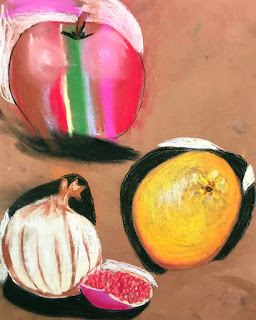
OIL PASTEL PEAR STILL LIFE
Oil Pastel Pear Still Life

Learning Targets
I can...- Create an original Oil Pastel Pear Still Life using drawing techniques learned in class
- Use form (two dimensional, three dimensional), tertiary colors (red-orange, yellow-orange, yellow-green, blue-green, blue-violet, red-violet), and value (light red, dark red) inspired by French Painter (1869-1954) Henri Matisse
- Use drawing techniques (blending, shading, defining) and design principles (composition, balance, variation) based on Expressionism
- Define Still Life (painting or drawing of an arrangement of objects such as a fruit, flower, or dishes)
Lesson One
Day One, Art Start
1. Still Life with Apples on Pink Tablecloth (1925) Henri Matisse

Lesson Activities
- Initials & Home Teacher on Back on Paper
Day Two, Art Start

Lesson Activities
1. Use tertiary color (red-orange, yellow-orange, yellow-green, blue-green, blue-violet, red-violet) to fill in the positive space (dishes, fruit, glasses) of oil pastel still life2. Use tertiary color (red-orange, yellow-orange, yellow-green, blue-green, blue-violet, red-violet) to fill in the negative space (wallpaper, fabric) of oil pastel still life
3. Use felt tip pens to add line types (contour line, cross hatching, outline) to positive space of Oil Pastel Pear Still Life
Day Three, Art Start
1. Retrieve Oil Pastel Pear Still Life for Assigned Self2. Set Up Studio Area (kneaded erasers, oil pastel, pencils)
Lesson Activities
1. Add tints (adding white, reflective light, light source) to subject matter (dishes, fruit, glasses) of the value of still life2. Add shades (adding black, cast shadows, shadow) to background (fabric, wallpaper) of value of still life
3. Use drawing tools (kneaded erasers, oil pastels, pencils) to add details to the Oil Pastel Pear Still Life
Teacher Demonstration Video
Artist Examples


Student Examples 




 Posts
Posts

