Tuesday, October 22, 2024
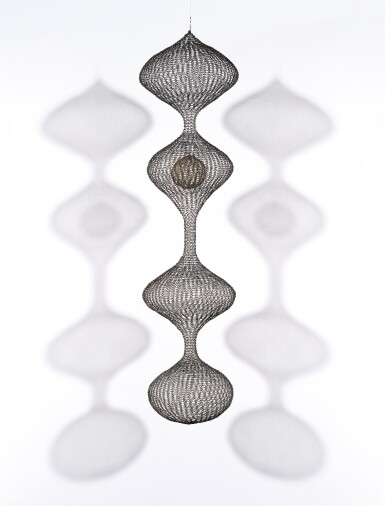
RUTH ASAWA HANGING SCULPTURES
Ruth Asawa Hanging Sculptures Learning Targets

I can...
- Create an original Ruth Asawa Hanging Sculptures using sculptures techniques learned in class
- Use line types (meandering, twisting, curving), geometric shapes (polyhedron, face, edge, prism), and space (positive, negative) inspired by Modernist Sculptor (1924-2013) Ruth Asawa
- Undestand sculpture techniques (carving, cast, modeling, assembling) and design principles (balance, emphasis, harmony) based on Modernism
- Define Basket Making (the process of weaving or sewing pliable materials into three dimensional artifacts)
Lesson One
Day One, Art Start

Lesson Activities
1. Choose 3 12" X 12" Colored Yarn
2. Use three compositional elements (shape, color, texture) to represent a special memory, place, or event
3. Use line variation (curved, straight, wavy) as a design principle (balance, movement, repetition) within the Ruth Asawa Hanging Sculptures
Day Two, Art Start
1. Retrieve Ruth Asawa Hanging Sculptures from Assigned Tables
2. S. 645 Hanging Three-Lobed Single Layer Continuous Form (1958) Ruth Asawa

3. Discussion Questions "Who is the artist of each sculpture? What do you know about this artist? What is the subject matter of this artwork? When was this sculpture completed and for whom (if known)? What medium was this sculpture made with? For what purpose or use does the sculpture have? How are these sculptures similar or different? What feeling was the artist trying to convey? How did the artist accomplish this composition? What does this sculpture reveal about the artist and her style? What do these pieces reveal about the society in which they were created? What does the sculpture represent? What do you think is happening in this sculpture? How is the artist telling us a story?"
Lesson Activities
1. Use compasses, protractors, and texture plates to add symmetrical shapes and expressive lines to the Ruth Asawa Hanging Sculptures
2. Use complementary colors (red green; blue orange; yellow purple) to fill in the negative space (background) of the Ruth Asawa Hanging Sculptures
3. Use complementary colors (red green; blue orange; yellow purple) to fill in the positive space (foreground) of the Ruth Asawa Hanging Sculptures
Day Three, Art Start
1. Retrieve Ruth Asawa Hanging Sculptures for Assigned Tables
2. Set Up Studio Area (glue bottles, balloons, string, yarn, brushes, scissors)
Lesson Activities
1. Use scissors to cut out two dimensional symmetrical shapes (square, circle, triangle) to create a three dimensional hanging sculptures
2. Glue down three dimensional symmetrical shapes (cylinder, cube, prism) to create a simplified hanging sculptures
3. Use sharpie marker to add beautiful patterns (stripes, swirls, hearts, dots) to the positive space (foreground) of the Ruth Asawa Hanging Sculptures
Artist Examples


 Student Examples


Friday, September 29, 2023
MIXED MEDIA BONES
Mixed Media Bones Learning Targets

I can...
- Create an original Mixed Media Bones using mixed media techniques learned in class
- Use line types (horizontal, vertical diagonal), neutral colors (black, grey, white), and space (positive, negative) inspired by American Painter (1887-1986) Georgia O'Keeffe
- Use drawing techniques (hatching, figure drawing, contrast, proportion) and design principles (composition, contrast, proportion) based on Modernism
- Define Proportion (size relationship of parts to a whole within the composition)
Lesson One
Day One, Art Start
1. Pelvis II (1944) Georgia O'Keeffe

2. Read Georgia's Bones by Jen Bryant

3. Discussion Questions "How is a photography from inside your body different from a regular photograph? What colors do you see? What kinds of lines can you find? What kind of shape can you find? What new title would you give this painting? Why do you think that the artist painted this painting? If you could change anything about this painting what would it be? What can be learned about an ancient society by studying artifacts? What makes humans want to predict the future? How can attributing special abilities to various community members impact power structures in society?"
Lesson Activities
1. Choose 12" X 15" Drawing Paper
2. Use pencil to add line types (horizontal, vertical, diagonal) of subject matter (bone) of bone drawings
3. Use line types (horizontal, vertical, diagonal) to add details (roses, feathers, fabric) to the negative space (background) of the Mixed Media Bones
Day Two, Art Start
1. Retrieve Mixed Media Bones for Assigned Tables
2. Pelvis With The Moon (1943) Georgia O'Keeffe

3. Discussion Questions "How would you tell someone about Georgia O'Keeffe's paintings? What are some photograph techniques she incorporated into her paintings? How as Georgia O'Keeffe inspired by other artists? Why did she say she painted skulls? Why do you think Georgia O'Keeffe draw the bones in her desert paintings? Why do you think Georgia O'Keeffe is an icon? What kind of stereotypes did Georgia O'Keeffe have to confront as a woman artist?"
Lesson Activities
1. Use drawing techniques (blending, contrast, shading) to add value (highlights, shadows) to the Mixed Media Bones
2. Look at images of photographs of different human bones (skull, teeth, femur, ribs) when adding details (highlights, shadows) to Mixed Media Bones
3. Use white chalk to add contrast to the positive space (bones, foreground) and negative space (background, shadows) of the Mixed Media Bones
Day Three, Art Start
1. Retrieve Mixed Media Bones for Assigned Tables
2. Set Up Studio Area (charcoal, white chalk, colored chalk)
Lesson Activities
1. Use drawing techniques (blending, contrasting, shading) to add neutral colors (black, grey, white) to the background of the Mixed Media Bones
2. Use drawing materials (tortillas, kneaded erasers, conte crayon) to blend in the negative space (background) of the Mixed Media Bones
3. Use charcoal (vine, willow, sticks) for addicting finishing details (bones, foreground) of the Mixed Media Bones
Artist Examples
 Student Examples


Tuesday, August 29, 2023
LOVE IS IN THE AIRPLANE COLLAGES
Love Is In The Airplane Collages

Learning Targets
I can...
- Create an original Airplane Collage using drawing techniques learned in class
- Use line types (horizontal vertical diagonal), shape variation (geometric organic free form) and texture (actual implied visual) inspired by Modern Artist (1890-1973) Stanton Macdonald-Wright and American Painter (1898-1922) Elsie Driggs
- Use collage techniques (pasted paper, decoupage, photomontage, assemblage) and design principles (movement, rhythm, balance) based on American Modernism
- Define Overlap (placement of objects over one another to create the illusion of depth)
Lesson One
Day One, Art Start
1. Aeroplane Synchron In Yellow-Orange (1928) Stanton Macdonald-Wright

2. Read Becoming Modern: American In The 1920s Primary Sources In History, Literature, and The Arts by The National Endowment For The Humanities

3. Discussion Questions "How did the airplane with its marvel and mystery symbolize modernism in the twenties? What are benefits and downsides of snapshot views of a historical period? How did "machine age" innovations change American life in the twenties? What makes the paintings modernist interpretations of the Machine Age? On first look, what impression of the airplane do you get from each painting? Why do you see in each painting? What do you hear in your head? What movement do you feel? Would you fly in the airplane? How would you rename each painting to reflect your answers to these questions? What are the core visual elements in these works? What impression of an airplane do you think Macdonald-Wright intended to convey in Airplane Synchromy? What impression of flight in the year 1920? How did he convey the marvel of the airplane? How did he convey the mystery of the airplane? How does Airplane Synchromy reflect Synchronism? How does it use color and abstraction to portray the airplane as a symbol of modernism?"
Lesson Activities
1. Choose 12" X 15" Drawing Paper
2. Use geometric shapes (triangles, circles, rectangles) to draw the exterior (outside) of the airplane collages
3. Use geometric shapes (triangles, circles, rectangles) to draw the main parts (wings, flaps, rudder, spinner, tail) of the Love Is In The Airplane Collages
Day Two, Art Start
1. Retrieve Love Is In The Airplane Collages for Assigned Tables
2. Aeroplane (1928) Elsie Driggs

3. Discussion Questions "What impression of the airplane do you think Driggs intended to convey in Aeroplane? What impression of flight in the year 1928? How did she convey the marvel of the airplane? How did she convey the mystery of the airplane? How does Aeroplane reflect Precisionism? How does it use simplicity and clarity to portray the airplane as a symbol of the modern? How do they differ in presenting he airplane as a symbol of modernity, human daring, and the unknown future? How can images as abstract as Macdonald-Wright's and as realistic as Drigg's both reflect modernism? Why might the artists have used the word aeroplane instead of airplane? Why might Macdonald-Wright have emphasized movement through air while Driggs emphasized stillness in air? Why might the artists have done this? What role does the pilot play in each painting? What role does the airplane play in each? How does the surrounding environment support these roles? How does the painting influence the viewer's response?"
Lesson Activities
1. Use line types (horizontal, vertical, diagonal) to outline neutral colors (black, grey, brown) of the airplane collages
2. Add decorative patterns (dots, stripes, swirls) to the positive space (airplane) of the airplane collages
3. Add line types (horizontal, vertical, diagonal) to the negative space (background) of the Love Is In The Airplane Collages
Day Three, Art Start
1. Retrieve Love Is In The Airplane Collages for Assigned Tables
2. Set Up Studio Area (tissue paper, glue sticks, scissors, cotton balls)
Lesson Activities
1. Use warm colors (red orange yellow) to fill in the negative space (background) of the airplane collages
2. Use cool colors (blue green purple) to fill in the positive space (airplane) of the airplane collages
3. Add highlights (lightness, darkness) to the positive space (airplane) of the Love Is In The Airplane Collages
Artist Examples
 Student Examples


Thursday, March 26, 2020
AUGUSTE HERBIN ABSTRACT ART
Auguste Herbin Abstract Art

Learning Targets
I can...- Create an original Auguste Herbin Abstract Art from drawing techniques learned in class
- Use geometric shapes (circle, triangle, oval, rectangle), line types (horizontal, vertical, diagonal) and value (lightness, darkness) inspired by French Artist (1882-1960) Auguste Herbin
- Use art element: shape (geometric, organic, biomorphic) and design principles (movement, proportion, gradation) based on Abstract Art
- Define Nonobjective (representing or intended to represent no natural or actual object, figure, or scene)
Lesson One
Day One, Art Start
1. Oiseay (1882-1960) Auguste Herbin

Lesson Activities
1. Use three geometric shapes (circle, oval, rectangle) to represent a title (days, weeks, color) for ones abstract work2. Use tints (white, grey, black) to fill in the positive space (geometric shape) for ones abstract work
3. Use tints (white, grey, black) to fill in the negative space (background) of ones Auguste Herbin Abstract Art
Day Two, Art Start
1. Retrieve Auguste Herbin Abstract Art for assigned table2. Composition Rouge (1949) Auguste Herbin

Lesson Activities
1. Add three different lines (diagonal, vertical, horizontal) to add visual interest within ones abstract work2. Use colored construction paper to fill in the positive space (geometric shape) within ones abstract work
3. Use colored construction paper to fill in the negative space (background) within ones Auguste Herbin Abstract Art
Day Three, Art Start
1. Retrieve Auguste Herbin Abstract Art for Assigned Table2. Set Up Studio Area (construction paper, paper cut outs, geometric shape templates)
Lesson Activities
1. Use black sharpie to draw three geometric shapes (circle, oval, triangle) and line types (horizontal, vertical, diagonal) of ones abstract work2. Use primary colors (red, yellow, blue) to fill in the positive shape (geometric shapes) of ones abstract work
3. Use primary colors (red, yellow, blue) to fill in the negative space (background) of ones Auguste Herbin Abstract Art
Artist Examples


 Student Examples


 Posts
Posts

